
 Emirati Perspectives and Insight Centre
Full text
1. Introduction: a small state on two chokepoints
Few countries depend on the sea as directly as the UAE. Its oil and gas exports, its container ports, its re-export trade and most of its food imports travel by ship. Most of its coastline faces the Arabian Gulf, whose only outlet to the open ocean is the Strait of Hormuz. Its trade with Europe, the Mediterranean and much of Africa normally passes through the Bab el-Mandeb Strait and the Suez Canal.
In May 2026 ADNOC's leadership described the problem in one sentence: "Right now, too much of the world's energy still moves through too few chokepoints" (WAM 2026b). This paper examines what that concentration means for the UAE, how the country has responded and what more it could do.
The paper is written for policymakers and analysts. It relies on open data and official statements, and it marks the limits of those sources. The data on shipping since March 2026 are particularly uncertain, for reasons explained in Section 3.
Section 2 sets out why Hormuz and the Red Sea matter. Section 3 describes the 2026 disruption of Hormuz. Section 4 examines the Red Sea detour that began in late 2023. Section 5 looks at the UAE's bypass infrastructure. Section 6 considers the UAE's diplomatic and security posture. Section 7 discusses risks, and Section 8 sets out recommendations.
2. Why the two chokepoints matter
2.1 Hormuz
The Strait of Hormuz lies between Oman and Iran and connects the Gulf with the Gulf of Oman and the Arabian Sea. According to the EIA, oil flows through the strait averaged 20 million barrels per day (b/d) in 2024, equivalent to about 20 per cent of global petroleum liquids consumption. Flows through the strait in 2024 and the first quarter of 2025 made up more than a quarter of global seaborne oil trade, and around a fifth of global liquefied natural gas trade also passed through it in 2024. The EIA notes that very few alternative options exist to move oil out of the Gulf if the strait is closed (EIA 2025).
For the UAE, the EIA records a shift before the 2026 war: in 2024, UAE crude oil and condensate volumes passing through Hormuz were 0.4 million b/d lower than in 2022, because refinery upgrades allowed more heavy crude to be refined at home and more light crude to be exported through the pipeline to Fujairah. The EIA adds that increased day-to-day use of the pipeline had limited the spare capacity available to reroute further volumes in a disruption (EIA 2025).
2.2 The Red Sea route
The Bab el-Mandeb Strait, between the Arabian Peninsula and the Horn of Africa, leads to the Red Sea and the Suez Canal. UNCTAD's Review of Maritime Transport 2024 found that by mid-2024 the tonnage of ships transiting the Gulf of Aden and the Suez Canal had fallen by 76 per cent and 70 per cent respectively compared with late 2023, as conflict in the Red Sea region drove ships away, while ship capacity arriving at the Cape of Good Hope had risen by 89 per cent (UNCTAD 2024).
2.3 The UAE as a trading hub
The UAE's container ports handled 23.5 million twenty-foot equivalent units (TEU) in 2024, up from 18.8 million in 2019, an increase of about 25 per cent, according to World Bank data (World Bank 2026). Figure 3, in Section 4, shows the trend. Much of that traffic depends on routes through one or both chokepoints.
3. Hormuz in 2026: the largest disruption on record
3.1 What the data show
The IEA describes the war in the region that began on 28 February 2026 as having "created the largest supply disruption in the history of the global oil market", while also impeding flows of natural gas and other key commodities (IEA 2026a).
IMF PortWatch publishes daily counts of ships transiting major chokepoints, based on the automatic identification system (AIS) signals that ships broadcast. Its data show that recorded transits through Hormuz averaged 85.5 a day across 2025 and 68.1 a day from 1 January to 27 February 2026. On 28 February the count was 57; on 1 March it was 20; and from 4 March it fell to single figures. In the first eighteen days of October 2026 it averaged 3.6 a day (IMF PortWatch 2026). Figure 1 shows the monthly averages.
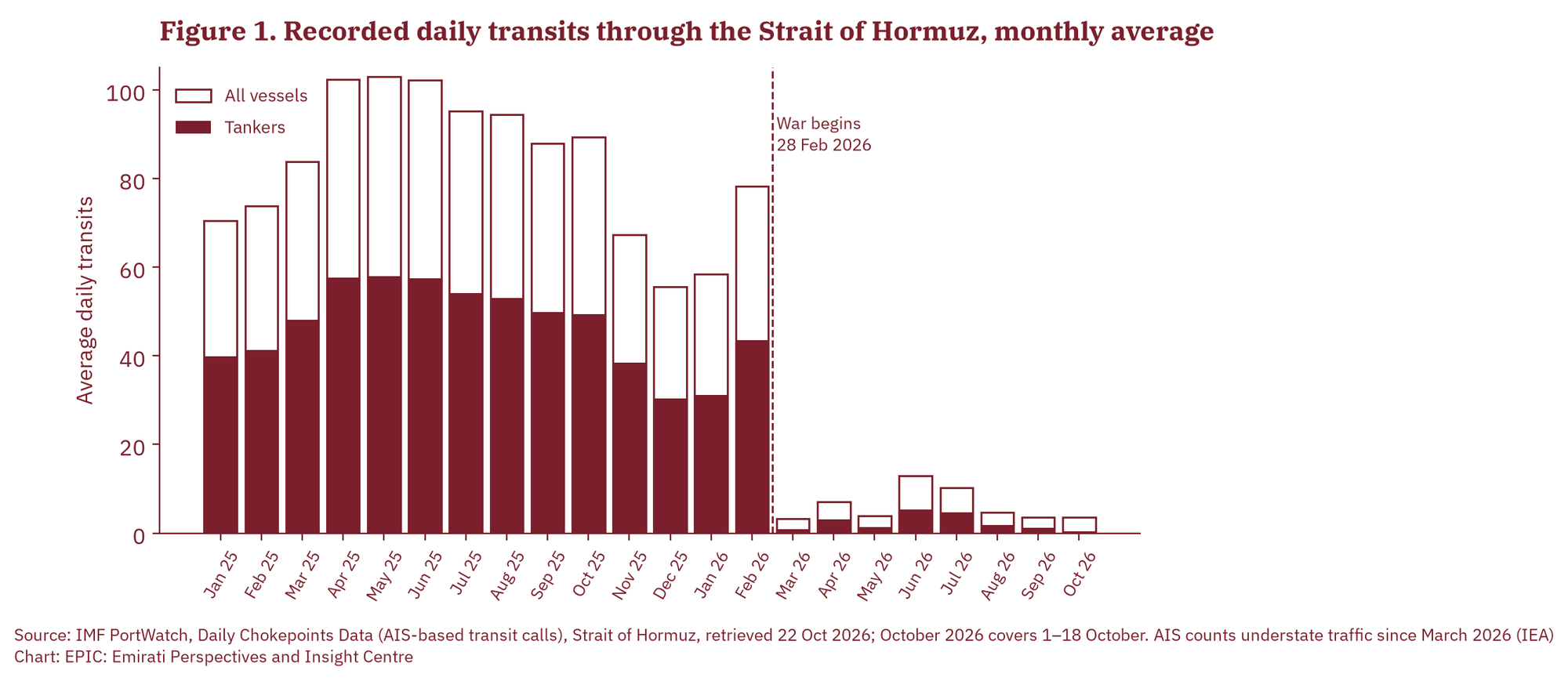
These counts must be read with care. The IEA warns that, since the conflict began, "a large and growing share of tankers have been transiting the shipping chokepoints with their transponders switched off", and that GPS jamming and AIS spoofing have been widely reported in the region. The recorded figures are therefore "likely to understate the true level of traffic" (IEA 2026a). The IEA's own estimate of oil flows tells a different story from the ship counts: total oil flows through Hormuz rose by 3.7 million b/d to 10.9 million b/d in September 2026, helped by ship-to-ship transfers in the Gulf of Oman (IEA 2026b). That is about half the 2024 level reported by the EIA. The fall in the AIS count is far steeper than the fall in oil volumes, which suggests that much of the remaining traffic is not visible in public tracking data.
3.2 Effects on oil markets
The IEA's Oil Market Report for October 2026 records that crude exports from Gulf producers rose to 13.9 million b/d in September, more than 75 per cent of pre-war levels, and that the UAE drove increases in supply from producers outside OPEC+. Bypass exports, through pipelines that avoid the strait, rose to 5.6 million b/d. Refined product exports from the Middle East, however, were 1.9 million b/d in September, against 4.7 million b/d before the war, and liquefied petroleum gas exports were 670,000 b/d against 1.5 million b/d. The IEA described the recovery as fragile, citing renewed attacks on regional energy infrastructure and tanker traffic, increased attacks by the Houthi movement in October, record freight rates, and a North Sea Dated crude price of around USD 134 a barrel at the time of writing (IEA 2026b).
3.3 Effects on the UAE
The UAE was directly affected. Bloomberg reported, via World Oil, that Fujairah, about 80 miles from the strait, was targeted several times in March 2026, with strikes damaging storage tanks, pumping systems and fuel-loading infrastructure, and that ADNOC export infrastructure had been shut after attacks before a partial restart (World Oil 2026). In May 2026 ADNOC's leadership said that the UAE had been "targeted by more than 3,000 missiles and drones" (WAM 2026b). This paper did not verify that figure against an independent count, and it is reported here as an official statement.
The disruption also reached the UAE's imports. Retailers and logistics companies described cargo being rerouted from Jebel Ali to Khor Fakkan on the east coast, or to Salalah in Oman, with road journeys of about 150 kilometres and more than 1,250 kilometres respectively, compared with 40 to 50 kilometres from Jebel Ali to Dubai supermarkets. Dubai inflation reached 5.5 per cent in May 2026, driven by fuel, transport and imported food prices linked to the conflict (The National 2026). EPIC's companion paper on food security examines this side of the disruption in more detail.
4. The Red Sea detour
The Red Sea disruption began more than two years before the 2026 war, and it has not ended. PortWatch data show that average daily transits through the Bab el-Mandeb Strait were 74.0 in 2023, then fell to 32.5 in 2024 and 33.5 in 2025. In 2026 to 18 October the average was 33.3. The Suez Canal shows the same pattern, falling from 73.7 a day in 2023 to 39.6 in 2024, 38.5 in 2025 and 40.9 in 2026. Over the same period average daily arrivals at the Cape of Good Hope rose from 49.1 in 2023 to 87.0 in 2024 and 90.5 in 2026 (IMF PortWatch 2026). Figure 2 shows the shift.
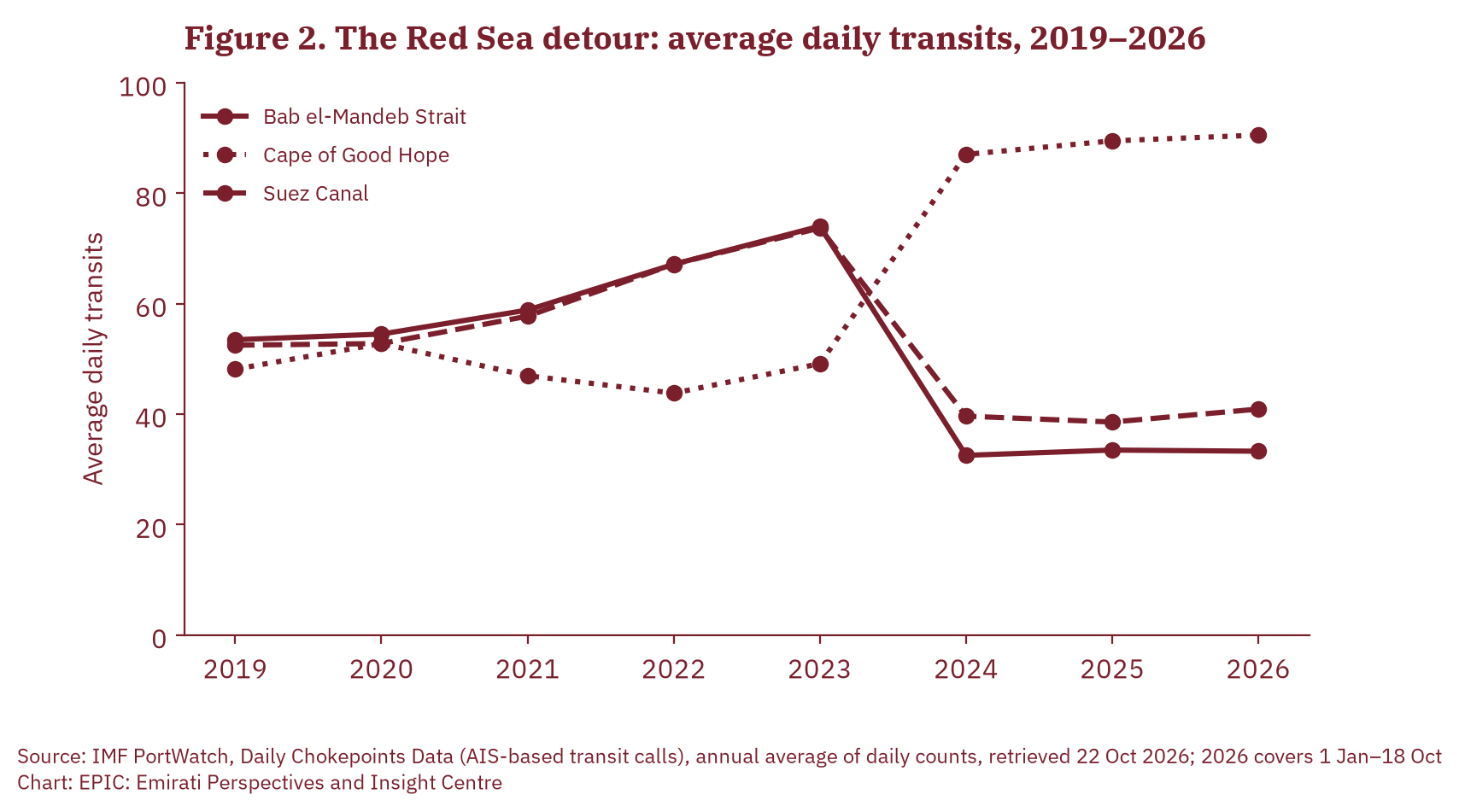
Monthly data show that Bab el-Mandeb traffic weakened further in the second half of 2026, from an average of about 36 a day in the first half of the year to about 27 a day from August to mid-October (IMF PortWatch 2026). These are the same AIS-based counts, with the same caveats.
The costs of the detour are borne widely. UNCTAD estimated that if the rise in container freight rates seen between October 2023 and June 2024 persisted to the end of 2025, global consumer prices could be 0.6 per cent higher by then. It also found that rerouting had raised demand for container ships by 12 per cent by mid-2024 compared with what it would otherwise have been (UNCTAD 2024).
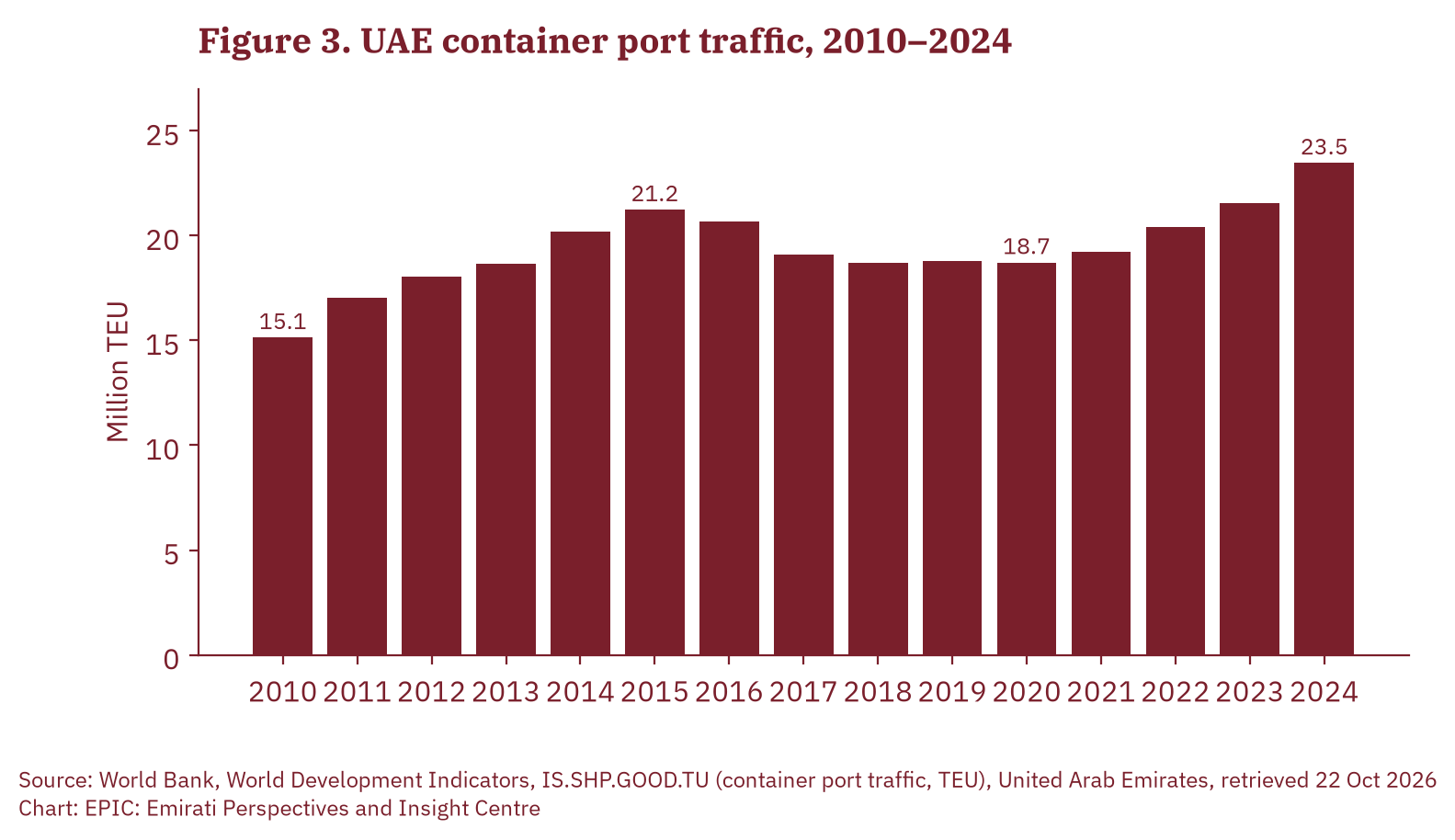
For the UAE the Red Sea detour has a mixed effect, as Figure 3 suggests. UAE container traffic kept rising in 2024, to its highest level in the World Bank series (World Bank 2026). The data do not show why, and this paper does not attempt to separate the effects of rerouting from other drivers of growth. What the data do show is that the UAE's ports grew through the first phase of disruption. Annual data for 2025 and 2026, which would show the effect of the Hormuz disruption, were not available in the World Bank series at the time of writing.
5. Bypass infrastructure: the east coast strategy
5.1 The Habshan–Fujairah pipeline
The UAE's main structural defence against a closure of Hormuz is its crude oil pipeline from the onshore fields at Habshan to the export terminal at Fujairah, on the Gulf of Oman. The EIA gives its capacity as 1.8 million b/d (EIA 2025). In the first weeks of the 2026 war, crude loadings at Fujairah averaged about 1.9 million b/d between 20 and 24 March, about 57 per cent above the 2025 average according to tanker-tracking data, and the pipeline was reported to be operating near capacity (World Oil 2026). Tracking data in the region are affected by signal interference, as World Oil noted, so these loading figures carry uncertainty.
In May 2026 ADNOC's leadership explained the logic: "That is exactly why the UAE made the decision more than a decade ago to invest in infrastructure that bypasses the Strait. And it is why we moved ahead with our second pipeline in 2025. Today it is already 50 percent complete, and we are accelerating delivery toward 2027." WAM reported that the second pipeline would double export capacity through Fujairah (WAM 2026b).
5.2 The limits of bypass
The 2026 experience shows three limits.
First, bypass capacity is finite. Even at full capacity, the existing pipeline carries only part of the UAE's potential exports, and the EIA had already noted before the war that routine use of the line limited spare capacity (EIA 2025).
Second, bypass routes are targets. The strikes on Fujairah in March 2026 showed that moving exports to the Gulf of Oman reduces but does not remove exposure (World Oil 2026).
Third, bypass works better for crude oil than for other cargoes. The IEA's data show refined products and liquefied petroleum gas recovering far more slowly than crude (IEA 2026b). Container cargo can be shifted to east-coast ports and trucked inland, but at extra cost and time (The National 2026).
5.3 Stocks as a buffer
ADNOC's leadership said in May 2026 that the world had "30 to 35 days of effective cover" in oil stocks and that this should at least double, and that ADNOC was working with Asian partners to expand and restock strategic storage (WAM 2026b). The IEA reported that global observed oil inventories at the end of September 2026 were 509 million barrels below their level at the end of February, and that G7 leaders had committed on 2 October to accelerate deliveries under the IEA collective action of 11 March (IEA 2026b). For the UAE, storage at home and with partners abroad is part of the same resilience system as pipelines and ports.
6. Diplomacy and posture
6.1 A small state's choices
A small state cannot secure a chokepoint alone. Its options are to build alternatives, to join or leave coalitions, to work through international law and organisations, and to use its weight as an energy supplier and investor.
The UAE has used each of these. In May 2023 the Ministry of Foreign Affairs said that, "as a result of our ongoing evaluation of effective security cooperation with all partners", the UAE had withdrawn its participation in the Combined Maritime Forces two months earlier. The ministry stressed that the UAE "remains committed to responsibly ensuring the safety of navigation in its seas, in accordance with international law" (MoFA 2023).
6.2 Freedom of navigation as a principle
Since the 2026 war began, UAE statements have framed the issue as one of principle. In May 2026 ADNOC's leadership called for an "absolute commitment to freedom of navigation through the Strait of Hormuz", and argued that accepting that one country can hold the waterway hostage would end freedom of navigation "as we know it" (WAM 2026b). That framing places the UAE's interest within a wider international interest, which is how small states usually seek to defend their security.
6.3 Energy policy as strategy
On 28 April 2026 the UAE announced that it would leave OPEC and OPEC+ with effect from 1 May 2026. The announcement referred to "near-term volatility, including disruptions in the Arabian Gulf and the Strait of Hormuz", and said that the decision followed a review of the UAE's production policy and capacity and would give the country flexibility to respond to market needs (WAM 2026a). Whatever its other motives, the decision links production policy to the question of routes: a producer with bypass capacity can place more crude on the market when others cannot.
7. Risks
7.1 A long disruption
The IEA describes the recovery of Gulf exports as fragile (IEA 2026b), and ADNOC's leadership said in May 2026 that full flows through Hormuz would not return before the first or second quarter of 2027 (WAM 2026b). Planning should assume that disruption, or the threat of it, may last for years rather than months.
7.2 Two chokepoints at once
For most of the period since late 2023, the UAE has faced disruption on the Red Sea route. Since February 2026 it has faced disruption at Hormuz as well, and Bab el-Mandeb traffic weakened further in the second half of 2026 (IMF PortWatch 2026). Simultaneous pressure on both routes leaves the overland corridors and the Gulf of Oman coast as the main outlets.
7.3 Information risk
Public tracking data have become less reliable just when they matter most (IEA 2026a). Decisions on stocks, insurance and routing depend on accurate information, and AIS gaps make it harder for governments and companies alike to see what is happening.
7.4 Cost and competitiveness
Even where goods keep moving, higher freight and insurance costs feed through to prices, as the inflation data for Dubai show (The National 2026). A hub economy depends on being reliable and competitive; prolonged high costs erode that position.
8. Policy recommendations
1. Complete and protect the second pipeline. The acceleration of the second Habshan–Fujairah pipeline towards 2027 is the most important single step in the UAE's maritime resilience. Its protection, and that of the Fujairah terminal and storage, should be treated as critical national infrastructure.
2. Plan bypass for more than crude. The 2026 data show that refined products, gas and containers recover more slowly than crude. Investment in east-coast port capacity, product storage and inland logistics should be assessed with the same seriousness as crude bypass.
3. Treat stocks and routes as one system. Strategic stocks of oil, food and critical goods, at home and with partners abroad, should be planned together with the capacity of alternative routes, so that the time stocks buy matches the time alternatives need.
4. Invest in maritime domain awareness. With public AIS data degraded, the UAE should strengthen its own monitoring capability and share data with trusted partners, so that routing and insurance decisions rest on reliable information.
5. Keep freedom of navigation on the international agenda. The UAE's interest in open sea lanes is shared by every major importing economy. It should continue to frame the issue in terms of international law and the global interest, and work through international organisations and with importing states to uphold it.
6. Publish resilience data. As with food security, outside analysts cannot easily judge the UAE's resilience because key data, such as bypass utilisation, east-coast port throughput and stock levels, are not published regularly. Periodic publication, at an appropriate level of detail, would strengthen confidence among investors and partners.
9. Conclusion
The UAE's geography is both its vulnerability and its advantage. It sits behind one chokepoint and depends on another, but it also has a coastline on the Gulf of Oman that several of its Gulf neighbours lack. Over more than a decade it has turned that coastline into an alternative route for oil exports and imports. The disruptions of 2023 to 2026 have tested that strategy harder than any planner expected, and the data show that it has worked, though at a cost and within clear limits. The next stage is to extend the same logic of redundancy from crude oil to products, gas, containers and food; to protect the bypass routes themselves; to improve the information on which decisions rest; and to defend, through diplomacy and law, the principle of freedom of navigation on which a small trading state ultimately depends.
References
EIA (US Energy Information Administration). 2025. "Amid Regional Conflict, the Strait of Hormuz Remains Critical Oil Chokepoint." Today in Energy, June 2025. https://www.eia.gov/todayinenergy/detail.php?id=65504.
EPIC Research Team. 2026. Imported Plates: The UAE's Food Security Arithmetic. EPIC-PP-2026-019. EPIC: Emirati Perspectives and Insight Centre.
IEA (International Energy Agency). 2026a. "Middle East Maritime Chokepoints Shipping Monitor." Last updated 7 October 2026. https://www.iea.org/data-and-statistics/data-tools/middle-east-maritime-chokepoints-shipping-monitor.
IEA (International Energy Agency). 2026b. Oil Market Report: October 2026. Paris: IEA, 14 October 2026. https://www.iea.org/reports/oil-market-report-october-2026.
IMF PortWatch. 2026. "Daily Chokepoints Data." International Monetary Fund. Retrieved 22 October 2026. https://portwatch.imf.org/.
MoFA (UAE Ministry of Foreign Affairs). 2023. "UAE Rejects Mischaracterisation of US-UAE Conversations Regarding Maritime Security." 31 May 2023. https://www.mofa.gov.ae/en/mediahub/news/2023/5/31/31-05-2023-uae-maritime-security.
The National. 2026. "UAE Food Stocks Will Not Be Compromised by Conflict, Economy Ministry Says." 19 July 2026. https://www.thenationalnews.com/news/uae/2026/07/19/uae-price-rise-supermarkets/.
UNCTAD (UN Trade and Development). 2024. "Vulnerability of Supply Chains Exposed as Global Maritime Chokepoints Come under Pressure." Press release on the Review of Maritime Transport 2024, UNCTAD/PRESS/PR/2024/024, 22 October 2024. https://unctad.org/press-material/vulnerability-supply-chains-exposed-global-maritime-chokepoints-come-under-pressure.
WAM (Emirates News Agency). 2026a. "UAE Announces Decision to Exit OPEC & OPEC+." 28 April 2026. https://www.wam.ae/en/article/bzxzuh7-uae-announces-decision-exit-opec-opec+.
WAM (Emirates News Agency). 2026b. "New Investment, AI, Freedom of Navigation Key to Building Resilient Energy System." 20 May 2026. https://www.wam.ae/en/article/c0b3eaf-new-investment-ai-freedom-navigation-key-building.
World Bank. 2026. "Container Port Traffic (TEU: 20 Foot Equivalent Units)" (IS.SHP.GOOD.TU). World Development Indicators. Retrieved 22 October 2026.
World Oil. 2026. "UAE Boosts Fujairah Oil Exports as Hormuz Disruption Redirects Crude Flows." Bloomberg report, 27 March 2026. https://www.worldoil.com/news/2026/3/27/uae-boosts-fujairah-oil-exports-as-hormuz-disruption-redirects-crude-flows/.
Sources and verification notes
Sources and verification notes: "Sea Lanes and the Small State"
All sources were retrieved and checked on 22 October 2026 (Asia/Dubai, UTC+4). Verdicts use the four house categories: correct, needs correction, unverifiable and mixed. Local copies are kept in research/epic-new/_data/sea/ (portwatch_chokepoints.csv from the IMF PortWatch ArcGIS service, eia65504.html, wb_IS.SHP.GOOD.TU.json).
| # | Claim in paper | Source checked | Verdict | Action |
|---|---|---|---|---|
| 1 | Hormuz 20 mb/d in 2024, ~20% of consumption; >1/4 of seaborne oil trade; ~1/5 of LNG trade; few alternatives | EIA Today in Energy 65504 (local HTML) | Correct | Kept |
| 2 | UAE crude via Hormuz 0.4 mb/d lower in 2024 than 2022; refinery upgrades; pipeline 1.8 mb/d to Fujairah on Gulf of Oman; routine use limits spare capacity | EIA 65504 | Correct | Kept |
| 3 | Gulf of Aden and Suez tonnage −76% and −70% vs late 2023; Cape +89%; +0.6% global consumer prices scenario; container ship demand +12% | UNCTAD press release PR/2024/024 | Correct | Kept |
| 4 | UAE container traffic 18.8 m TEU (2019) → 23.5 m (2024), +25%, series high | World Bank WDI IS.SHP.GOOD.TU | Correct | Kept |
| 5 | War began 28 Feb 2026; "largest supply disruption in the history of the global oil market"; AIS switched off, jamming, spoofing; counts understate | IEA Middle East Maritime Chokepoints Shipping Monitor (updated 7 Oct 2026) | Correct | Kept |
| 6 | Hormuz recorded transits: 85.5/day (2025), 68.1 (1 Jan–27 Feb 2026), 57 on 28 Feb, 20 on 1 Mar, single figures from 4 Mar, 3.6 (1–18 Oct) | IMF PortWatch daily data (local CSV) | Correct | Kept |
| 7 | Hormuz oil flows 10.9 mb/d in Sept (+3.7), STS in Gulf of Oman; Gulf crude exports 13.9 mb/d, >75% of pre-war; UAE drove non-OPEC+ gains; bypass 5.6 mb/d; products 1.9 vs 4.7 mb/d; LPG 670 kb/d vs 1.5 mb/d; Houthi attacks in Oct; Dated ~USD 134; stocks −509 mb; G7 on 2 Oct; collective action of 11 Mar | IEA Oil Market Report, 14 Oct 2026 | Correct | Kept; producer-specific detail not relevant to the UAE omitted |
| 8 | "About half the 2024 level" | Derived: 10.9 / 20 | Correct | Kept, marked as comparison |
| 9 | Fujairah ~80 miles from strait, targeted several times, storage, pumping and loading damage; ADNOC export infrastructure shut then partly restarted; loadings ~1.9 mb/d 20–24 Mar, +57% vs 2025; pipeline near capacity; tracking interference | World Oil (Bloomberg), 27 Mar 2026 | Correct | Kept, uncertainty noted |
| 10 | "Too much of the world's energy..."; second pipeline 50% complete, accelerating to 2027, doubles Fujairah capacity; ">3,000 missiles and drones"; 30–35 days cover; Asian storage; freedom of navigation quotes; full flows not before Q1/Q2 2027 | WAM, 20 May 2026 | Correct | Kept, attributed to ADNOC leadership; missile and drone figure flagged as an official statement not independently verified |
| 11 | Second pipeline "will double capacity" (Reuters headline) | Reuters page returned 401 | Unverifiable | Not used; the WAM wording is used instead |
| 12 | UAE withdrew from Combined Maritime Forces two months before 31 May 2023; committed to safety of navigation | MoFA statement, 31 May 2023 | Correct | Kept |
| 13 | UAE exit from OPEC and OPEC+ announced 28 Apr 2026, effective 1 May; cites Hormuz disruption; production review | WAM, 28 Apr 2026 | Correct | Kept |
| 14 | Bab el-Mandeb 74.0 (2023), 32.5 (2024), 33.5 (2025), 33.3 (2026); Suez 73.7, 39.6, 38.5, 40.9; Cape 49.1, 87.0, 90.5; H1 2026 ~36/day vs ~27 Aug–mid-Oct | IMF PortWatch daily data | Correct | Kept |
| 15 | Bab el-Mandeb 2026 fall attributed to a specific actor's blockade (search synthesis) | Not opened at a primary source | Unverifiable | Not used |
| 16 | Rerouting via Khor Fakkan (~150 km) and Salalah (>1,250 km) vs 40–50 km; Dubai inflation 5.5% in May 2026 | The National, 19 Jul 2026 | Correct | Kept; a third rerouting example in the article was not used |
| 17 | Hormuz tanker crossings "12–14 daily vs 50 pre-war" (Kpler, via search synthesis) | Not opened | Unverifiable | Not used |
| 18 | Most UAE coastline on the Arabian Gulf; Kuwait, Qatar and Bahrain have no Gulf of Oman coast | General geography | Mixed | Kept in general wording ("several of its Gulf neighbours") |
Figures. Figure 1 from IMF PortWatch (fig1_hormuz_transits.csv), monthly means of daily counts; October 2026 covers 1–18 October; the AIS caveat is printed on the chart. Figure 2 from IMF PortWatch (fig2_red_sea_detour.csv), annual means; 2026 to 18 October. Figure 3 from World Bank WDI (fig3_uae_container_traffic.csv). No values missing, so no n/a entries were needed.
Summary. 18 items checked: 14 correct, 0 needs correction, 1 mixed, 3 unverifiable (all not used), plus 1 derived comparison (correct).
Corrections applied. Items 11, 15 and 17 not used; item 10 missile and drone figure explicitly flagged; item 18 softened. No [UNVERIFIED] items remain.