
 Emirati Perspectives and Insight Centre
Full text
1. Introduction: one electron in four
When the fourth unit of the Barakah plant entered commercial operation in September 2024, the Emirates Nuclear Energy Corporation (ENEC) said that the plant would generate 40 terawatt-hours (TWh) of electricity a year and provide up to 25 per cent of the UAE's electricity, describing "one in every four electrons on the UAE grid" as coming from Barakah (ENEC 2024). In just over a decade, a country whose electricity had come almost entirely from gas acquired what the government describes as the single largest source of clean electricity in the UAE and the Arab world (UAE Government 2026).
This paper examines what that change has achieved and what it implies for the next stage of the UAE's power transition. It is written for policymakers and analysts who want an evidence-based picture rather than a promotional one. Every figure is drawn from a named public source, and targets and forecasts are identified as such.
Section 2 sets out what has happened to UAE electricity since 2015. Section 3 describes how Barakah was built, including the policy and legal framework that made it possible. Section 4 assesses the plant's effects on emissions, gas use and industry. Section 5 looks at the gap between the present system and the targets for 2030 and 2035. Section 6 discusses risks. Section 7 sets out recommendations.
2. A decade of change in UAE electricity
2.1 From gas alone to a mixed system
Ember, an independent energy think tank, publishes an open dataset of electricity generation by country and source. Its figures for the UAE are shown in Figure 1. In 2015, gas produced 99.8 per cent of the country's electricity. By 2024 the share had fallen to 68.3 per cent, while nuclear accounted for 22.9 per cent and solar for 8.6 per cent (Ember 2026).
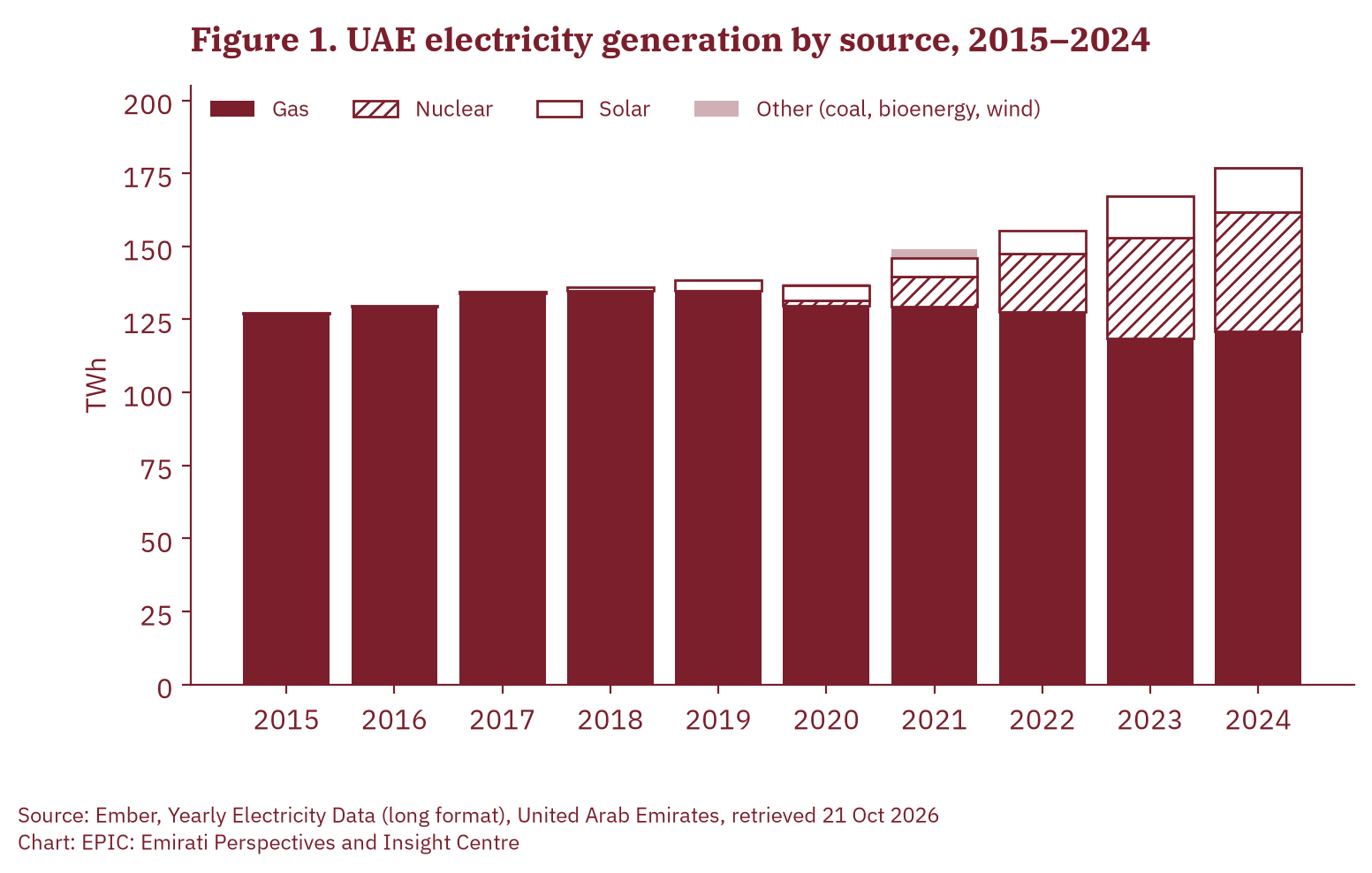
The change happened while demand was rising quickly. Total generation grew from 138.45 TWh in 2019 to 177.26 TWh in 2024, an increase of 28 per cent. Generation from gas fell from 134.79 TWh to 121.01 TWh over the same period, a decline of about 10 per cent. Nuclear generation rose from zero to 40.63 TWh and solar from 3.66 TWh to 15.21 TWh (Ember 2026).
In other words, the whole of the growth in demand since 2019 was met by low-carbon sources, and gas generation fell in absolute terms. That is an unusual result for a fast-growing economy.
2.2 What happened to emissions
Ember estimates that carbon dioxide emissions from UAE power generation fell from 91.4 million tonnes in 2019 to 82.9 million tonnes in 2024, and that the carbon intensity of each kilowatt-hour fell from 660.1 grams to 467.5 grams, a reduction of about 29 per cent (Ember 2026). Figure 2 shows the trend.
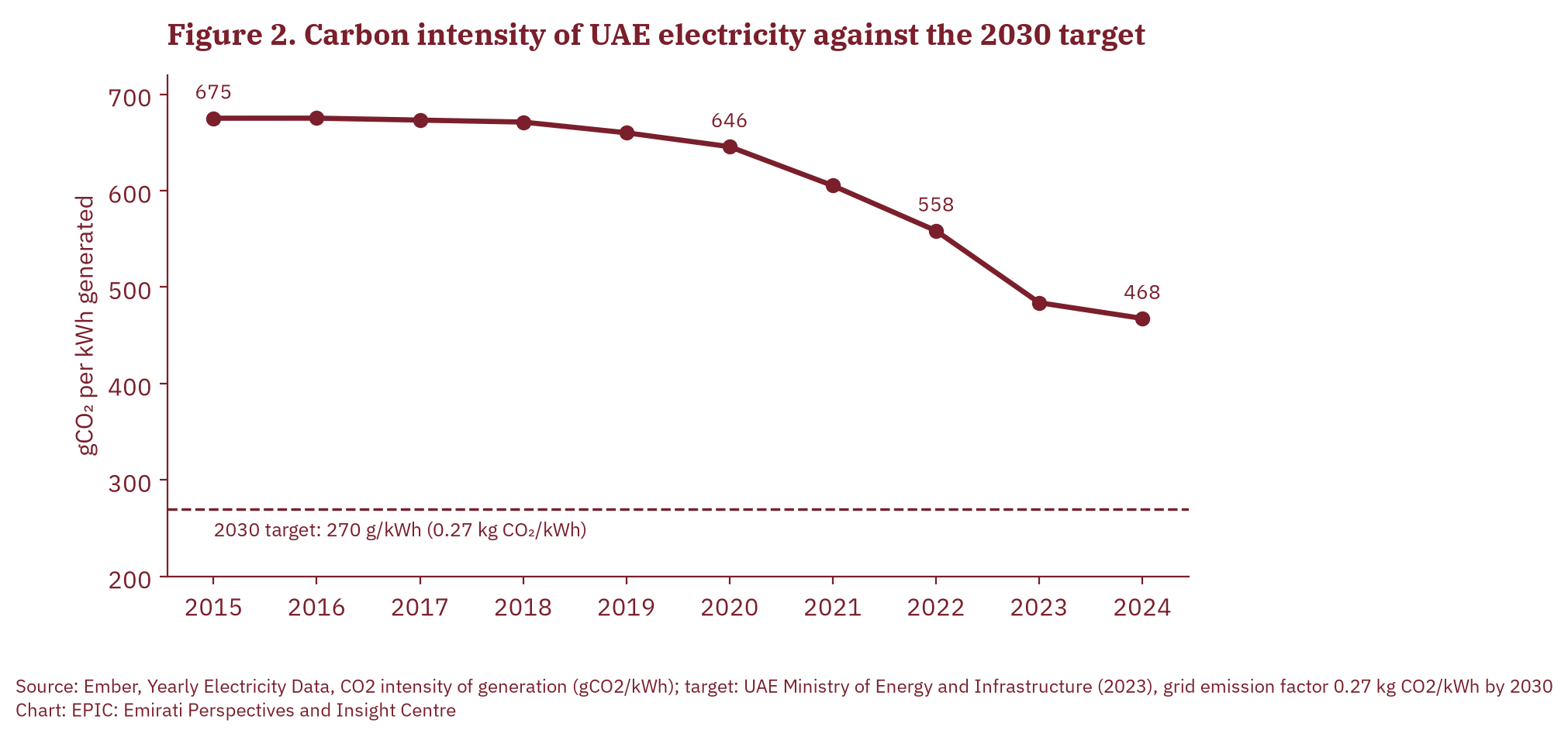
The curve is flat until 2019 and falls steeply from 2020, when the first Barakah unit was connected to the grid. The fall slows in 2024, when only part of a year's output from the fourth unit was added. This shape matters for policy. The large reductions of the past five years came mainly from a single programme that is now complete.
Ember's intensity figure measures emissions from generation divided by electricity generated. The UAE's official grid emission factor may be calculated on a different basis, so the comparison with the national target in Figure 2 indicates the size of the gap rather than an exact distance.
3. How Barakah was built
3.1 Policy first
The UAE's nuclear programme began with policy rather than procurement. In April 2008 the government published its policy on "The Evaluation and Potential Development of Peaceful Nuclear Energy". It set out principles of operational transparency, the highest standards of non-proliferation, safety and security, direct work with the International Atomic Energy Agency (IAEA), partnership with responsible nations and long-term sustainability. Its central commitment was to forgo domestic enrichment and reprocessing of nuclear fuel, the two parts of the fuel cycle that can most readily be used for non-peaceful purposes (ENEC n.d.).
In 2009 that commitment became a legal obligation. The agreement for peaceful nuclear cooperation between the United States and the UAE, transmitted to the US Congress in 2009, includes an article that, in the words of the US President's transmittal message, transforms the UAE's policy of relying on international markets for fuel "into a legally binding obligation". The message described this as "the first instance of such an obligation on the part of a U.S. cooperating partner in an agreement of this type", and gave the United States the right to end cooperation if the obligation were materially violated (The White House 2009). The same year, the UAE signed the IAEA Additional Protocol and adopted a federal law on the peaceful uses of nuclear energy, which established the Federal Authority for Nuclear Regulation (FANR) as an independent regulator and made enrichment and reprocessing facilities illegal on UAE territory (World Nuclear Association 2026).
3.2 One design, four units
In December 2009 ENEC selected a consortium led by Korea Electric Power Corporation (KEPCO) to build four APR1400 pressurised water reactors at a single site. The contract for construction, commissioning and initial fuel was worth about USD 20.4 billion, and the overall project financing later managed by the joint venture Barakah One PJSC totalled USD 24.4 billion (World Nuclear Association 2026). Each unit has a net capacity of 1,345 megawatts, and the four together are described by the government as having a combined capacity of 5.6 gigawatts (World Nuclear Association 2026; UAE Government 2026).
The site, in the Al Dhafra region of Abu Dhabi, lies about 53 kilometres west-southwest of Ruwais (UAE Government 2026). Its conditions required adaptation of the reference design: the seawater at Barakah is about 35°C, compared with about 27°C at the reference units in Korea, so larger heat exchangers and condensers were needed (World Nuclear Association 2026).
Barakah's construction began in July 2012 for Unit 1, May 2013 for Unit 2, September 2014 for Unit 3 and September 2015 for Unit 4 (World Nuclear Association 2026).
3.3 Late, but delivered
Commercial operation of the four units was initially expected in 2017, 2018, 2019 and 2020 respectively. It came in April 2021, March 2022, February 2023 and September 2024 (World Nuclear Association 2026; UAE Government 2026). Figure 3 shows the gap.
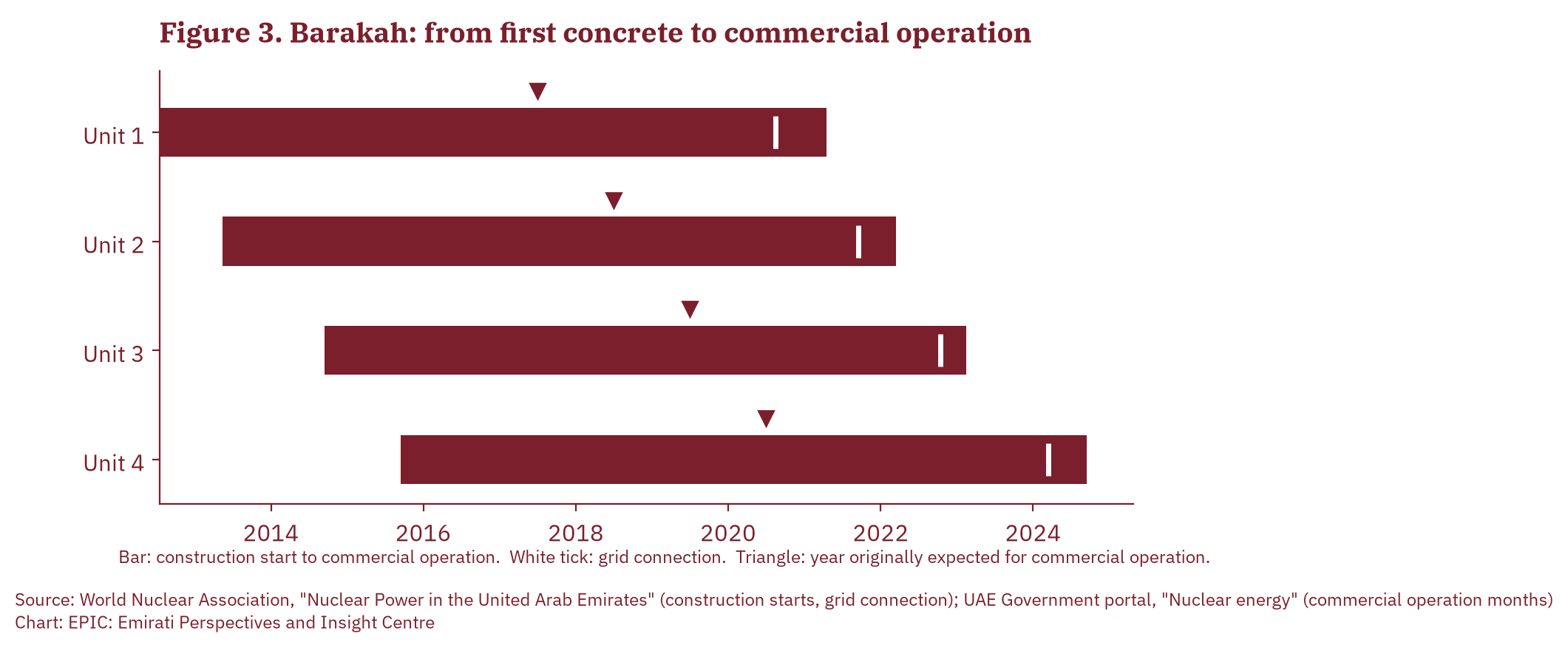
The main cause of delay was not construction. Construction of Unit 1 was completed in March 2018. But when the operating company, Nawah Energy Company, carried out its operational readiness review in early 2018, FANR made more than 400 adverse findings, and start-up was postponed by at least 18 months so that Nawah could correct a wide range of technical, organisational and management issues. One underlying problem was the need to develop competence in English as a working language between Arabic- and Korean-speaking staff (World Nuclear Association 2026). FANR issued the operating licence for Unit 1 in February 2020, and the unit was connected to the grid in August 2020 (World Nuclear Association 2026).
The delay is often treated as a weakness. It can also be read as evidence that the regulator was willing to hold a national flagship project to its standards. For a first nuclear programme, that institutional fact is as important as the hardware.
3.4 Fuel and supply chains
Because the UAE does not enrich uranium, it must buy fuel services abroad. By August 2012 ENEC had awarded six contracts covering uranium concentrates, conversion and enrichment, spread among several suppliers for each stage (World Nuclear Association 2026). In July 2025 ENEC signed an agreement with Framatome to supply fuel assemblies for Barakah, broadening and diversifying its long-term fuel supply chain (UAE Government 2026). The renunciation of enrichment therefore carries a continuing obligation: to keep fuel supply diverse enough that no single supplier or route becomes a point of failure.
4. What Barakah has changed
4.1 Emissions
ENEC states that Barakah prevents 22.4 million tonnes of carbon emissions a year and contributes 24 per cent of the UAE's 2030 decarbonisation commitments under its Nationally Determined Contribution (ENEC 2024). The government portal gives a figure of approximately 21 million tonnes (UAE Government 2026). These are operator and government estimates of avoided emissions, which depend on assumptions about what would otherwise have been burned, and they should be read as such. They are consistent in scale with the fall in Ember's power-sector emissions despite strong demand growth.
4.2 Gas
Gas generation in the UAE fell by about 10 per cent between 2019 and 2024 (Ember 2026). ENEC also states that consumption of natural gas for power generation in Abu Dhabi reached a 13-year low because of Barakah's contribution (ENEC 2024). Gas not burned in power stations can be put to other uses, including industry and export, which gives nuclear power an economic value beyond its climate value.
4.3 Industry and clean certificates
Barakah's output is being used to market lower-carbon industrial products. ENEC reports that 85 per cent of the clean energy certificates managed by EWEC are powered by Barakah, and that companies including ADNOC, Emirates Global Aluminium and Emirates Steel Arkan use them (ENEC 2024). ENEC presents these certificates as allowing such companies to produce greener products that can be sold at a premium (ENEC 2024).
4.4 Water
As the companion EPIC paper on water security sets out, the UAE is moving its desalination from thermal plants to reverse osmosis, which runs on electricity. Abu Dhabi's water and electricity company has explained that it powers reverse osmosis plants with nuclear energy in winter, when power demand is low (Novo 2023). Barakah therefore supports the decarbonisation of water as well as of electricity.
5. The gap to 2030 and 2035
5.1 The targets
The UAE updated its Energy Strategy 2050 in July 2023. According to the Ministry of Energy and Infrastructure, the strategy aims to raise renewable energy capacity to 14.2 gigawatts by 2030, to increase the share of installed clean energy capacity in the total energy mix to 30 per cent by 2030, and to achieve a grid emission factor of 0.27 kilograms of CO2 per kilowatt-hour by 2030. It foresees investment of AED 150–200 billion by 2030 (MoEI 2023).
The UAE's third Nationally Determined Contribution, submitted to the UN climate convention in November 2024, commits the country to a 47 per cent reduction in greenhouse gas emissions by 2035 compared with 2019, from 196.3 to 103.5 million tonnes of CO2 equivalent. It states that the power and water sector emitted up to 78.9 million tonnes in 2019 and that the UAE will explore pathways towards a reduction of more than 50 per cent in that sector by 2035, with efforts towards a grid emission coefficient more efficient than 0.243 tonnes per megawatt-hour, described as aspirational. It also records that Abu Dhabi currently integrates 40 per cent clean energy, renewable and nuclear, into its energy mix and targets 60 per cent by 2035 (UAE 2024).
5.2 The arithmetic
On Ember's figures, the carbon intensity of UAE electricity was 467.5 grams per kilowatt-hour in 2024. Reaching 270 grams would require a further reduction of about 42 per cent within six years (Ember 2026; MoEI 2023). The reduction since 2019, of about 29 per cent, was achieved with the addition of 5.6 gigawatts of nuclear capacity, which runs around the clock. No further nuclear units are under construction in the UAE (World Nuclear Association 2026). Talks on two more APR1400 units at Barakah were reported in 2023 but had not proceeded at the time of the World Nuclear Association's most recent update (World Nuclear Association 2026).
The rest of the gap must therefore be closed mainly by solar power, storage and efficiency. Ember records 6.5 gigawatts of solar capacity in the UAE in 2024 (Ember 2026), against the 2030 target of 14.2 gigawatts of renewable capacity (MoEI 2023). Solar output in the UAE peaks at midday and falls to zero at night, so its contribution to cutting carbon intensity depends on storage.
5.3 Solar around the clock
The most important project for this purpose is the round-the-clock renewable project being developed in Abu Dhabi by Masdar and EWEC. It combines 5.2 gigawatts of solar photovoltaic capacity with a 19 gigawatt-hour battery energy storage system to deliver 1 gigawatt of continuous clean power. Masdar broke ground in October 2025, reached financial close in July 2026 on a total investment of USD 6.1 billion, and expects the project to be operational in 2027 (Masdar 2026).
If it performs as designed, the project would provide a second block of firm low-carbon power, smaller than Barakah's but built in a fraction of the time and without fuel. It is a test case, watched far beyond the UAE, of whether solar and batteries can supply baseload power at gigawatt scale.
5.4 Demand
The denominator matters as much as the numerator. Electricity demand in the UAE rose from 149.26 TWh in 2021 to 177.02 TWh in 2024, and demand per person from 15.25 to 16.05 megawatt-hours (Ember 2026). Masdar itself notes that electricity demand is accelerating with artificial intelligence, data centres and advanced manufacturing (Masdar 2026). Every new data centre or electrified industrial process that draws from a gas-heavy grid makes the 2030 intensity target harder to reach unless new low-carbon supply arrives at the same pace.
6. Risks
Concentration. Barakah supplies more than a fifth of UAE electricity from one coastal site with four identical units. A generic issue affecting the APR1400 design, or a disruption at the site, would affect a large share of supply at once. Grid planning needs reserves sized for that possibility.
Fuel supply. The renunciation of enrichment makes the UAE dependent on international fuel markets. ENEC's spread of suppliers and the 2025 Framatome agreement reduce this risk (World Nuclear Association 2026; UAE Government 2026), but supply chains for nuclear fuel services are concentrated globally and exposed to geopolitical shocks.
Spent fuel. The UAE follows a "dual track" approach to radioactive waste, developing a national storage and disposal programme while exploring regional options, with used fuel stored in reactor pools for up to 20 years (World Nuclear Association 2026). A long-term decision on disposal will be needed within the plants' operating lives.
Skills. The 2018 delay showed that the scarce resource in a new nuclear programme is qualified, experienced people. Sustaining an Emirati workforce able to operate, maintain and regulate the plant over an operating life that its partners plan in terms of 60 years (World Nuclear Association 2026) is a long-term commitment.
Coupling. As water production moves to reverse osmosis, a power disruption becomes a water disruption. The two sectors' risks are now linked.
7. Policy recommendations
1. Publish a national power-sector emissions series on the target basis. The grid emission factor target of 0.27 kg CO2/kWh should be reported annually, with its method, so that progress can be checked against independent estimates such as Ember's.
2. Plan the post-Barakah decade explicitly. With no further nuclear units under construction, a published pathway to 2030 and 2035 should set out how much firm low-carbon capacity, from solar-plus-storage, any further nuclear units and other sources, is needed and when decisions must be taken given lead times.
3. Scale round-the-clock solar on evidence. The Masdar–EWEC project should be accompanied by open publication of its performance data after commissioning, so that further procurement can be based on measured availability and cost.
4. Tie new large loads to new clean supply. Large new electricity users, such as data centres, should be encouraged or required to contract additional low-carbon supply, so that their growth does not raise the grid's carbon intensity.
5. Diversify and stockpile nuclear fuel. Maintain multiple qualified suppliers for each stage of the fuel cycle and a strategic reserve of fabricated fuel, consistent with the non-proliferation commitments.
6. Decide the spent fuel pathway early. Set a timetable for a decision on long-term storage or disposal, so that the question does not fall to a later generation by default.
7. Plan water and power as one system. Because desalination now depends on electricity, capacity and reserve planning for water and power should be integrated across emirates.
8. Share the model. The UAE's combination of a legally binding renunciation of enrichment, an independent regulator and a single proven design is a reference point for other states considering nuclear power. EPIC recommends that the experience, including the reasons for delay, be documented for international audiences.
8. Conclusion
Barakah turned the UAE from a single-fuel electricity system into a mixed one in four years. It met all the growth in demand since 2019 with low-carbon power and cut the carbon intensity of electricity by close to a third. It did so under a framework that put non-proliferation and regulation first, and accepted delay as the price of meeting standards. The next stage is harder because it lacks a single large lever. Closing the remaining gap to the 2030 target will depend on solar and storage built at speed, on demand growth that is matched by new clean supply, and on treating water and power as one system.
References
Ember. 2026. "Yearly Electricity Data." Long-format dataset, United Arab Emirates. Accessed 21 October 2026. https://ember-energy.org/data/yearly-electricity-data/.
ENEC (Emirates Nuclear Energy Corporation). 2024. "UAE Celebrates Historic Milestone as Unit 4 of the Barakah Plant Commences Commercial Operation: Delivering Full-fleet Operations." Press release, September 2024. https://www.enec.ae/news/latest-news/uae-celebrates-historic-milestone-as-unit-4-of-the-barakah-plant-commences-commercial-operation/.
ENEC (Emirates Nuclear Energy Corporation). n.d. "The UAE Nuclear Energy Policy." https://www.enec.ae/about-us/overview/the-uae-nuclear-energy-policy/.
Masdar. 2026. "Masdar Reaches Financial Close for World-First US$6.1 Billion Gigascale 24/7 Clean Energy Project." Press release, 13 July 2026. https://masdar.ae/en/news/newsroom/masdar-reaches-financial-close-world-first-gigascale-clean-energy-project.
MoEI (UAE Ministry of Energy and Infrastructure). 2023. "Minister of Energy and Infrastructure Reveals Details of the Updated UAE Energy Strategy 2050 and the National Hydrogen Strategy." News release, 4 July 2023. https://www.moei.gov.ae/en/media-center/news/4/7/2023/minister-of-energy-and-infrastructure-reveals-details-of-the-updated-uae-energy-strategy-2050-and.
Novo, Cristina. 2023. "'Creating a Pipeline of RO Projects That Attract Private Investment Drives Technology Innovation'." Interview with Mark Hedges, Emirates Water and Electricity Company. Smart Water Magazine, 1 August 2023. https://smartwatermagazine.com/news/emirates-water-electricity-ewec/creating-a-pipeline-ro-projects-attract-private-investment.
The White House. 2009. "Message from the President on the US-UAE Peaceful Uses of Nuclear Energy Agreement." Office of the Press Secretary, 2009. https://obamawhitehouse.archives.gov/the-press-office/message-president-us-uae-peaceful-uses-nuclear-energy-agreement.
UAE (United Arab Emirates). 2024. The United Arab Emirates' Third Nationally Determined Contribution (NDC 3.0). Submitted to the UNFCCC, November 2024. https://unfccc.int/documents/613857.
UAE Government. 2026. "Nuclear Energy." The Official Portal of the UAE Government. Accessed 21 October 2026. https://u.ae/en/information-and-services/environment-and-energy/water-and-energy/types-of-energy-sources/nuclear-energy.
World Nuclear Association. 2026. "Nuclear Power in the United Arab Emirates." Country profile. Accessed 21 October 2026. https://world-nuclear.org/information-library/country-profiles/countries-t-z/united-arab-emirates.
Sources and verification notes
Sources and verification notes: "The Quarter Grid"
All sources were retrieved and checked on 21 October 2026 (Asia/Dubai, UTC+4). Verdicts use the four house categories: correct, needs correction, unverifiable and mixed. Local copies are kept in research/epic-new/_data/ (ember_yearly.csv, ndc3.pdf/txt, wna_uae.txt).
| # | Claim in paper | Source checked | Verdict | Action |
|---|---|---|---|---|
| 1 | Generation 138.45 TWh (2019) → 177.26 TWh (2024), +28%; gas 134.79 → 121.01 TWh (−10%); nuclear 40.63, solar 3.66 → 15.21 TWh | Ember yearly data (local CSV) | Correct | Kept |
| 2 | Shares 2015 gas 99.8%; 2024 gas 68.3%, nuclear 22.9%, solar 8.6% | Ember | Correct | Kept |
| 3 | Power CO2 91.4 → 82.9 Mt; intensity 660.1 → 467.5 g/kWh (−29%) | Ember | Correct | Kept, method caveat added |
| 4 | Demand 149.26 TWh (2021) → 177.02 (2024); per capita 15.25 → 16.05 MWh; solar capacity 6.5 GW (2024) | Ember | Correct | Kept |
| 5 | 40 TWh/yr, up to 25%, "one in every four electrons"; 22.4 Mt avoided; 24% of NDC; 85% of EWEC certificates; ADNOC, EGA, Emirates Steel Arkan; gas for power at 13-year low in Abu Dhabi | ENEC (2024) Unit 4 release | Correct | Kept, attributed as operator statements |
| 6 | ~21 Mt avoided; 5.6 GW; commercial operation Apr 2021, Mar 2022, Feb 2023, Sept 2024; 53 km WSW of Ruwais; Framatome agreement July 2025; largest clean source in UAE and Arab world | u.ae "Nuclear energy" | Correct | Kept, attributed |
| 7 | April 2008 policy; six principles; forgo enrichment and reprocessing | ENEC policy page | Correct | Kept |
| 8 | 123 Agreement Article 7 legally binding; "first instance" quote; right to end cooperation | White House transmittal message (2009) | Mixed | Draft said "transmitted in May 2009"; exact date not shown on the saved page, so changed to "2009" |
| 9 | KEPCO selected Dec 2009; USD 20.4 bn contract; USD 24.4 bn financing; 1,345 MWe net; 35°C vs 27°C seawater; construction starts; original COD 2017–2020; >400 FANR findings, ≥18-month delay; English bridging language; Unit 1 licence Feb 2020, grid Aug 2020; 2012 fuel contracts; dual-track waste, 20-year pool storage; 2023 talks on two more units not proceeded; Additional Protocol 2009; 2009 law bans enrichment/reprocessing | World Nuclear Association country profile (local copy wna_uae.txt) | Correct | Kept |
| 10 | 14.2 GW renewables, 30% installed clean capacity, 0.27 kg CO2/kWh by 2030; AED 150–200 bn | MoEI (2023) release, 4 July 2023 | Correct | Kept |
| 11 | NDC 3.0: 47% by 2035 vs 2019 (196.3 → 103.5 Mt); power and water 78.9 Mt in 2019; >50% pathway; 0.243 t/MWh aspirational; Abu Dhabi 40% clean, 60% by 2035 | UAE NDC 3.0 (FAOLEX copy of UNFCCC submission) pp. 20–23 | Correct | Kept |
| 12 | 5.2 GW PV + 19 GWh BESS, 1 GW continuous; groundbreaking Oct 2025; financial close July 2026, USD 6.1 bn; operational 2027; demand from AI and data centres | Masdar (2026), 13 July 2026 | Correct | Kept |
| 13 | RO plants powered by nuclear in winter | Novo (2023) | Correct | Kept |
| 14 | "Four identical units in sequence is a recognised way to reduce cost" | No source | Unverifiable | Removed |
| 15 | "Exporters facing carbon border measures" | No source attached | Unverifiable | Replaced with ENEC's own statement on premium products |
| 16 | 42% further cut needed to reach 270 g/kWh | Derived: 1 − 270/467.5 | Correct | Kept |
| 17 | "60-year" operating life | WNA (60-year joint operation) | Mixed | Reworded and attributed |
Figures. Figure 1 and Figure 2 from the Ember CSV (fig1_generation_mix.csv, fig2_carbon_intensity.csv; 2030 target from MoEI 2023). Figure 3 from WNA and u.ae (fig3_barakah_timeline.csv); months are plotted at mid-month where the source gives only the month. No missing values.
Summary. 17 items checked: 12 correct, 0 needs correction, 2 mixed, 2 unverifiable (both removed), plus 1 derived figure (correct).
Corrections applied. Item 8 date generalised; item 14 removed; item 15 replaced; item 17 reworded. No [UNVERIFIED] items remain.