
 Emirati Perspectives and Insight Centre
Full text
1. Introduction
Health security is the capacity of a country to prevent, detect and respond to threats to public health that can cross borders and disrupt society. For the UAE, a global transport and trading hub with a large migrant population, such threats arrive quickly. This paper asks what the COVID-19 pandemic revealed about the UAE's capacity and what has changed since.
Section 2 reviews the legal framework. Section 3 examines the pandemic response. Section 4 assesses system capacity. Section 5 covers new institutions. Section 6 identifies vulnerabilities, and Section 7 sets out recommendations.
2. The legal framework
The core legislation is Federal Law No. 14 of 2014 on the control of communicable diseases. It applies to listed communicable diseases, requires medical professionals to report cases within 24 hours, and provides the legal basis for isolation, quarantine and other control measures. Health services are delivered through a mixed federal and emirate-level system: the federal Ministry of Health and Prevention alongside the Department of Health in Abu Dhabi and the Dubai Health Authority.
3. The pandemic response: a vaccination sprint
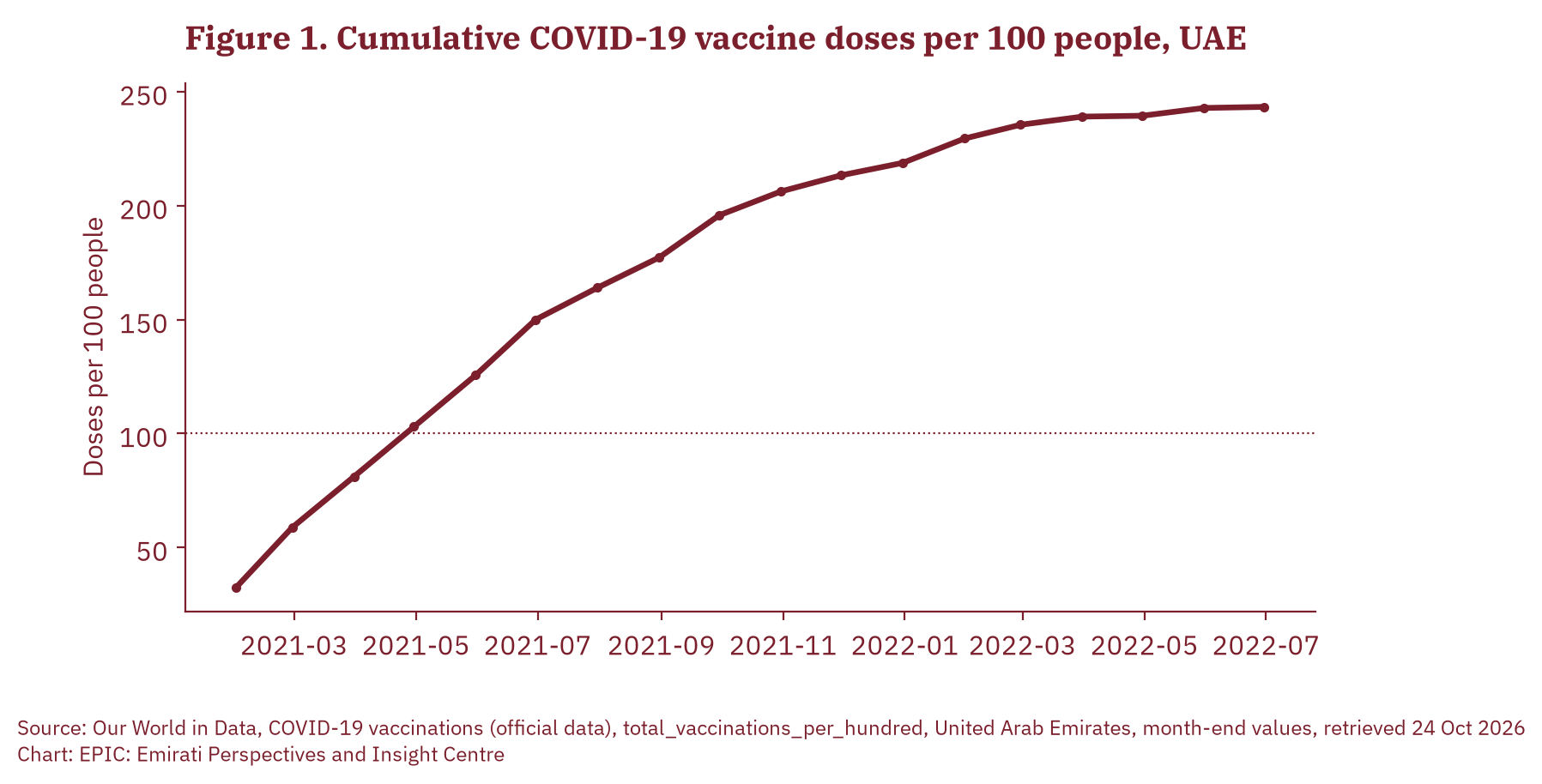
The defining feature of the UAE's response was the speed of vaccination (Figure 1). Data compiled by Our World in Data show that total doses administered reached about 33 per 100 people by the end of January 2021, passed 100 per 100 by the end of April 2021 and reached about 219 per 100 by the end of December 2021. The cumulative total stood at 24,922,054 doses at the end of June 2022, the same figure shown on the national emergency authority's dashboard. Because the population denominator may not keep pace with migration, per-capita figures should be read as approximate.
The UAE also moved into vaccine production. On 29 March 2021 the government announced Hayat-Vax, a vaccine manufactured by a joint venture between the Chinese company Sinopharm CNBG and the Abu Dhabi technology company G42. Interim production began with the UAE pharmaceutical company Julphar at an initial capacity of 2 million doses a month, while a plant in Abu Dhabi's Khalifa Industrial Zone was planned to reach 200 million doses a year. The joint venture had earlier run a phase III clinical trial with more than 43,000 volunteers.
4. System capacity
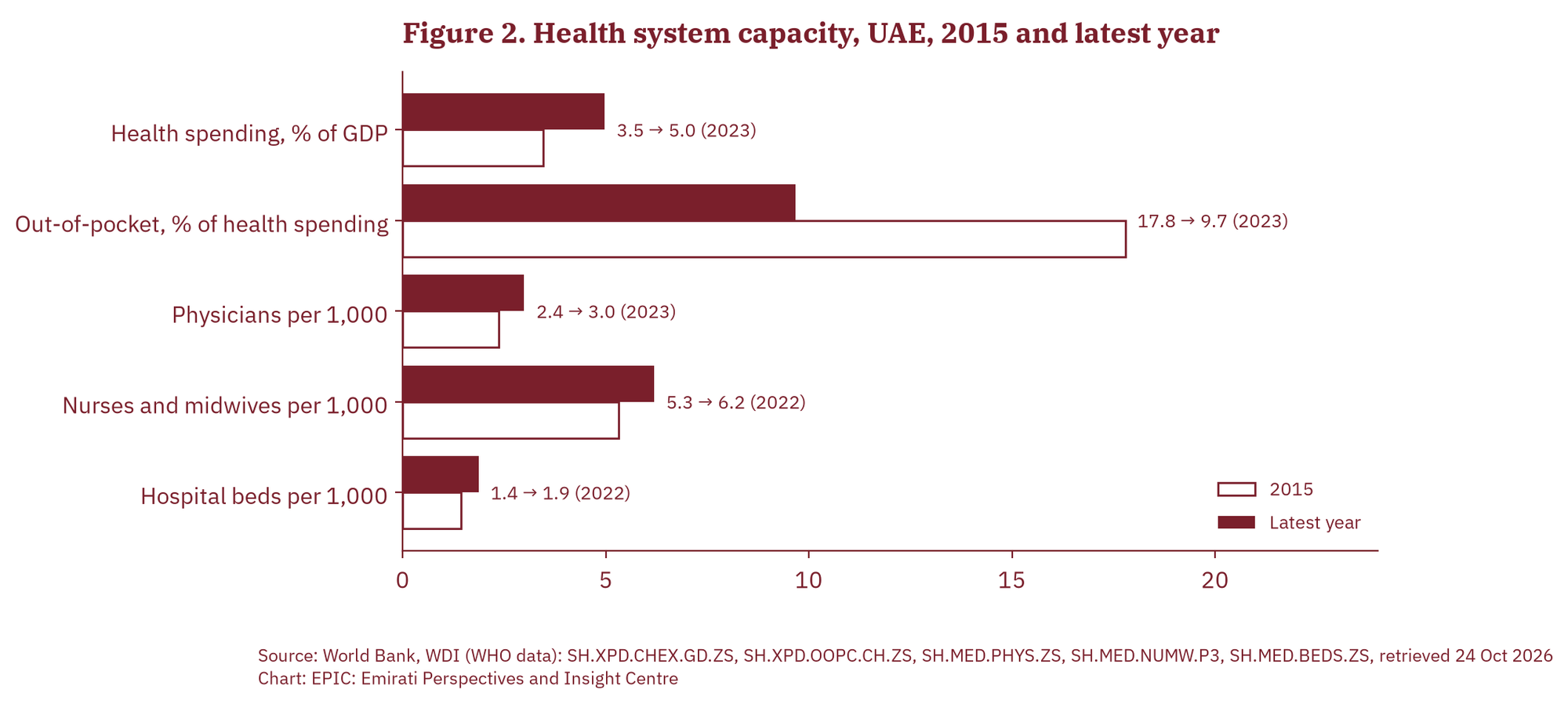
WHO data published by the World Bank show that the health system has grown substantially (Figure 2).
Spending. Current health expenditure was 3.5 per cent of GDP in 2015, rose to 5.8 per cent in 2020, the first pandemic year, and was about 5.0 per cent in 2023. Per person it rose from about USD 1,480 in 2015 to about USD 2,400 in 2023.
Who pays. Out-of-pocket spending fell from about 18 per cent of current health expenditure in 2015 to about 9.7 per cent in 2023. Domestic general government spending accounted for about 67 per cent in 2023.
Workforce. Physicians per 1,000 people rose from 2.36 in 2015 to 2.99 in 2023, and nurses and midwives from 5.3 to 6.2 per 1,000 between 2015 and 2022.
Beds. Hospital beds rose from 1.43 to 1.87 per 1,000 people between 2015 and 2022. This remains a low figure in absolute terms, partly reflecting a young population, but it limits surge capacity.
Outcomes. Life expectancy at birth was about 83.1 years in 2024 in the World Bank series. It fell to about 79.1 in 2021 before recovering, a reminder of the pandemic's toll.
5. New institutions
Medicines regulation. Federal Decree-Law No. 28 of 2023 established the Emirates Drug Establishment, issued on 25 September 2023 and in force from 30 September 2023. Its jurisdiction covers the whole country, including free zones, and extends to pharmaceuticals, medical devices, supplements and a range of other products. A single national regulator can speed approvals and strengthen supply oversight in an emergency.
Genomics. The Emirati Genome Programme, launched in Abu Dhabi in 2019 and later extended across the country, had sequenced more than 800,000 samples according to the Abu Dhabi Department of Health in 2025. Genomic capacity built for precision medicine can also support pathogen surveillance.
6. Vulnerabilities
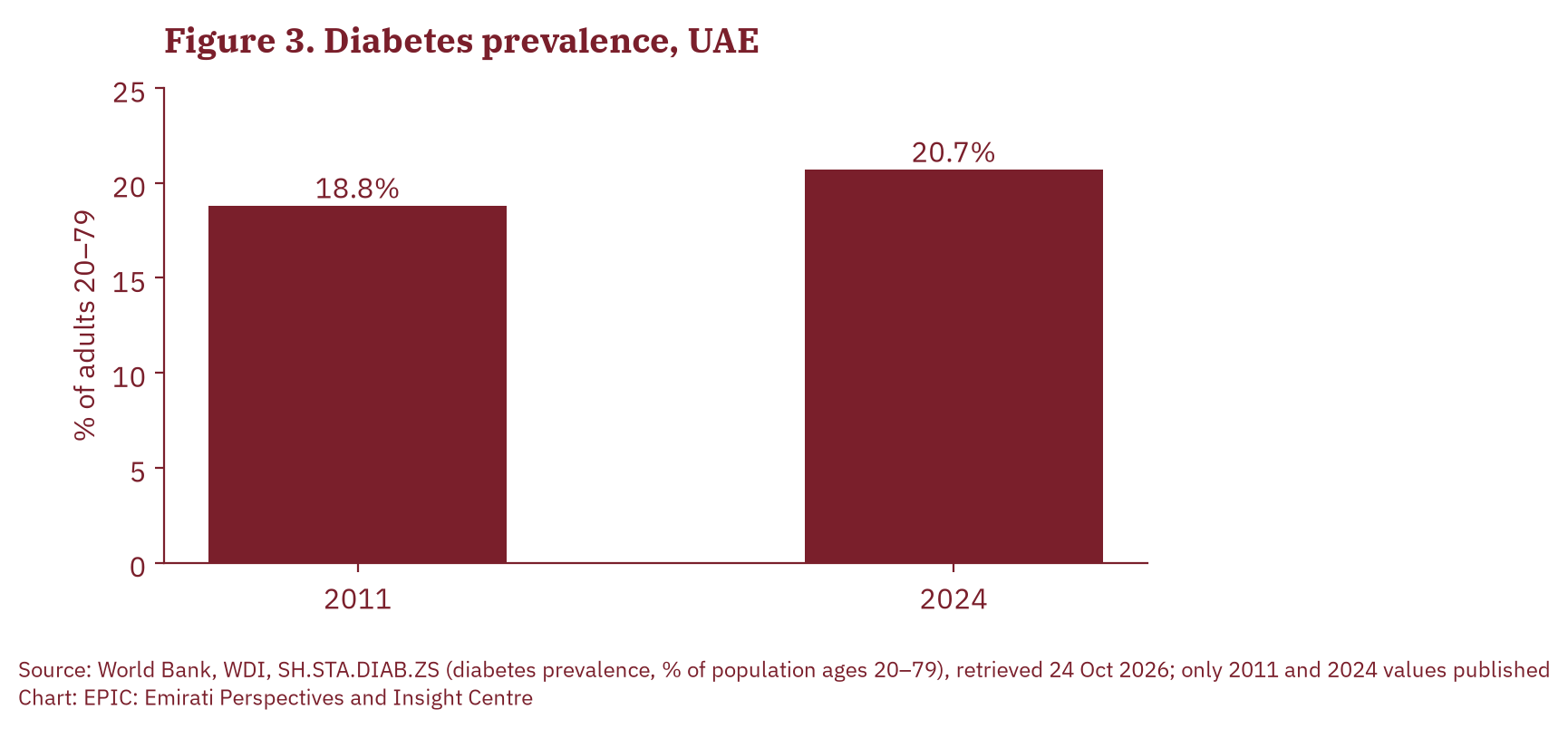
Chronic disease. The World Bank series puts diabetes prevalence among adults aged 20 to 79 at 20.7 per cent in 2024 (Figure 3). Chronic disease increases the severity of infectious outbreaks and the load on hospitals.
Surge capacity. At under 2 beds per 1,000 people, the system depends on rapid conversion of facilities in a crisis.
Supply. The share of medicines that the UAE imports was not found in an opened official source for this paper. The Hayat-Vax venture showed that domestic production can be built quickly, but its long-term commercial role was not established in the sources opened for this paper.
Data integration. Three health authorities operate distinct systems. Fast, shared data across emirates is a precondition for effective outbreak response.
7. Recommendations
- Publish a national health security plan. Set out surge targets for beds, staff and critical supplies, and test them in regular exercises.
- Integrate outbreak data nationally. Create a common reporting standard across federal and emirate health authorities.
- Use the Emirates Drug Establishment for supply resilience. Map critical medicines and maintain stockpiles or domestic production options for the most essential.
- Link genomics to pathogen surveillance. Use national sequencing capacity for wastewater and pathogen monitoring.
- Treat chronic disease as a security issue. Diabetes prevention reduces vulnerability to future outbreaks.
8. Conclusion
The UAE showed in 2021 that it could mobilise quickly. It has since spent more, hired more and built new institutions. The next test will come without warning; preparing for it depends on surge capacity, integrated data and a healthier population.
About this paper
EPIC-PP-2026-024. Written by the EPIC Research Team. All data are cited to public sources listed in the references; where no published value exists, the paper says so.
References
- Abu Dhabi Department of Health (2025). Statement on the Emirati Genome Programme, Abu Dhabi Media Office.
- Emirates News Agency (WAM) (2021). "UAE commences COVID-19 vaccine production with Hayat-Vax rollout", 29 March 2021.
- Emirates News Agency (WAM) (2023). "Board of Directors of new Emirates Drug Establishment holds inaugural meeting", 29 December 2023.
- National Emergency Crisis and Disasters Management Authority. UAE COVID-19 updates dashboard. https://covid19.ncema.gov.ae/
- Our World in Data. COVID-19 vaccinations dataset (sourced from official data and WHO), retrieved 24 October 2026.
- The National (2025). "Personalised medicine a step closer as 800,000 Emiratis contribute to genome programme", 17 April 2025.
- UAE Legislation portal. Federal Law No. 14 of 2014 on the control of communicable diseases; Federal Decree-Law No. 28 of 2023 establishing the Emirates Drug Establishment.
- World Bank. World Development Indicators: SM.POP.TOTL.ZS, SH.XPD.CHEX.GD.ZS, SH.XPD.CHEX.PC.CD, SH.XPD.OOPC.CH.ZS, SH.XPD.GHED.CH.ZS, SH.MED.PHYS.ZS, SH.MED.NUMW.P3, SH.MED.BEDS.ZS, SP.DYN.LE00.IN, SH.STA.DIAB.ZS. Retrieved 24 October 2026.
Sources and verification notes
Sources and verification notes: "Ready for the Next Outbreak"
All sources were retrieved and checked on 24 October 2026 (Asia/Dubai, UTC+4). Local copies in research/epic-new/_data/health/.
| # | Claim in paper | Source checked | Verdict | Action |
|---|---|---|---|---|
| 1 | About three quarters of residents are international migrants | WB SM.POP.TOTL.ZS (74%, 2024) | Correct | Kept (replaces draft "most connected society", unverifiable) |
| 2 | UAE "among the most connected societies in the world" | No ranking source | Unverifiable | Dropped |
| 3 | Federal Law No. 14 of 2014: listed diseases, 24-hour reporting, isolation and quarantine | UAE Legislation portal; u.ae | Correct | Kept |
| 4 | Doses per 100: ~33 (Jan 2021), >100 (Apr 2021), ~219 (Dec 2021), ~243 (Jun 2022) | OWID vaccinations dataset | Correct | Kept |
| 5 | Cumulative 24,922,054 doses, matches NCEMA dashboard | OWID; NCEMA dashboard | Correct | Kept |
| 6 | Hayat-Vax announced 29 Mar 2021; Sinopharm CNBG–G42 JV; Julphar 2m doses/month; KIZAD 200m/year; 43,000+ trial volunteers | WAM 29 Mar 2021; Reuters 29 Mar 2021 | Correct | Kept |
| 7 | Health spending 3.5% GDP (2015), 5.8% (2020), 5.0% (2023) | WB SH.XPD.CHEX.GD.ZS | Correct | Kept |
| 8 | Per capita ~USD 1,480 (2015), ~2,400 (2023) | WB SH.XPD.CHEX.PC.CD | Correct | Kept |
| 9 | Out-of-pocket ~18% (2015) to 9.7% (2023); government ~67% (2023) | WB SH.XPD.OOPC.CH.ZS, SH.XPD.GHED.CH.ZS | Correct | Kept |
| 10 | Physicians 2.36 to 2.99 per 1,000 (2015–2023); nurses 5.3 to 6.2 (2015–2022) | WB SH.MED.PHYS.ZS, SH.MED.NUMW.P3 | Correct | Kept |
| 11 | Beds 1.43 to 1.87 per 1,000 (2015–2022) | WB SH.MED.BEDS.ZS | Correct | Kept |
| 12 | Life expectancy 83.1 (2024), 79.1 (2021) | WB SP.DYN.LE00.IN | Correct | Kept |
| 13 | Federal Decree-Law 28/2023: issued 25 Sep, in force 30 Sep 2023; national jurisdiction incl. free zones; product scope | UAE Legislation portal; WAM 29 Dec 2023 | Correct | Kept |
| 14 | Emirati Genome Programme launched 2019, extended nationally; 800,000+ samples | Abu Dhabi DoH 2025; The National 17 Apr 2025 | Correct | Kept |
| 15 | Diabetes 20.7% of adults 20–79 (2024) | WB SH.STA.DIAB.ZS | Correct | Kept |
| 16 | "The UAE imports much of its medicine" | No official share found | Unverifiable | Dropped; gap stated |
| 17 | Three health authorities (MoHAP, DoH Abu Dhabi, DHA) operate distinct systems | PMC8421098 (2021) describes the three bodies | Mixed | Kept, framed as structure, not a judgement on interoperability |
| 18 | UAE Global Health Security Index 2021 score/rank (drafted) | GHS Index country PDF; overall score not confirmed in text extract | Unverifiable | Dropped |
Totals: 18 claims checked: 14 correct, 0 needs correction, 3 unverifiable (dropped), 1 mixed (reworded).