
 Emirati Perspectives and Insight Centre
Full text
1. Introduction: a population built by migration
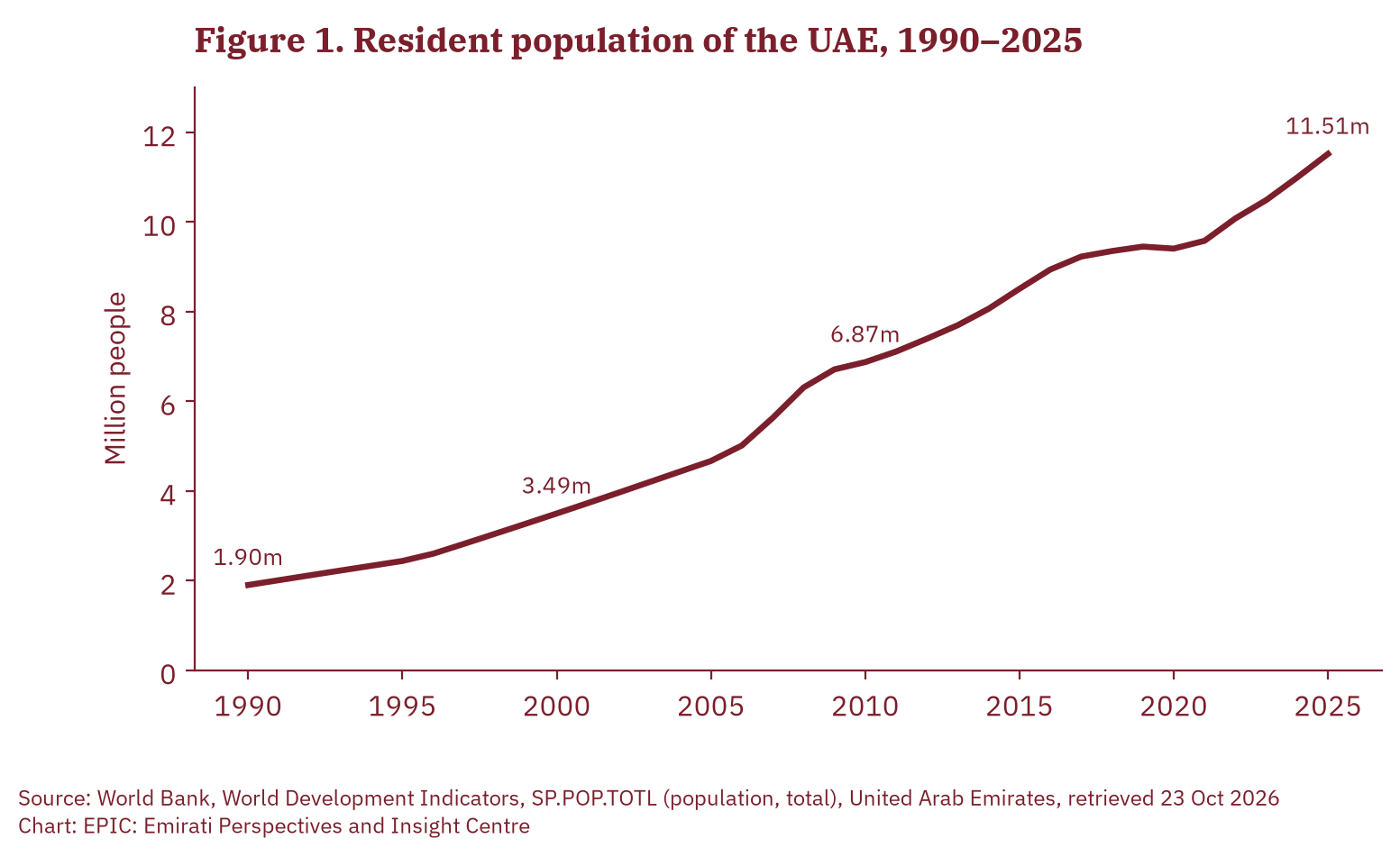
Few countries have grown as quickly, or as deliberately, as the UAE. World Bank population estimates put the resident population at about 1.90 million in 1990, 3.49 million in 2000, 6.87 million in 2010 and 11.51 million in 2025 (Figure 1). The growth has come overwhelmingly from labour migration. United Nations estimates published by the World Bank put the international migrant stock at 74 per cent of the population in 2024, down from a peak of about 79 per cent in 2015.
This paper treats that structure as a fact of national strategy rather than a problem to be explained away. A small citizen population has used migration to build an economy far larger than its own labour supply could sustain. The question for policy is not whether the UAE should depend on foreign labour, but how the citizen workforce can take a larger and more productive share of an economy that will remain open. Section 2 sets out the demographic arithmetic. Section 3 describes the labour market. Section 4 examines the Emiratisation framework introduced since 2021. Section 5 discusses the long-term residence and social protection reforms. Section 6 assesses the gaps, and Section 7 sets out recommendations.
2. The demographic arithmetic
Three features of the population stand out in the World Bank data.
The first is its sex ratio. Men made up about 63.9 per cent of the population in 2024. The share has fallen slowly from a peak of about 69 per cent in 2000 to 2005, but remains heavily weighted towards men, a reflection of male-dominated labour migration in construction, transport and services.
The second is its age structure. People aged 15 to 64 made up 82.1 per cent of the population in 2024, and people aged 65 and over only 1.77 per cent. Most residents arrive as working adults and leave before old age, so the country carries an unusually small burden of dependency. This structure is a product of the residence system rather than of the citizen population, whose age profile is not published in the international series.
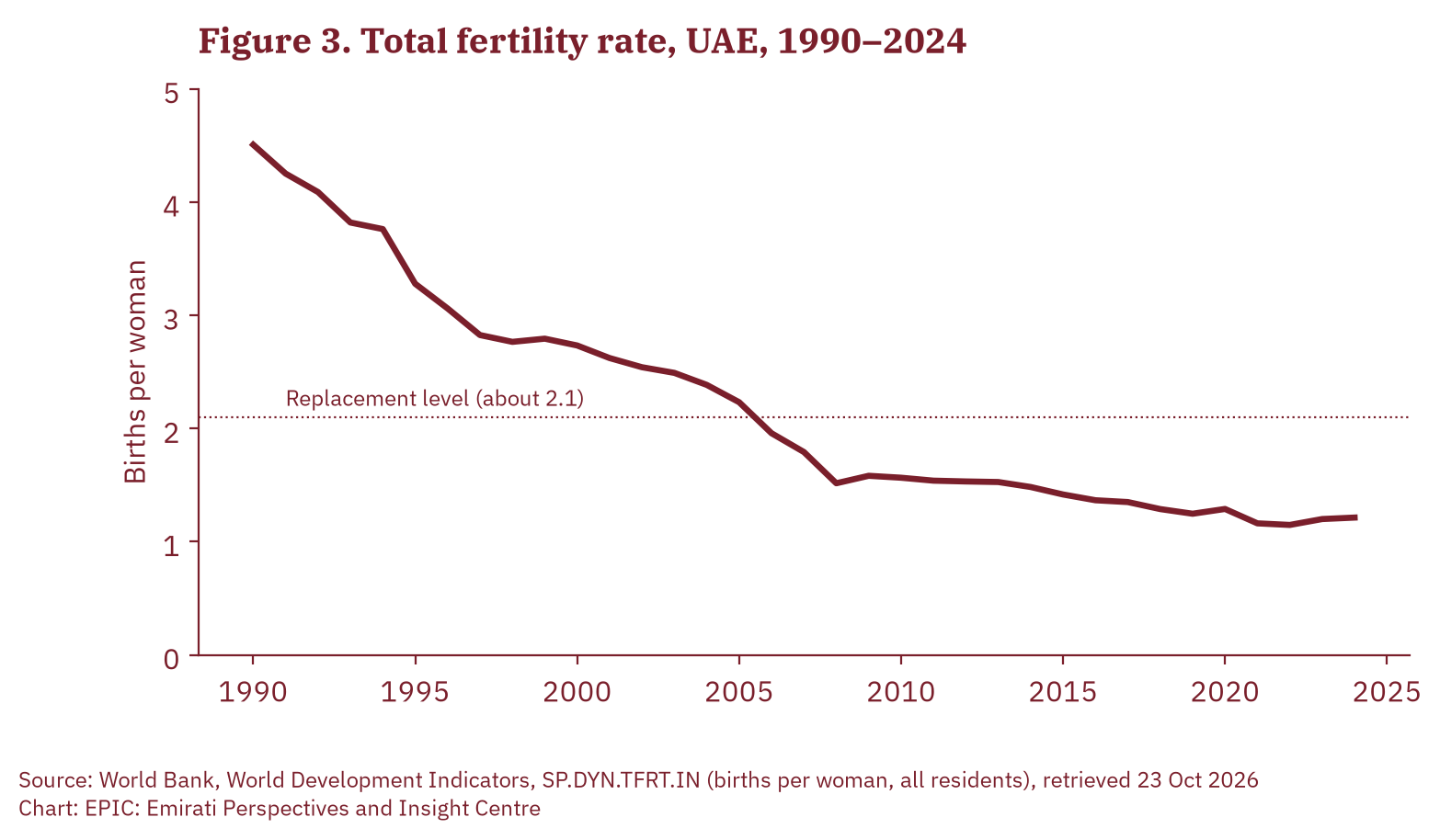
The third is fertility. The World Bank series puts the total fertility rate at 4.51 births per woman in 1990, 2.73 in 2000, 1.56 in 2010 and 1.21 in 2024 (Figure 3). The rate covers all residents, not only citizens, so it partly reflects the fact that many migrant workers live in the UAE without their families. It nevertheless signals that the citizen population cannot be assumed to grow quickly enough on its own to change the national share of the workforce.
3. A large, young and active labour market
The ILO modelled estimates published by the World Bank put the UAE labour force at about 7.23 million people in 2024, up from about 0.99 million in 1990 and 4.38 million in 2010. The participation rate of the population aged 15 and over was about 78.5 per cent in 2024. The rate is high because so many residents are present in the country specifically to work.
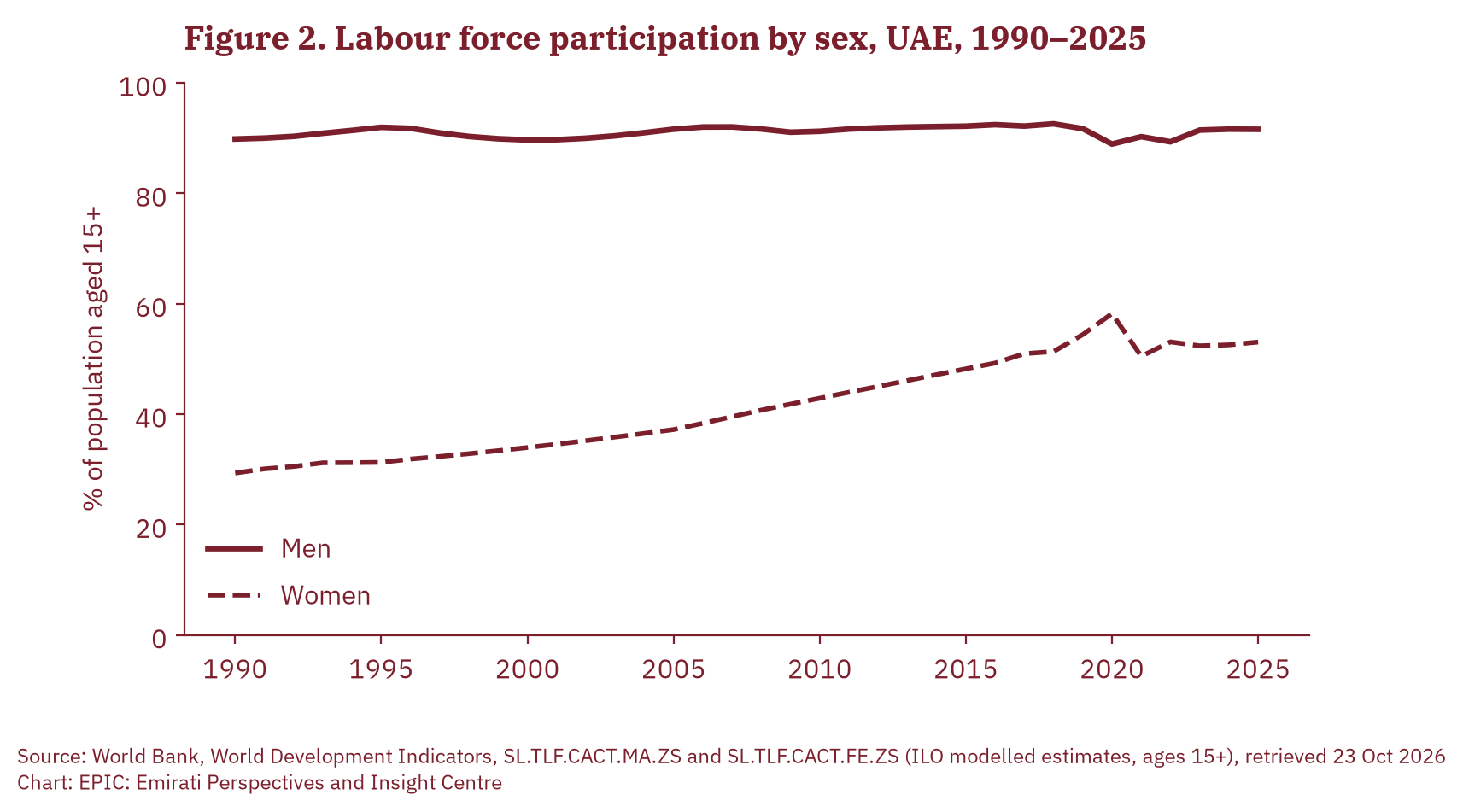
Behind the average lie large differences between men and women. The modelled participation rate for men was about 91.6 per cent in 2024. For women it was about 52.5 per cent, but it has risen markedly over three decades, from about 29.3 per cent in 1990 and 42.9 per cent in 2010 (Figure 2). Data released by the Emirati Talent Competitiveness Council in September 2025 indicate that women make up more than 70 per cent of the Emiratis working in the private sector.
Modelled unemployment is low: about 2.2 per cent of the labour force in 2024, rising to about 6.4 per cent among people aged 15 to 24. These figures should be read with care. They are ILO model estimates, not survey results, and they describe the whole resident labour force, in which a migrant who loses work usually has a limited period to find another job or leave. They therefore say little about the position of citizens, whose unemployment rate is not published in the same series.
4. Emiratisation since 2021: from aspiration to quota
For most of the UAE's history, citizens worked predominantly in government, and policies to encourage private-sector employment relied on persuasion and incentives. That changed in 2021 and 2022.
4.1 Nafis
In September 2021 the government launched Nafis as one of the "Projects of the 50". The programme is run by the Emirati Talent Competitiveness Council and combines support for citizens, such as salary top-ups and training, with incentives for employers. The UAE Government portal states that Nafis aims to employ 75,000 Emiratis in the private sector over five years.
4.2 The 2 per cent rule
The Cabinet then approved a requirement that private establishments with 50 or more employees raise the share of Emiratis in skilled jobs by 2 percentage points a year, reaching an overall increase of 10 per cent by 2026. MoHRE announced in December 2022 that companies which had not met the 2022 target would, from 1 January 2023, pay AED 6,000 a month for each Emirati not employed as required, a total of AED 72,000 a year, and that the amount would rise by AED 1,000 a year until 2026. Targets were later extended to companies with 20 to 49 employees in specified sectors, which were required to employ one Emirati in 2024 and two in 2025, with annual contributions of AED 96,000 and AED 108,000 for non-compliance. Cabinet Resolution No. 95 of 2022 and Cabinet Resolution No. 44 of 2023 set penalties for "fake Emiratisation" and for evasion through workforce reductions or reclassification.
4.3 Results so far
The official figures show rapid growth. MoHRE reported that more than 152,000 Emiratis were working in the private sector at over 29,000 companies on 30 June 2025. At a meeting of the Emirati Talent Competitiveness Council on 7 October 2025, the figure presented was about 154,000, with more than 136,000 having joined since the launch of Nafis, and nearly 30,000 companies employing citizens. On these figures the five-year target of 75,000 was exceeded well within its period.
The figures need context. A total of about 154,000 Emiratis in private employment is small against a labour force of about 7.2 million: roughly 2 per cent, although the quota itself applies only to skilled jobs at covered firms. The official statements do not publish the distribution of these jobs by wage level, sector or duration, nor the share of new hires who remain in post after two or three years.
5. Residence and protection: making the open market more stable
Two reforms since 2019 have changed the terms on which non-citizens live and work in the UAE.
The first is long-term residence. Cabinet Decree No. 56 of 2018 on residence permits for investors, entrepreneurs and specialised talents took effect in February 2019, and the federal identity authority began receiving applications for long-term visas on 1 May 2019. The present Golden Visa offers renewable five- or ten-year residence without a sponsor. It moves the system, at the top end, from a model of temporary workers towards one of long-term residents.
The second is social protection for job loss. Federal Decree-Law No. 13 of 2022 introduced an unemployment insurance scheme for private-sector and federal government employees, with subscription starting on 1 January 2023. Employees with a basic salary of AED 16,000 or less pay AED 5 a month; those earning more pay AED 10. After 12 months of continuous subscription, an insured worker who loses a job for reasons other than discipline can receive 60 per cent of basic salary for up to three months.
Both reforms reduce the volatility of an economy that has relied on rapid entry and exit of labour. They also widen the gap between a stable, skilled, long-term resident workforce and a larger temporary one, which matters for Emiratisation, because citizens compete mainly with the former.
6. Assessment: where the constraints now lie
Three constraints stand out.
Data. The international series used in this paper describe all residents. The UAE does not publish, in an accessible regular series, the size of the citizen labour force, citizen participation by sex and age, or citizen unemployment. Without these numbers it is not possible to judge whether the rise in private-sector employment reflects new entrants, moves from government, or re-entry by people previously out of work.
Design. A quota measured in headcount rewards hiring, not productive employment. The penalties for fake Emiratisation show that the government is aware of the risk. Targets that also tracked wages, retention and progression would align the incentives of firms with the purpose of the policy.
Demography. With a resident fertility rate of about 1.2 and a young but small citizen population, the citizen share of the workforce cannot rise quickly through numbers alone. The decisive variables are participation, especially of Emirati women, and the level of skills that citizens bring to the jobs that matter most for growth.
7. Recommendations
- Publish a citizen labour market series. The Federal Competitiveness and Statistics Centre and MoHRE should publish at least annually the citizen labour force, participation by sex and age, unemployment and private-sector employment by sector and wage band.
- Move from headcount to quality targets. After the 10 per cent milestone in 2026, targets should weight retention after two years, wage progression and the share of citizens in specialist and managerial roles.
- Treat women's participation as the main lever. Since women already make up most Emiratis in private employment, childcare, flexible work and transport policies are labour market policies, not only social ones.
- Report outcomes of Nafis independently. An independent evaluation of the programme's cost per sustained job would strengthen confidence in its results.
- Use long-term residence for skills transfer. Golden Visa holders in priority sectors could be linked to structured mentoring and training of Emirati staff.
8. Conclusion
The UAE has built an economy with a labour force several times the size of its citizen population. That model has succeeded and will continue. Emiratisation since 2021 has shown that firm targets can change hiring behaviour quickly. The next stage depends on better data, quality-based targets and higher participation, so that a nation of newcomers is also a nation whose citizens hold a growing share of its most productive work.
About this paper
EPIC-PP-2026-021. Written by the EPIC Research Team. All data are cited to public sources listed in the references; where no published value exists, the paper says so.
References
- Emirati Talent Competitiveness Council (2025). "ETCC celebrates four years of Nafis, showcasing pioneering milestones and impressive growth", 15 September 2025. https://www.etcc.gov.ae/
- Emirates News Agency (WAM) (2025). "More than 152,000 Emiratis employed in private sector by end of June: MoHRE", 21 July 2025.
- Emirates News Agency (WAM) (2025). "Mansour bin Zayed chairs board meeting of Emirati Talent Competitiveness Council, honours Nafis Award winners", 7 October 2025.
- Federal Authority for Identity, Citizenship, Customs and Port Security (2019). "ICA starts to receive long-term UAE residency visas applications for entrepreneurs and specialised talents", 1 May 2019.
- Ministry of Human Resources and Emiratisation (2022). "Emiratisation targets: Starting 1 January 2023, non-compliant companies to be fined", 29 December 2022.
- Ministry of Human Resources and Emiratisation (2022). "Subscription to Unemployment Insurance Scheme starts on 1st January 2023", 28 December 2022.
- UAE Government (2022). Federal Decree-Law No. 13 of 2022 concerning the Unemployment Insurance Scheme.
- UAE Government portal. "Employing Emiratis in the private sector"; "Golden visa"; "Insurance against job loss". https://u.ae/
- World Bank. World Development Indicators: SP.POP.TOTL, SM.POP.TOTL.ZS, SP.POP.TOTL.MA.ZS, SP.POP.1564.TO.ZS, SP.POP.65UP.TO.ZS, SP.DYN.TFRT.IN, SL.TLF.TOTL.IN, SL.TLF.CACT.ZS, SL.TLF.CACT.FE.ZS, SL.TLF.CACT.MA.ZS, SL.UEM.TOTL.ZS, SL.UEM.1524.ZS. Retrieved 23 October 2026.
Sources and verification notes
Sources and verification notes: "A Nation of Newcomers"
All sources were retrieved and checked on 23 October 2026 (Asia/Dubai, UTC+4). Verdicts use the four house categories: correct, needs correction, unverifiable and mixed. Local World Bank API copies are in research/epic-new/_data/labour/.
| # | Claim in paper | Source checked | Verdict | Action |
|---|---|---|---|---|
| 1 | Population 1.90m (1990), 3.49m (2000), 6.87m (2010), 11.51m (2025); about sixfold | WB SP.POP.TOTL | Correct | Kept |
| 2 | Migrant stock 74% (2024), peak about 79% (2015) | WB SM.POP.TOTL.ZS (UN DESA) | Correct | Kept |
| 3 | Men 63.9% of population (2024); peak about 69% in 2000–2005 | WB SP.POP.TOTL.MA.ZS | Correct | Kept |
| 4 | Ages 15–64 82.1%, 65+ 1.77% (2024) | WB SP.POP.1564.TO.ZS, SP.POP.65UP.TO.ZS | Correct | Kept |
| 5 | TFR 4.51 (1990), 2.73 (2000), 1.56 (2010), 1.21 (2024) | WB SP.DYN.TFRT.IN | Correct | Kept |
| 6 | Labour force 0.99m (1990), 4.38m (2010), 7.23m (2024) | WB SL.TLF.TOTL.IN | Correct | Kept |
| 7 | Participation 78.5% total, men 91.6%, women 52.5% (2024); women 29.3% (1990), 42.9% (2010) | WB SL.TLF.CACT.* | Correct | Kept |
| 8 | Unemployment 2.2% (2024), youth 6.4% | WB SL.UEM.TOTL.ZS, SL.UEM.1524.ZS | Correct | Kept; labelled ILO modelled |
| 9 | UAE participation "one of the highest recorded anywhere" | No ranking source opened | Unverifiable | Dropped |
| 10 | Sex ratio "among the most unbalanced in the world" | No ranking source opened | Unverifiable | Dropped |
| 11 | Nafis launched Sept 2021 as a Project of the 50 | ETCC, 15 Sep 2025 | Correct | Kept |
| 12 | Nafis benefits include child allowances | Not in sources opened | Unverifiable | Dropped; kept salary top-ups and training |
| 13 | Nafis target of 75,000 Emiratis over five years | u.ae, Employing Emiratis in the private sector | Correct | Kept |
| 14 | 2% a year for firms with 50+, 10% by 2026 | u.ae; MoHRE 29 Dec 2022 | Correct | Kept |
| 15 | AED 6,000/month from 1 Jan 2023, AED 72,000/yr, +AED 1,000 a year to 2026 | MoHRE 29 Dec 2022 | Correct | Kept |
| 16 | Firms 20–49: one Emirati 2024, two 2025; AED 96,000 / 108,000 | u.ae | Correct | Kept |
| 17 | Cabinet Resolutions 95/2022 and 44/2023 on fake Emiratisation and evasion | u.ae | Correct | Kept |
| 18 | 152,000+ Emiratis at 29,000+ firms, 30 June 2025 | WAM 21 Jul 2025; MoHRE | Correct | Kept |
| 19 | About 154,000; 136,000+ since Nafis; nearly 30,000 firms (7 Oct 2025) | WAM 7 Oct 2025; The National | Correct | Kept |
| 20 | Women over 70% of Emiratis in private sector | ETCC 15 Sep 2025 | Correct | Kept |
| 21 | 154,000 is roughly 2% of a 7.2m labour force | Calculation from 6 and 19 | Correct | Kept; caveat on quota scope added |
| 22 | Cabinet Decree 56/2018 effective Feb 2019; ICA applications 1 May 2019; 5- or 10-year Golden Visa | ICA 1 May 2019; u.ae Golden visa | Correct | Kept |
| 23 | Federal Decree-Law 13/2022; start 1 Jan 2023; AED 5/10; 60% for up to 3 months after 12 months | MoHRE 28 Dec 2022; u.ae | Correct | Kept |
| 24 | No regular public citizen labour force series | Searches of FCSC/MoHRE did not find one | Mixed | Kept, worded as "not published in an accessible regular series" |
Totals: 24 claims checked: 20 correct, 0 needs correction, 3 unverifiable (dropped), 1 mixed (reworded).