
 Emirati Perspectives and Insight Centre
Full text
1. Introduction
Every constitutional democracy has a story it tells about its enemies. In the story, the enemy arrives from outside, breaks the law, and is caught. The Muslim Brotherhood does not fit that story, which is precisely why it has proved so durable in Europe. It registers associations under national law. It applies for grants, sits on consultative bodies, trains young professionals, files legal complaints and petitions European institutions. Its representatives speak the language of equality, minority rights and non-discrimination with fluency. Much of this activity would be unremarkable if it came from an ordinary interest group. What makes it a security question is the purpose it serves and the structure that directs it.
This paper treats the Muslim Brotherhood as what official European assessments say it is: a political organisation with a transnational structure, a long-term strategy and goals that conflict with the constitutional orders in which it operates. The paper is about that organisation and its methods. It is not about the faith of Europe's Muslim citizens, the overwhelming majority of whom have nothing to do with the Muslim Brotherhood and are among the first people its activism claims to speak for without their consent. The French government's 2025 report makes the same distinction, and so did the Graz public prosecutor in November 2020 when it said that the Muslim Brotherhood was "no religious community" and stood for religiously motivated political extremism (ORF Steiermark 2020).
The argument proceeds in four steps. Section 2 sets out what kind of organisation the official record describes. Section 3 introduces the philosophical problem: how a tolerant order may defend itself against an intolerant movement that uses the order's own freedoms. Sections 4 and 5 present the documented cases and the repertoire of methods they reveal, with data drawn only from published official sources. Sections 6 and 7 assess why European responses have been uneven and set out a policy framework. Throughout, the paper tries to do what several of the sources themselves do: take the threat seriously while keeping the evidence honest. A case against the Muslim Brotherhood that overstates its facts helps the Muslim Brotherhood, because the organisation's most effective defence has always been to present any scrutiny as prejudice.
The paper draws on five bodies of official assessment, from Sweden, Germany, Austria, France and the United Arab Emirates. They were chosen for the record each left behind. In every case a state body set out its judgement in a public, dated document that names organisations and can be checked page by page, which is not true of most European governments' thinking on the Muslim Brotherhood. The five also differ in the instrument they reached for. Sweden worked through grant conditions, Germany through annual intelligence reporting, France through an inter-ministerial report followed by administrative dissolution, and the UAE through terrorist designation. Austria is included because its instrument failed. A sample made only of states whose measures held up in court would have told the reader what they wanted to hear, and Operation Luxor is the case that puts the paper's argument to the test. The British review of 2015 is used for definitions and not as a case, because only its main findings were published (Foreign Affairs Committee 2016, para 117). On the narrow question of what states found and what they did about it, official sources are given more weight than academic or journalistic ones. They are not treated as neutral. Where a finding was publicly contested, as the Swedish study was in 2017, the dispute is reported alongside it, and the paper leans on later administrative decisions taken under ordinary rules as well as on the contested text. Where a figure comes from the movement's own declarations and a different one from the state, both are given. The selection has a cost. Belgium and the Netherlands have documented records of their own and are not examined as cases, and the United Kingdom is used only for its definitions. The paper's conclusions therefore concern the states it examines and should be tested against others before being generalised.
2. What kind of organisation?
The first question is definitional, and the official sources answer it with unusual consistency. Germany's Federal Office for the Protection of the Constitution (Bundesamt für Verfassungsschutz, BfV) lists the Muslim Brotherhood as founded in Egypt in 1928, still shaped by the ideology of its founder Hassan al-Banna, and present by its own account in more than 70 countries. Its stated goal, in the BfV's words, is the establishment of a political and social system on its own doctrinal foundations. The BfV adds a detail that matters for any discussion of means: the Muslim Brotherhood has professed the renunciation of violence since the 1970s, with an exception for what it calls resistance against "occupation", which it applies above all to Israel (BfV 2025, p.245).
The British government's review, commissioned by the Prime Minister in April 2014 (Cabinet Office 2015) and summarised by him in December 2015, reached a similar view by a different route. It described the Muslim Brotherhood as "deliberately opaque, and habitually secretive", said that "it can be seen primarily as a political project", and concluded that "membership of, association with, or influence by the Muslim Brotherhood should be considered as a possible indicator of extremism". It also found that Muslim Brotherhood-associated groups "have at times had a significant influence on national organisations which have claimed to represent Muslim communities", as well as on charities and some mosques (Prime Minister's Office 2015).
The French report of May 2025 uses the vocabulary of entryism. Following "a vision, an identity and a plan", it says, the Muslim Brotherhood pursues a strategy of entrisme, relying on the technique of the double discourse, "by which they conceal their real intentions while displaying adherence to the rules and principles governing Western collective life" (Ministère de l'Intérieur 2025, p.20; EPIC translation).
Three features recur across these sources and define the object of this paper.
The first is that the Muslim Brotherhood is a political organisation with a hierarchy. It has members, oaths, leaders and an inner circle. The French report estimates the sworn inner circle of its French branch at around 400 people, with a maximum of 1,000 (Ministère de l'Intérieur 2025, p.40). It describes the Council of European Muslims (CEM), created in 1989 as the Federation of Islamic Organisations in Europe (FIOE) and renamed in 2020, as the "keystone" of the European structure and the most important organisation the movement has created in Europe (p.29). The BfV notes that the German organisation it treats as the Muslim Brotherhood's central body avoids public declarations of allegiance, yet "numerous links" between its high-ranking functionaries and prominent foreign members of the Muslim Brotherhood show that it belongs to the global network (BfV 2025, p.245).
The second is legalism. The BfV's term is "legalist Islamism": organisations that pursue anti-constitutional goals through lawful means, aiming at long-term social change rather than immediate confrontation (BfV 2020, pp.179–180). Its 2021 report says such organisations claim to be "the central point of contact for all Muslim concerns in Germany" and seek, over the long run, to shape the social and political system and to establish their agenda in politics and society (BfV 2022, p.197).
The third is concealment. The British review's "deliberately opaque", the BfV's observation that public statements avoid professions of allegiance, and the French report's "double discourse" describe the same practice. An organisation that renames its national bodies, distributes functions across formally independent associations and denies membership in its own network is designed to make the ordinary tools of democratic accountability, such as party registration, campaign finance disclosure and parliamentary questions, slide off it.
These features make the Muslim Brotherhood dangerous in a specific sense. Its main danger is the steady accumulation of institutional positions from which it can shape who speaks for a population, what children are taught, which organisations receive public money and how criticism of political Islamism is framed in law and in public debate. That is a slower danger, and democracies are bad at noticing slow things.
3. The philosophical problem: tolerating those who use tolerance
3.1 Popper's paradox
Karl Popper's best-known remark on the subject sits in a footnote. In The Open Society and Its Enemies he wrote that "unlimited tolerance must lead to the disappearance of tolerance", because if we extend tolerance to those who are intolerant and are not prepared to defend a tolerant society against their onslaught, "the tolerant will be destroyed, and tolerance with them" (Popper 2013, p.581, note 4 to chapter 7). The passage is often quoted as a licence for suppression. It is nothing of the kind. Popper immediately adds that he does not imply "that we should always suppress the utterance of intolerant philosophies; as long as we can counter them by rational argument and keep them in check by public opinion, suppression would certainly be most unwise". The right to suppress arises when the intolerant "are not prepared to meet us on the level of rational argument, but begin by denouncing all argument", and teach their followers to answer arguments with fists or pistols. Only then: "We should therefore claim, in the name of tolerance, the right not to tolerate the intolerant."
Popper's test is behavioural. It asks whether a movement will submit to argument. Applied to the Muslim Brotherhood, the test gives an uncomfortable answer. The organisation does not refuse argument in public. It argues constantly and often skilfully. What the official record describes is a movement that argues in public on one set of terms while pursuing a different programme in private, and that treats public argument against it as an act of discrimination to be answered through complaints, campaigns and litigation. A double discourse is a refusal of rational argument conducted by other means. If the claims a movement makes in public are not the claims it acts on, then the public is not being met "on the level of rational argument" at all. It is being managed.
3.2 Loewenstein's militant democracy
Karl Loewenstein, writing in 1937 as a refugee from Nazi Germany, was more blunt. "Democracy and democratic tolerance have been used for their own destruction," he wrote, and "the mechanism of democracy is the Trojan horse by which the enemy enters the city" (Loewenstein 1937a, pp.423–424). His central observation concerned method. Fascism, he noticed, "officially annexed legality": it exploited the rights of assembly, speech and association and the procedures of parliamentary democracy to dismantle them from within. The democracies of the 1930s lost because they insisted on fighting a movement that used legality as a weapon with nothing but legality's own forms.
Loewenstein's prescription was what he called militant democracy: a democracy prepared to restrict the political rights of those who would use them to destroy it. "Fire is fought with fire," he concluded, and the democracies must "meet and defeat the fascist technique on its own battle-ground" (Loewenstein 1937b, pp.656, 658). He also saw that statutes alone would not do the work. "The statute-book is only a subsidiary expedient of the militant will for self-preservation" (p.657).
Honesty requires noting what else Loewenstein wrote on that page. He was prepared to speak of a "disciplined" or even "authoritarian" democracy as the price of survival, and a contemporary reader should not import that language uncritically. Post-war constitutionalism took his insight and domesticated it. Germany's Basic Law allows the prohibition of associations whose purposes are directed against the constitutional order (Article 9(2)), the forfeiture of basic rights by those who abuse them to combat the free democratic basic order (Article 18), and the prohibition of anti-constitutional parties by the Federal Constitutional Court (Article 21(2)) (Grundgesetz, Arts 9(2), 18, 21(2)). The European Court of Human Rights has accepted the underlying logic. In Herri Batasuna and Batasuna v Spain (2009, §81) the Court restated its Grand Chamber reasoning in Refah Partisi v Turkey (2003). It held that "a State cannot be required to wait, before intervening, until a political party has seized power and begun to take concrete steps to implement a policy incompatible with the standards of the Convention and democracy, even though the danger of that policy for democracy is sufficiently established and imminent". The Court attached a condition that matters for this paper's argument: the State may act preventively only "where the presence of such a danger has been established by the national courts, after detailed scrutiny subjected to rigorous European supervision". (Wording checked against reproductions of §81 by the Carter Center's Election Standards database and in the Court's own later quotation of it; HUDOC could not be accessed directly.)
3.3 The Rawlsian caution and the legalist gap
John Rawls offers the most careful liberal statement of the limits. In A Theory of Justice he argued that an intolerant sect "does not itself have title to complain of intolerance", yet "its freedom should be restricted only when the tolerant sincerely and with reason believe that their own security and that of the institutions of liberty are in danger" (Rawls 1971, original edition, p.220; revised edition 1999, p.193). Rawls's condition is demanding and should be accepted. It means the case against the Muslim Brotherhood must be made with evidence about the security of institutions, not with suspicion about beliefs.
This is where the Muslim Brotherhood becomes the hard case. Loewenstein's fascists marched in uniform. The legal tools militant democracy produced (party bans, association bans, forfeiture of rights) were designed for movements whose hostility was visible. A legalist organisation that does not stand for election, does not call for violence in Europe, denies its own membership and channels its activity through dozens of formally separate associations offers no single act that triggers these tools. Alexander Kirshner's theory of militant democracy holds that exclusionary measures should be used only to thwart antidemocrats from 'invidiously violating others' rights', and that defensive efforts 'should be shaped by a sense of the damage likely to result from defensive action' (Kirshner 2014, pp.6–7). The question for Europe is how to show damage done slowly, through lawful channels, by an organisation that hides its own shape.
The answer this paper develops is that the relevant damage is institutional. When an organisation with anti-constitutional aims captures the channels through which a democratic state funds civil society, recognises representatives, educates children and interprets discrimination, it injures the democratic rights of the very citizens it claims to represent. It narrows whose voice reaches the state. Popper's test and Rawls's condition can both be met by evidence of that kind. The next sections show that European states have, in fact, been gathering it.
4. The documented record
4.1 Sweden: the 2017 MSB study and what followed
In 2016 Sweden's Civil Contingencies Agency (Myndigheten för samhällsskydd och beredskap, MSB) commissioned a study of the Muslim Brotherhood in Sweden. Written by Magnus Norell, Aje Carlbom and Pierre Durrani and published in early 2017, the 35-page study argued that the Muslim Brotherhood had been active in Sweden since the 1970s and was connected to a set of national organisations, including the Islamic Association in Sweden, the study association Ibn Rushd, Sweden's Young Muslims and Islamic Relief (Norell, Carlbom and Durrani 2017). Its most quoted sentence is about direction: "At root, Islamists are building a parallel social structure that competes with the rest of society over Swedish citizens' fundamental values" (pp.30–31; EPIC translation).
The study's analytical contribution was to identify the mechanism. It described how state support flows to civil-society bodies through the Swedish Agency for Support for Faith Communities (SST), the Agency for Youth and Civil Society (MUCF) and the Swedish Inheritance Fund, amounting to many millions of kronor over the years (p.10). It identified the "gatekeeper" role that organisations acquire when public authorities treat them as the natural representatives of a population (p.18), and it used the term entryism explicitly, quoting the European federation's stated policy of "working towards achieving representation of Muslims within European institutions and authorities" (p.19).
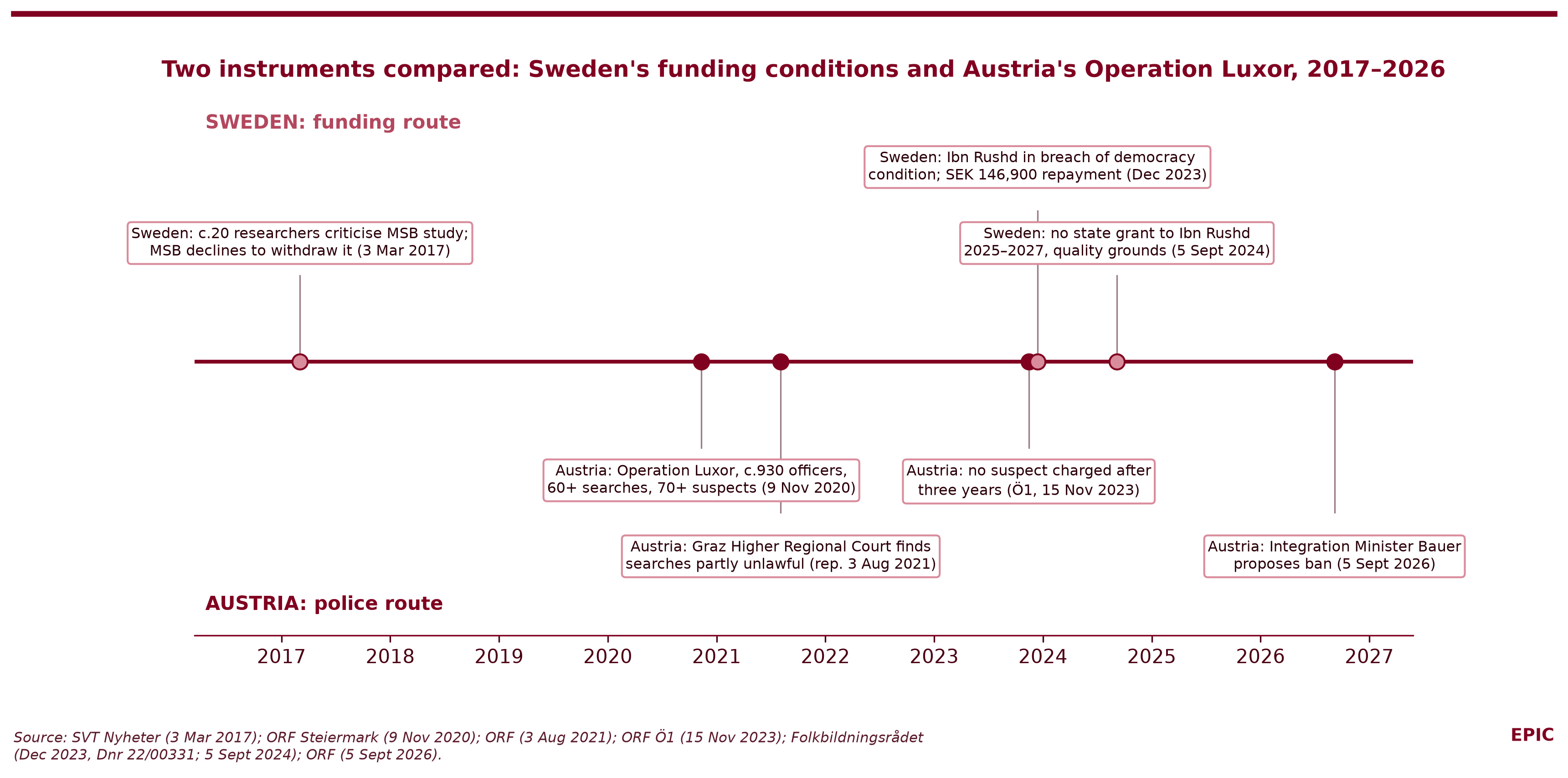
The study was fiercely contested. On 3 March 2017 about twenty Swedish researchers in religious studies criticised it publicly, arguing that it lacked sources for its claims; MSB responded that it would not withdraw the report, adding that "it is Magnus Norell who stands for the content" (SVT Nyheter 2017; EPIC translation), a remark that placed responsibility for the content on the author rather than on the agency. That controversy should not be wished away. It is, however, worth recording what Swedish public bodies later found on their own account. The same SVT report noted that MUCF had already withdrawn support from Sweden's Young Muslims for 2017 because it judged the organisation's activities incompatible with respect for democratic ideas. In December 2023 the National Council of Adult Education (Folkbildningsrådet) decided that Ibn Rushd had breached the democracy condition attached to state grants in parts of its activity, citing study material on child marriage, corporal punishment of children and homosexuality that it found incompatible with both the grant conditions and Swedish law, and ordered repayment of SEK 146,900 (Folkbildningsrådet 2023). In September 2024 the Council decided, on separate quality grounds, that Ibn Rushd would receive no state grant for 2025 to 2027, judging that it lacked the capacity to run its activity in line with the purposes of the grant; Ibn Rushd was then the smallest of Sweden's study associations, with just over 6,000 participants (Folkbildningsrådet 2024).
The Swedish case shows how slowly the system moves and how it eventually moves. A contested intelligence-style study in 2017 became, six years later, a formal administrative finding under the ordinary rules of public funding. The democracy condition, a modest administrative tool, did what grand declarations could not.
4.2 Germany: legalist Islamism under constitutional observation
Germany offers the longest continuous official record. The BfV and its regional counterparts observe the Muslim Brotherhood as an extremist organisation, and the federal annual report publishes an estimate of its following every year. The figures in Table 1 are taken directly from those reports.
Table 1. Persons assessed by the BfV as belonging to the Muslim Brotherhood milieu in Germany, 2017–2025
| Year | Persons | Note |
|---|---|---|
| 2017 | 1,040 | BfV annual report |
| 2018 | 1,040 | BfV annual report |
| 2019 | 1,350 | BfV annual report |
| 2020 | 1,450 | BfV annual report |
| 2021 | 1,450 | BfV annual report |
| 2022 | 1,450 | BfV annual report |
| 2023 | 1,450 | BfV annual report |
| 2024 | 1,450 | Includes about 350 members of the DMG |
| 2025 | 1,450 | Includes 350 members of the DMG |
Sources: BfV, Verfassungsschutzbericht 2019 (2020), p.181; Verfassungsschutzbericht 2021 (2022), p.181; Verfassungsschutzbericht 2024 (2025), pp.204, 245; Verfassungsschutzbericht 2025 (2026), pp.229, 271. The 2019 figure includes 400 DMG members.
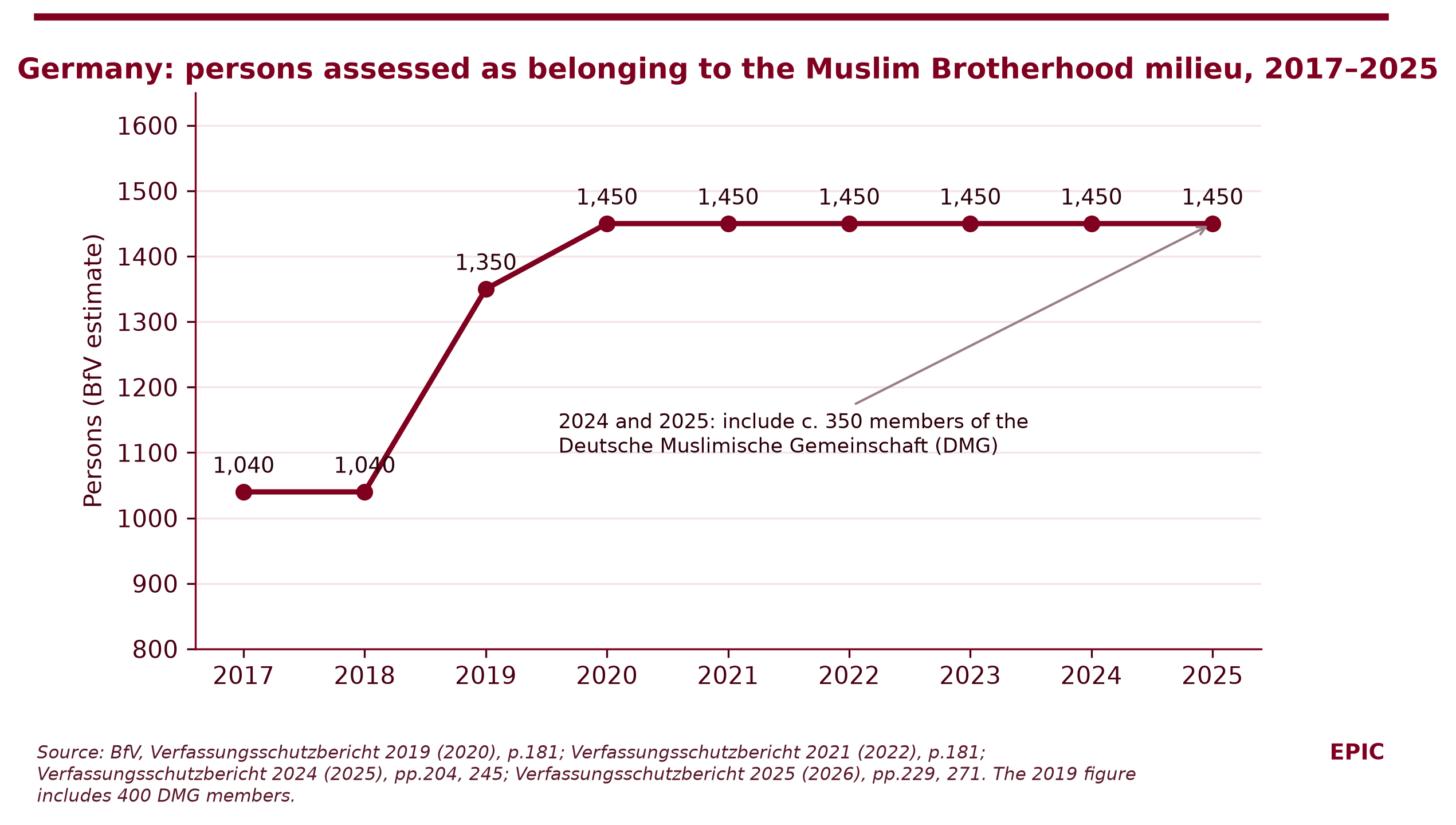
The numbers are small. In 2025 the BfV put the total Islamist following in Germany at 28,645, up from 28,280 the year before (BfV 2026, p.228), so the Muslim Brotherhood milieu, unchanged at 1,450 (p.229), is about one in twenty of that total. Reading the size of a following as a measure of danger would miss the BfV's point. Its concern is influence, and the organisation it observes is built for influence. The Deutsche Muslimische Gemeinschaft (DMG), known until September 2018 as the Islamische Gemeinschaft in Deutschland (IGD), is described as the most important and central organisation of the Muslim Brotherhood's following in Germany. Its aim, the BfV writes, is to present itself to politicians, authorities and civil-society partners as the contact point for a supposedly moderate, open-minded current, while pursuing a strategy of influence in the political and social sphere aligned with Muslim Brotherhood ideology (BfV 2025, p.245).
The renaming of 2018 is a small fact that tells a large story. An organisation under observation changed its name to one that sounds more representative. It did not change its leadership network, which the BfV continued to document. The German system's answer has been persistence: annual public reporting that names the organisation, explains the assessment and gives the numbers, so that a ministry, a municipality or a political party considering a partnership cannot later claim ignorance.
4.3 Austria: Operation Luxor and the limits of the police instrument
Austria chose a different instrument. On the morning of 9 November 2020, under the direction of the Graz public prosecutor's office, about 930 police officers carried out more than 60 searches of homes and of business and association premises in Styria, Carinthia, Lower Austria and Vienna. Investigators named more than 70 suspects and several associations and companies; 30 people were detained for immediate questioning. The suspected offences included membership of a terrorist organisation, terrorist financing, anti-state connections, criminal organisation and money laundering. Cash in the millions was seized and accounts were frozen. No weapons or explosives were found. Interior Minister Karl Nehammer called the Muslim Brotherhood "deeply dangerous" and said it sought to undermine democracy and fight fundamental rights. The prosecutors stressed that the operation had no connection with the terrorist attack in Vienna a week earlier and was not directed at Muslims or at the recognised religious community (ORF Steiermark 2020).
What followed should be studied by every European government considering the same path. In August 2021 the Higher Regional Court of Graz upheld several complaints and declared the searches unlawful in those cases (ORF 2021). By November 2023, three years after the raids, Austrian public radio reported that not one suspect had been charged, let alone convicted, that dozens of proceedings had been discontinued and that several of the raids had been declared unlawful by courts (Ö1 2023).
Table 2. Operation Luxor: documented scale and outcomes
| Item | Documented figure or outcome | Source |
|---|---|---|
| Date | 9 November 2020 | ORF Steiermark 2020 |
| Officers deployed | About 930 | ORF Steiermark 2020 |
| Searches | More than 60, in four federal states | ORF Steiermark 2020 |
| Suspects | More than 70, plus several associations and companies | ORF Steiermark 2020 |
| Persons detained for questioning | 30 | ORF Steiermark 2020 |
| Weapons or explosives found | None | ORF Steiermark 2020 |
| Court review | Several searches declared unlawful by the Higher Regional Court of Graz (reported 3 August 2021) | ORF 2021 |
| Position three years later | No charges; dozens of proceedings discontinued | Ö1 2023 |
Austria's assessment of the Muslim Brotherhood has not changed. Austrian ministers have continued to regard it as a threat, and in September 2026 Integration Minister Claudia Bauer said she would push for a ban on the Muslim Brotherhood and other Islamist organisations as part of a broader prohibition of political Islam (ORF 2026). The lesson of Luxor concerns instruments. Criminal law requires proof of specific offences by specific people. A legalist organisation is designed so that its most consequential activities are not offences. When the state reaches for the criminal instrument against a movement whose strategy is lawful conduct, it hands that movement the outcome it most wants: a public record of acquittals, discontinued cases and unlawful searches that can be cited for years as proof of persecution. Militant democracy needs evidence that survives a courtroom, or it needs tools that do not depend on one.
4.4 France: the 2025 report and the measurement of entryism
The most detailed official account so far is French. In April 2024 the government commissioned a group of senior officials to assess the Muslim Brotherhood and political Islamism in France. Their report, Frères musulmans et islamisme politique en France, was released by the Interior Ministry in May 2025 (file dated 2 May 2025) (Ministère de l'Intérieur 2025). It identifies Musulmans de France, founded in 1983 as the Union des organisations islamiques de France (UOIF), as the national branch of the Muslim Brotherhood, and it quantifies the network around it more precisely than any earlier European document.
Table 3. France: the documented footprint of the Muslim Brotherhood's national branch
| Indicator | Figure | Source |
|---|---|---|
| Places of worship affiliated with Musulmans de France | 139 | Ministère de l'Intérieur 2025, p.40 |
| Further places of worship considered close to the movement | 68 | p.40 |
| Départements covered | 55 | p.40 |
| Share of France's c.2,800 Muslim places of worship | About 7% | p.40 |
| Share of places of worship opened 2010–2020 | About 10% (45 of 447) | p.40 |
| Average Friday attendance at these sites | About 91,000 | p.40 |
| Associations claimed by Musulmans de France | 53 (31 active, 22 ordinary members) | p.40 |
| Associations assessed in the French government's 2025 report as attached to the movement | 280 | p.40 |
| Estimated sworn inner circle | About 400, at most 1,000 | p.40 |
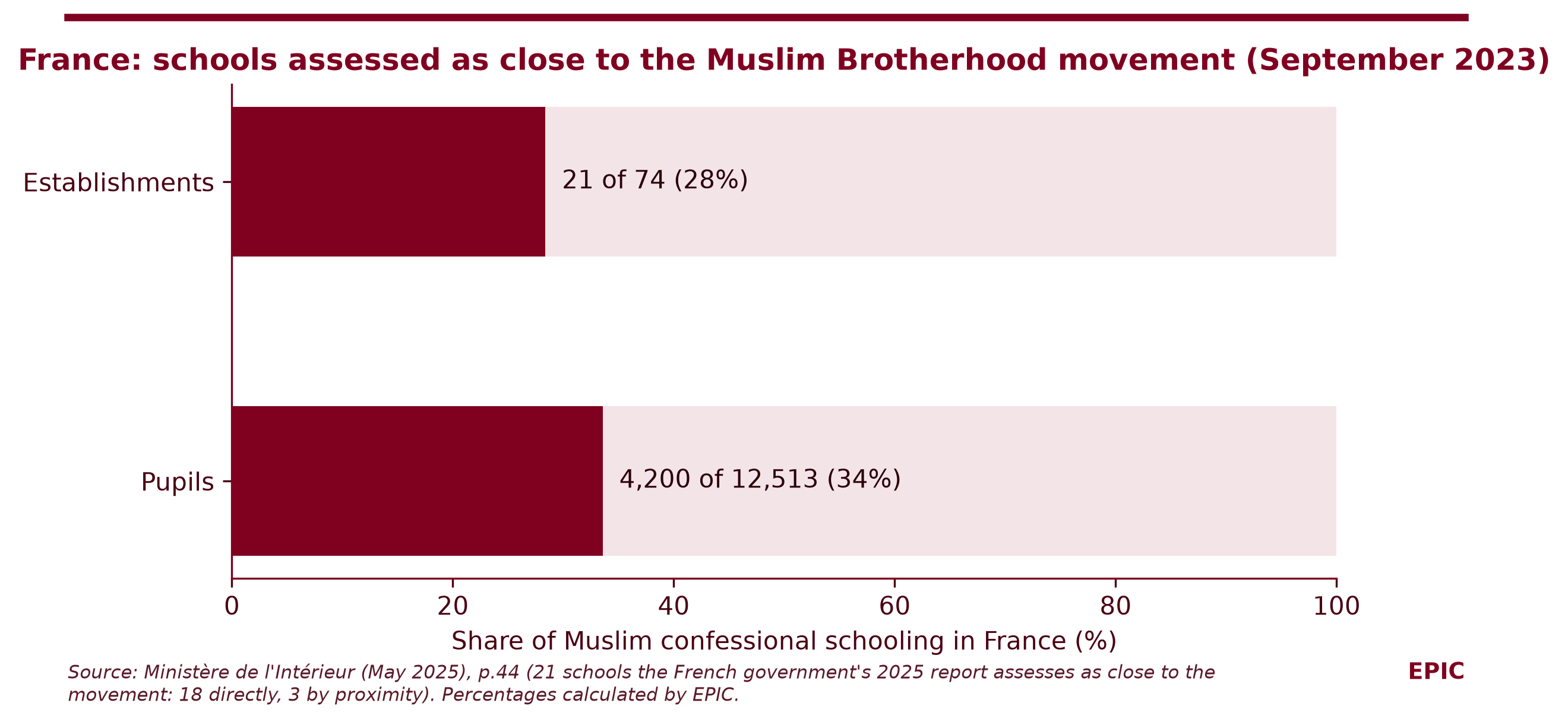
| Schools assessed in the French government's 2025 report as close to the movement (Sept. 2023) | 21 of 74 Muslim confessional establishments (18 directly, 3 by proximity) | p.44 |
| Pupils in schools assessed as close to the movement | About 4,200 of 12,513 | p.44 |
Figures as reported in the French government report and summarised in Assemblée nationale report no. 2235 (2025). Percentages for schools calculated by EPIC.
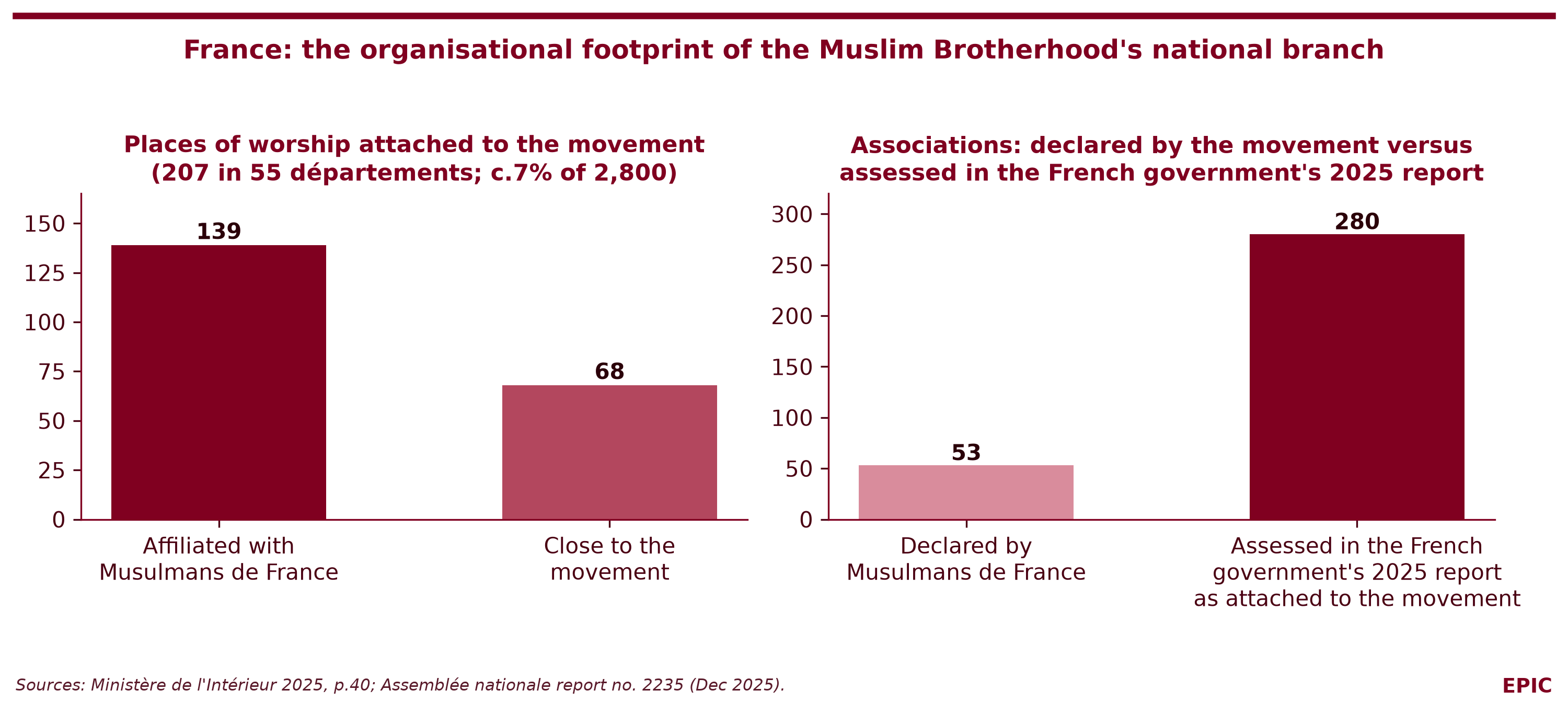
The gap between the 53 associations the movement declares and the 280 that the French government's 2025 report assesses as attached to it is the clearest measurement of concealment in the European record. The movement's own count amounts to fewer than one in five of the state's. The pattern in education is just as telling. Of 74 Muslim confessional schools operating in September 2023, 21 were identified in the French government's 2025 report as close to the movement (18 directly and 3 by proximity). They educated about 4,200 of 12,513 pupils, a third of the total (p.44). Education is where a long-term political project invests when it expects to be judged across generations.
French administrative law has given the state tools that operate below the criminal threshold. In December 2023 the state terminated the contract that funded the Averroès secondary school in Lille, and, as at May 2025, the challenges to that decision had been rejected (Ministère de l'Intérieur 2025, p.44). On 2 December 2020 the government dissolved by decree the Collectif contre l'islamophobie en France (CCIF). On 24 September 2021 the Conseil d'État upheld the dissolution on the ground that the association's publications and leaders had incited discrimination, hatred or violence, under article L.212-1(6) of the Internal Security Code. It found that the separate ground of provocation to terrorism had been wrongly applied (Conseil d'État 2021). The detail matters. France won because it argued the case it could prove.
The report is also notable for its restraint. It states that "if a Muslim Brotherhood risk does exist, it must be assessed at its proper measure", particularly at national level, while judging the local risk real (p.6). It records that interviews pointed to "a relative weakening of the ideological matrix" since the mid-2010s (p.20). Some readers have taken this as a softening. It reads better as discipline. A report that concedes what the evidence does not show is harder to dismiss on the points the evidence does show.
French Parliament has since gone further than the government. A National Assembly commission of inquiry into links between political actors and organisations that support terrorism or propagate Islamist ideology, chaired by Xavier Breton with Matthieu Bloch as rapporteur, registered its report on 10 December 2025 (Assemblée nationale 2025). On 22 January 2026 the Assembly adopted a European resolution, by 157 votes to 101 with one abstention, aiming to place the Muslim Brotherhood movement on the European Union's list of terrorist organisations ("visant à inscrire la mouvance des frères musulmans sur la liste européenne des organisations terroristes") (Assemblée nationale 2026). The resolution is not binding. Its significance is that a national parliament has formally carried the question to the European level.
4.5 The European level: youth federations, campaigns and funding
The French report devotes particular attention to the European institutions. It describes the Forum of European Muslim Youth and Student Organisations (FEMYSO) as the CEM's "youth branch" and as a training structure for high-potential cadres, in which French activists are very active, and it records that FEMYSO appears on the EU's transparency register and lobbies the European Parliament and Commission (Ministère de l'Intérieur 2025, pp.31–32). It also states that "the European institutions are also a major source of funding for the movement" (p.33; EPIC translation).
One episode showed the method in public. On 3 November 2021 the Council of Europe was reported to have withdrawn social-media material from a campaign that included the slogan "Beauty is in diversity as freedom is in hijab", after objections from the French government. The material had come out of workshops held with FEMYSO (BBC News 2021). The episode is minor in itself. Its significance is structural: a youth federation that French officials link to the Muslim Brotherhood was able to place its framing inside the communications of Europe's principal human rights organisation, and the institution noticed only when a member state objected.
4.6 The UAE designation of November 2014
The United Arab Emirates reached a firm conclusion earlier than any European state. On 15 November 2014, under Federal Law No. 7 of 2014 on combating terrorism offences, the UAE Cabinet approved a list of designated terrorist organisations (WAM 2014). The list included the Muslim Brotherhood, its UAE branch and the International Organisation of the Muslim Brotherhood, alongside al-Qaeda, Daesh and other armed groups. It also included organisations based in Europe and North America. The European entries are set out in Table 4.
Table 4. Europe-based entities on the UAE terrorist list of November 2014
| Entity as named on the list (WAM official English text) | Country |
|---|---|
| Associazione Musulmani Italiani (Association of Italian Muslims) | Italy |
| The Finnish Islamic Association (Suomen Islam-seurakunta) | Finland |
| The Muslim Association of Sweden (Sveriges muslimska förbund, SMF) | Sweden |
| Det Islamske Forbundet i Norge (Islamic Association in Norway) | Norway |
| Islamic Relief UK | United Kingdom |
| The Cordoba Foundation (TCF) in Britain | United Kingdom |
| Islamic Relief Worldwide (IRW), listed as "of the Global Muslim Brotherhood" | United Kingdom |
| Muslim Association of Britain (MAB) | United Kingdom |
| Union of Islamic Organisations of France (L'Union des Organisations Islamiques de France, UOIF) | France |
| Federation of Islamic Organisations in Europe | Europe-wide |
| Islamic Society of Germany (Islamische Gemeinschaft Deutschland) | Germany |
| The Islamic Society in Denmark (Det Islamiske Trossamfund, DIT) | Denmark |
| The League of Muslims in Belgium (La Ligue des Musulmans de Belgique, LMB) | Belgium |
Source: UAE Cabinet list under Federal Law No. 7 of 2014, published by WAM on 15 November 2014 (85 entries as published, one of which appears twice; checked against the WAM page on 20 October 2026). The list also includes one Belgrade-based organisation unrelated to the Muslim Brotherhood, excluded here.
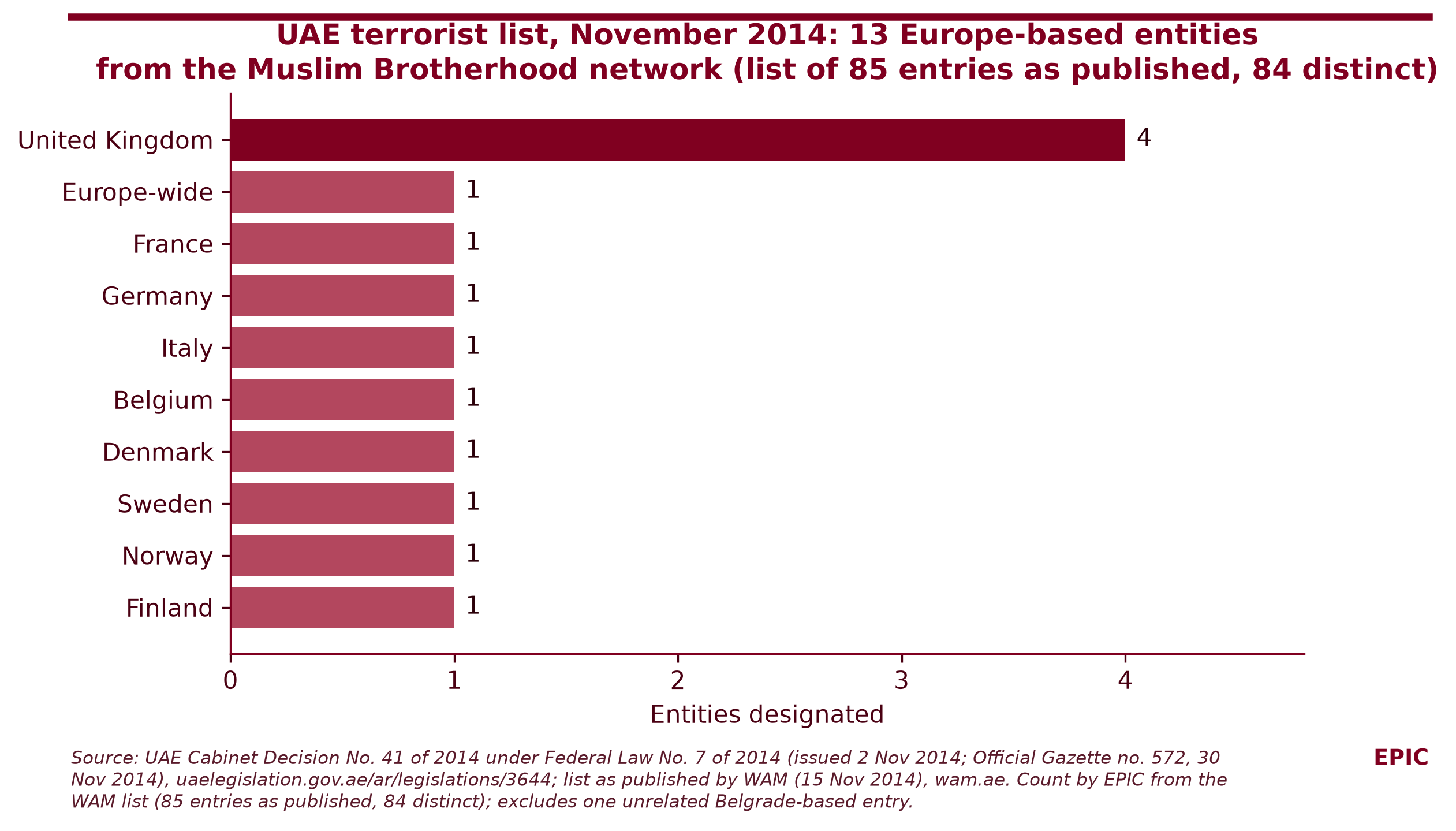
In 2014 the listed British bodies rejected the designation. Islamic Relief said its inclusion 'can only be attributable to a mistake' (Islamic Relief Worldwide 2014), and the Cordoba Foundation called the accusations 'libellous' (Cordoba Foundation 2014). A decade later the record reads differently. Two of the listed national bodies, the UOIF in France and the IGD in Germany, are exactly the organisations that French and German state assessments now identify as the Muslim Brotherhood's national branch and central organisation (Ministère de l'Intérieur 2025; BfV 2026). The UAE's judgement and the later European findings converge on the same names. The UAE has continued the policy, designating in January 2025 a further group of individuals and entities "for their links to the terrorist Muslim Brotherhood organisation" (WAM 2025). In January 2026 the United States designated the Lebanese chapter of the Muslim Brotherhood as a foreign terrorist organisation and the Egyptian and Jordanian chapters as specially designated global terrorists (US Department of State 2026).
The UAE's approach reflects a different constitutional starting point. It did not have to translate a political judgement into the evidentiary language of a European criminal court. That difference cuts both ways. It allowed the UAE to act early and clearly. It also means that European states cannot simply copy the method. They need routes to the same destination that their own courts will accept.
5. The repertoire: how democratic means serve political ends
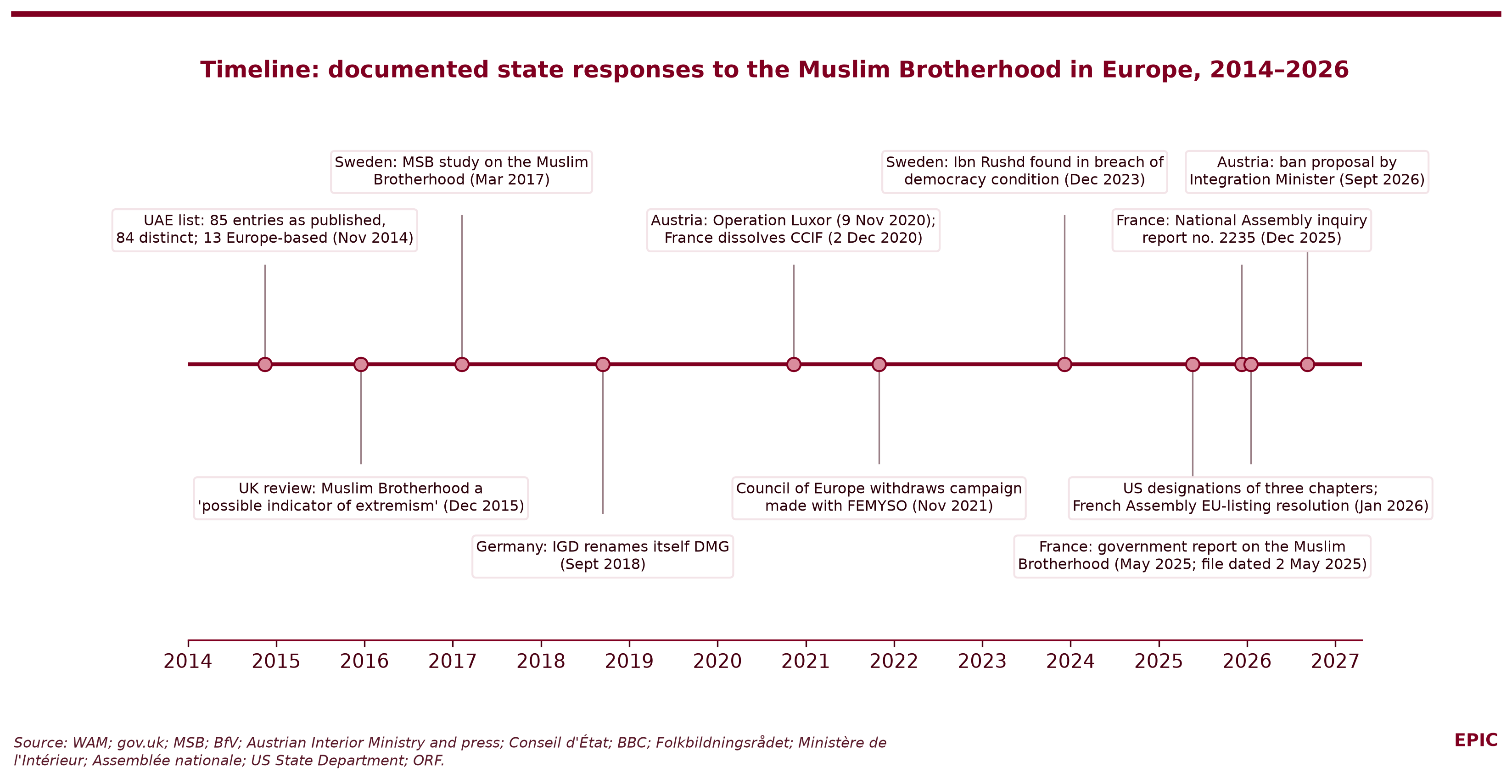
The five bodies of evidence describe the same toolkit. Setting it out plainly helps separate what is legitimate in a democracy from what is being exploited.
5.1 The association as a container
Freedom of association allows any group of citizens to form a legal person with a bank account, a board and the capacity to receive grants. The Muslim Brotherhood's European structure uses this freedom as a container technology. Functions that a political party would hold under one roof (youth recruitment, training, fundraising, publishing, advocacy, education, representation) are distributed across many associations whose formal independence makes each look like an ordinary civic body. The 280 associations that the French government's 2025 report assesses as attached to the movement, against the 53 the movement itself declares, measure this distribution. The arrangement is lawful. Its effect is to make the whole invisible to rules designed to scrutinise wholes.
5.2 Public money as leverage
European welfare states fund civil society generously and with good reason. The Swedish study documented the routes by which grants reach organisations in the Muslim Brotherhood's orbit (Norell, Carlbom and Durrani 2017, p.10), and the French report records European funding for organisations in its orbit (Ministère de l'Intérieur 2025, p.32). Public funding does more than pay salaries. It confers legitimacy, because other officials presume that a body funded by the state has been vetted, and that presumption is worth more than the money.
5.3 Representation and gatekeeping
When a ministry wants to consult "the community", it needs an address. Organisations that present themselves as the natural representatives of a population acquire what the Swedish study called a gatekeeper role (p.18) and what the BfV describes as the claim to be the central contact for all Muslim concerns (BfV 2022, p.197). Once installed, a gatekeeper decides which voices reach the state. Reformist or simply unaffiliated citizens find themselves represented by an organisation they did not choose. This is the most direct way in which a legalist strategy injures other people's democratic rights, and it is the point at which Rawls's condition about the security of free institutions is met.
5.4 Rights language as a shield
The French report identifies the denunciation of "Islamophobia" as one of the Muslim Brotherhood's leitmotifs, used to discredit measures inspired by the principle of laïcité and policies against violent radicalisation and Islamist separatism, which are presented as discrimination against Muslims (Ministère de l'Intérieur 2025, p.20). The tactic is effective because it borrows a real concern. Discrimination against Muslims exists in Europe and should be fought. When the concept is stretched to cover any scrutiny of a political organisation, it becomes a shield for that organisation and a weapon against its critics, including Muslim critics. The CCIF case shows the end point: an organisation that presented itself as a human rights defender was dissolved because of what it published and promoted (Conseil d'État 2021).
5.5 Education and the long horizon
Schools and youth camps are where a political project secures its next generation. In France, a third of pupils in Muslim confessional schools attend establishments that the French government's 2025 report assesses as close to the movement (Ministère de l'Intérieur 2025, p.44). That figure and the Swedish finding on study material that breached the democracy condition (Folkbildningsrådet 2023) point to the same priority, and a curriculum shapes pupils long after any single campaign has ended.
5.6 The double discourse
All five methods depend on a sixth: speaking differently to different audiences. The French report's "double discourse", the British review's "deliberately opaque" and the BfV's note that public appearances avoid professions of allegiance describe an organisation that adjusts its message to the listener (Ministère de l'Intérieur 2025, p.20; Prime Minister's Office 2015; BfV 2025, p.245). This is the point at which Popper's test is failed. A democracy can argue with a movement that says what it wants. It cannot argue with a movement whose public statements are designed to be unfalsifiable.
Table 5. The repertoire mapped to the democratic instrument it exploits and the documented evidence
| Method | Democratic instrument used | Documented example |
|---|---|---|
| Distribution across associations | Freedom of association | 280 associations assessed as attached to the movement, against 53 declared (France, 2025) |
| Public funding | Grant schemes for civil society | State grants via SST, MUCF and the Inheritance Fund (Sweden, 2017); repayment order to Ibn Rushd (Sweden, 2023) |
| Gatekeeping | Consultation and representation | Claim to be the central contact for all Muslim concerns (Germany, BfV) |
| Rights framing | Anti-discrimination law and discourse | CCIF dissolved for inciting hatred or discrimination (France, 2020–2021) |
| Education | Freedom to run independent schools and study associations | 21 of 74 confessional schools assessed as close to the movement (France, 2023) |
| Institutional messaging | Access to international organisations | Council of Europe campaign withdrawn after FEMYSO workshops (2021) |
| Concealment | Low disclosure thresholds for associations | Renaming of IGD as DMG (Germany, 2018); double discourse (France, 2025) |
6. Why European responses have been uneven
Three obstacles explain why European democracies, with all their legal resources, have struggled to respond coherently.
The first is evidentiary. Criminal law and the classic tools of militant democracy require proof of acts. The Muslim Brotherhood's method generates few acts that meet that standard. Austria's experience is the warning. A police operation on the scale of Luxor produces headlines on the first day and a record of discontinued cases for years afterwards. Every unlawful search becomes an argument for the organisation's narrative of victimhood.
The second is fragmentation. The Muslim Brotherhood is organised across borders, while European responses are national and often sub-national. A body denied funding in one member state can re-form in another. The French report records that, just before the CCIF was dissolved in France, its leaders reconstituted it in Belgium, where it became the CCIE (Ministère de l'Intérieur 2025, p.35). Associations registered in one jurisdiction lobby institutions in another. The European level, which could see the whole, has until recently been the least alert.
The third is intellectual. The Swedish controversy of 2017 showed how quickly the analysis of a political organisation is recast as hostility to a religious minority. Some of that criticism was made in good faith and some of it pointed to real weaknesses in sourcing. Its broader effect was to make officials wary of the subject altogether. That wariness is itself a success for the double discourse. When officials are afraid to describe an organisation accurately, they default to treating its representatives as neutral community voices.
6.1 The objection from overreach
The strongest case against this paper accepts that the Muslim Brotherhood exists and has a European presence. Its target is the category built around it, "Muslim Brotherhood-linked". That category, the objection runs, has no stable edge, and states use its looseness to discipline Muslim civil society in general.
Farid Hafez puts the argument most sharply. Reading Austria's campaign against "political Islam", Germany's "legalistic Islamism" and France's "Islamist separatism" side by side, he treats all three terms as empty signifiers, labels whose vagueness is what makes them useful to governments. Their shared idea, he writes, is "not that Muslims break the law or commit violence. Rather, the argument is that Muslims use the law to subvert their European nation-states" (Hafez 2023, abstract). On this reading, the BfV category on which section 2 relies works as a device that turns lawful participation into evidence against the participant, and its practical effect is to push organised Muslims out of public life.
The objection has evidence behind it, and some of that evidence sits in this paper's own sections. Operation Luxor was justified with the language of political Islam and the Muslim Brotherhood, and it produced no charges and several searches that the courts found unlawful (§4.3). Esther Feeken's study of the operation records that the appeal court ruled the raid unlawful for lack of initial suspicion, and she reads the episode as a step towards "soft authoritarian" security governance (Feeken 2025). She also records that the search warrant cited an expert report on the Muslim Brotherhood, and that its authors were later removed from the case over concerns about their impartiality (Feeken 2025). If the expertise was that weak, the error went beyond the choice of instrument that §4.3 diagnoses.
The pattern recurs elsewhere. The Swedish study that §4.1 draws on was publicly attacked by about twenty researchers for lacking sources for its claims (SVT Nyheter 2017). In Britain, a cross-party committee of the House of Commons reviewed the 2015 government review that §2 quotes. It turned the charge of opacity back on the state: "We criticise the lack of transparency of the Muslim Brotherhood, but this criticism also applies to the Government's Review of the Muslim Brotherhood" (Foreign Affairs Committee 2016, para 125). In France, Amnesty International warned when the CCIF dissolution was announced that the move "could have a chilling effect on all people and organisations engaged in combating racism and discrimination in France". It also objected that French law allows the government to dissolve an association by decree, and to do so "on vague grounds and without requiring prior judicial scrutiny" (Amnesty International 2020a).
Put together, the objection runs as follows. The label is elastic. The evidence offered for it is often secret or second-hand, and sometimes contested. The tools it justifies act first and are reviewed later, if at all. And the cost falls far less on the sworn members of a hierarchy, of whom the French report counts a few hundred, than on the thousands of Muslims who run mosques, schools, youth clubs and anti-discrimination groups. Those Muslims now have to wonder whether a grant application or a consultation invitation will one day appear in an intelligence report. A chilled civil society is a democratic harm in its own right, the very kind this paper says it wants to prevent.
The reply
Much of this should be conceded, and the paper is stronger for conceding it.
The first concession is about language. "Linked" is doing too much work in this paper and in the sources it cites. The French government's 2025 report itself distinguishes 53 associations the movement claims from 280 that the report assesses as attached to the movement (§4.4), and among the schools it counts 18 identified directly and 3 by proximity. Those are different relationships, and a reader who sees only the word "linked" cannot tell them apart. EPIC should adopt a graded vocabulary and keep to it: membership or formal affiliation where a source documents it, declared umbrella membership where the organisation itself acknowledges it, and assessed proximity where the only basis is a state judgement. The third category deserves the most caution because it is the one an organisation cannot easily rebut.
The second concession is that Luxor counts as evidence against the paper's framing as well as a lesson in method. A state that believed it understood the Muslim Brotherhood in Austria mobilised hundreds of officers on that belief and could not make a single charge stick. Some of that failure may lie in the gap between lawful conduct and criminal offences, which is the paper's explanation. Some of it may lie in the quality of the expertise the state relied on, which is the critics' explanation. The paper cannot settle that from the public record, and it should say so.
The third concession is Amnesty's procedural point. Dissolution by decree, reviewed only afterwards, imposes its costs before any court has looked at the evidence. The CCIF dissolution survived review in the Conseil d'État only on the incitement ground; the terrorism ground was rejected (§4.4). That outcome shows review working. It also shows that the government's original case went further than it could prove, and in the meantime other associations watched and drew their own conclusions.
Where the objection fails is in its central move. Hafez's claim is about Muslims: that the shared idea of these policies is that Muslims use the law to subvert the state. The official sources this paper relies on make a narrower claim about a particular organisation, and several of them go out of their way to separate the two. The Graz prosecutors said the operation was not directed at Muslims or at the recognised religious community (§4.3). The French report calls for the risk to be "assessed at its proper measure" and concedes a weakening of the movement's ideological core (§4.4). To read every such statement as cover is to make the objection unfalsifiable, which is the same fault this paper finds in the double discourse. A critic who holds that no evidence about a specific organisation could ever be separated from prejudice against a faith has stopped making an empirical argument.
The chilling argument also runs in two directions. Section 5.3 describes Muslims who are reformist, secular or simply unaffiliated finding themselves represented by organisations they did not choose. Their exclusion is also a chill, quieter and less often reported, because the gatekeeper controls the channel through which complaints would travel. A policy of never describing the Muslim Brotherhood's networks protects the associations the label might wrongly touch, at the expense of the Muslims those networks speak over. Neither harm cancels the other. The question is which instruments reduce both.
That question points away from labels and towards conditions. Grant conditions and audit rights can be written to apply to every association that takes public money, whatever its faith or politics, and enforced on what an organisation does. The Swedish repayment order against Ibn Rushd (§4.1) rested on specific teaching material assessed against a stated democracy condition, and Ibn Rushd could contest it on those terms. An assessment of that kind can be wrong, but its errors can be found. The objection rightly demands safeguards, and the framework in §7 should carry them. Any official finding of affiliation should rest on published criteria, and a named organisation should have a right of reply before such a finding is relied on. Where a choice exists, conditions that bind all grantees are preferable to measures aimed at one network. With those safeguards in place, the burden of proof sits with the state.
7. Militant democracy for a legalist adversary: a policy framework
If the Muslim Brotherhood's method is to convert democratic instruments into channels of influence, the response must work on the instruments. Popper's insistence on argument and Rawls's demand for evidence point to proportionate tools that can be contested in court. Loewenstein's insight points to the need for will. The framework below combines them.
7.1 Make public money conditional and transparent. The Swedish democracy condition is the model. Every public grant to a civil-society organisation should carry an enforceable commitment to the constitutional order, with audit rights and repayment for breaches. Funding bodies should publish who they fund and why. The European institutions should apply the same standard to their own programmes, including those administered at arm's length.
7.2 Look through the container. Disclosure rules for associations that receive public funds or seek consultative status should cover beneficial control: board interlocks, umbrella membership, foreign funding and the transfer of assets between affiliated or commonly controlled bodies. The French gap between 53 and 280 associations exists because the law allows it to exist.
7.3 Diversify representation. No single organisation should be treated by ministries or municipalities as the voice of a population. Consultation that draws on many sources, including individuals and organisations without affiliation to any transnational movement, removes the gatekeeper's leverage.
7.4 Protect education. States that fund or contract private schools should require transparency on governance and funding, including what is taught, and should be prepared to end contracts on evidence, as France did with Averroès. Training institutes for imams and teachers should be subject to the same scrutiny of governance and funding.
7.5 Reserve proscription for what can be proved. The CCIF case shows that association bans and terrorist designations remain legitimate tools where evidence meets the legal standard. They should be used in the form the evidence supports, as France did when it relied on the ground the Conseil d'État upheld. Large-scale criminal operations against a legalist network belong at the end of the sequence, after the administrative evidence has been built.
7.6 Act at the European level. The French National Assembly's resolution of January 2026 points this way. Whether or not the European Union lists the Muslim Brotherhood, it can coordinate the exchange of assessments among member states and apply common funding conditions across its own programmes. It can also stop the practice of re-forming dissolved bodies across borders.
7.7 Learn from the Gulf without copying it. The UAE identified the network early and named its European components in 2014; a decade of European findings has borne that judgement out on the central names. European states do not need to adopt the UAE's legal procedures to take its analysis seriously. The most productive form of cooperation is the exchange of evidence and assessments between governments that now see the same organisation from different vantage points.
8. Conclusion
Loewenstein's Trojan horse was a metaphor for a movement that used democratic procedures to enter the city. The Muslim Brotherhood's version is quieter. It does not need to win elections. It needs to be funded and consulted, and then left alone, and for decades in much of Europe it was. The documented record from Sweden, Germany, Austria and France, together with the UAE's early designation, shows an organisation that turns associations into containers and public money into legitimacy. It uses representation as a gate and rights language as a shield, invests in education for the long term, and presents a different face to each audience.
The philosophical tradition gives democracies the right to defend themselves against this method, provided they meet its conditions. Popper's test is met when a movement's public argument is not the programme it acts on. Rawls's condition is met when the evidence shows damage to the institutions of liberty, and capture of the channels of representation, funding and education is such damage. What the tradition does not provide is a single instrument. The European experience suggests that the tools that work are unglamorous: grant conditions, audits, disclosure rules, school contracts, published intelligence assessments and precisely argued dissolutions. The tool that failed was the grand gesture without the evidence to sustain it.
Europe's democracies have learned, slowly and at some cost, to describe the Muslim Brotherhood accurately. The next task is to end the public funding and default consultation on which the movement relies, in schools as elsewhere, by means that national courts will uphold.
References
Assemblée nationale (2025) Rapport fait au nom de la commission d'enquête sur les liens existants entre les représentants de mouvements politiques et des organisations et réseaux soutenant l'action terroriste ou propageant l'idéologie islamiste, no. 2235, 17th legislature, registered 10 December 2025 (chair: Xavier Breton; rapporteur: Matthieu Bloch). Available at: https://www.assemblee-nationale.fr/dyn/17/rapports/cepolisl/l17b2235_rapport-enquete.pdf
Assemblée nationale (2026) Scrutin no. 5106, 22 January 2026, on the proposed European resolution concerning the inscription of the Muslim Brotherhood on the EU terrorist list. Available at: https://www.assemblee-nationale.fr/dyn/17/scrutins/5106 ; adopted text: https://www.assemblee-nationale.fr/dyn/17/textes/l17t0215_texte-adopte-seance.pdf
BBC News (2021) 'Hijab campaign tweets pulled by Council of Europe after French backlash', 3 November 2021. Available at: https://www.bbc.com/news/world-europe-59149035
BfV (Bundesamt für Verfassungsschutz) (2020) Verfassungsschutzbericht 2019. Berlin: Bundesministerium des Innern. Available at: https://verfassungsschutzberichte.de/pdfs/vsbericht-2019.pdf
BfV (2022) Verfassungsschutzbericht 2021. Berlin: Bundesministerium des Innern und für Heimat.
BfV (2026) Verfassungsschutzbericht 2025. Berlin: Bundesministerium des Innern, published 30 June 2026. Available at: https://www.verfassungsschutz.de/SharedDocs/publikationen/DE/verfassungsschutzberichte/2026-06-30-verfassungsschutzbericht-2025.pdf
BfV (2025) Verfassungsschutzbericht 2024. Berlin: Bundesministerium des Innern, published 10 June 2025. Available at: https://www.verfassungsschutz.de/SharedDocs/publikationen/DE/verfassungsschutzberichte/2025-06-10-verfassungsschutzbericht-2024.pdf
Cabinet Office et al. (2015) 'Muslim Brotherhood review: main findings', 17 December 2015. Available at: https://www.gov.uk/government/publications/muslim-brotherhood-review-main-findings
Conseil d'État (2021) Decision no. 449215, 24 September 2021, Association de défense des droits de l'homme – Collectif contre l'islamophobie en France. Available at: https://www.conseil-etat.fr/fr/arianeweb/CE/decision/2021-09-24/449215
Cordoba Foundation (2014) Response to the UAE terrorist list, 17 November 2014, as quoted by 5Pillars, 19 November 2014. Available at: https://5pillarsuk.com/2014/11/19/the-cordoba-foundation-responds-to-uaes-terror-list/
European Court of Human Rights (2003) Refah Partisi (the Welfare Party) and Others v Turkey [GC], nos 41340/98, 41342/98, 41343/98 and 41344/98, 13 February 2003.
European Court of Human Rights (2009) Herri Batasuna and Batasuna v Spain, nos 25803/04 and 25817/04, 30 June 2009.
Folkbildningsrådet (2023) 'Verksamhet i Ibn Rushd prövad mot demokrativillkor', decision in case Dnr 22/00331, December 2023. Available at: https://folkbildningsradet.se/aktuellt-och-projekt/nyheter/nyhetsarkiv-2023/verksamhet-i-ibn-rushd-provad-mot-demokrativillkor/ ; decision summary: https://folkbildningsradet.se/media/iy4jnnlb/sammanfattning-och-beslut-ibn-rushd-dnr-22-00331.pdf
Folkbildningsrådet (2024) 'Folkbildningsrådet beslutar om bidragen till studieförbunden', 5 September 2024. Available at: https://folkbildningsradet.se/aktuellt-och-projekt/nyheter/nyhetsarkiv-2024/folkbildningsradet-beslutar-om-bidragen-till-studieforbunden/
Grundgesetz für die Bundesrepublik Deutschland (Basic Law for the Federal Republic of Germany), 23 May 1949, as amended, Articles 9(2), 18 and 21(2). Available at: https://www.gesetze-im-internet.de/gg/
Gulf News (2014) 'UAE publishes list of terrorist organisations', WAM report, November 2014. Available at: https://gulfnews.com/uae/government/uae-publishes-list-of-terrorist-organisations-1.1412895
Islamic Relief Worldwide (2014) 'Islamic Relief denies terrorist links', 17 November 2014 (page republished December 2014). Available at: https://islamic-relief.org/news/islamic-relief-denies-terrorist-links/
Kirshner, A.S. (2014) A Theory of Militant Democracy: The Ethics of Combatting Political Extremism. New Haven: Yale University Press.
Loewenstein, K. (1937a) 'Militant Democracy and Fundamental Rights, I', American Political Science Review, 31(3), pp.417–432. doi:10.2307/1948164
Loewenstein, K. (1937b) 'Militant Democracy and Fundamental Rights, II', American Political Science Review, 31(4), pp.638–658. doi:10.2307/1948103
Ministère de l'Intérieur (2025) Frères musulmans et islamisme politique en France. Paris, May 2025 (file dated 2 May 2025). Available at: https://www.interieur.gouv.fr/sites/minint/files/medias/documents/2025-05/2025-05-02-rapport-freres-musulmans.pdf
Norell, M. (ed.), Carlbom, A. and Durrani, P. (2017) Muslimska Brödraskapet i Sverige. Karlstad: Myndigheten för samhällsskydd och beredskap (MSB). Available at: https://rib.msb.se/filer/pdf/28248.pdf
Ö1 (2023) 'Praxis: "Operation Luxor" gescheitert?', ORF Ö1, 15 November 2023. Available at: https://oe1.orf.at/programm/20231115/739724/Anamnese-der-Operation-Luxor
ORF (2021) 'Operation „Luxor": Razzien waren teilweise rechtswidrig', news.ORF.at, 3 August 2021. Available at: https://orf.at/stories/3223450/
ORF (2026) 'Bauer will Verbot der Muslimbruderschaft', news.ORF.at, 5 September 2026. Available at: https://orf.at/stories/3441290/
ORF Steiermark (2020) 'Operation „Luxor" gegen Muslimbrüder und Hamas', 9 November 2020. Available at: https://steiermark.orf.at/stories/3075071/
Popper, K.R. (2013) The Open Society and Its Enemies. One-volume edition. Princeton: Princeton University Press (first published 1945).
Prime Minister's Office (2015) 'Muslim Brotherhood review: statement by the Prime Minister', 17 December 2015. Available at: https://www.gov.uk/government/speeches/muslim-brotherhood-review-statement-by-the-prime-minister
Rawls, J. (1971) A Theory of Justice. Cambridge, MA: Harvard University Press (original edition; revised edition 1999, in which the passage is at p.193).
SVT Nyheter (2017) 'Forskare sågar terrorexperten Magnus Norells rapport om islamism i Sverige', 3 March 2017. Available at: https://www.svt.se/nyheter/inrikes/20-tal-forskare-sagar-terrorexperten-magnus-norells-rapport-om-islamism
UAE Cabinet (2014) Cabinet Decision No. 41 of 2014 (قرار مجلس الوزراء رقم 41 لسنة 2014), issued 2 November 2014, Official Gazette no. 572 (30 November 2014). Available at: https://uaelegislation.gov.ae/ar/legislations/3644
US Department of State (2026) 'Terrorist Designations of Muslim Brotherhood Chapters', 13 January 2026. Available at: https://www.state.gov/releases/office-of-the-spokesperson/2026/01/terrorist-designations-of-muslim-brotherhood-chapters
WAM (Emirates News Agency) (2014) Report on the UAE Cabinet's approval of the list of designated terrorist organisations, 15 November 2014. Available at: https://www.wam.ae/en/article/hsz97ivy-uae-cabinet-approves-list-designated-terrorist
WAM (2025) Report on the UAE's addition of individuals and entities affiliated with the Muslim Brotherhood to its local terrorist list, 8 January 2025. Available at: https://www.wam.ae/en/article/bhl4p89-uae-places-individuals-entities-its-local
Sources and verification notes
Sources and verification notes: "Entryism by Due Process"
All sources were retrieved and checked between 18 and 20 October 2026 (Asia/Dubai); revised 20 October 2026 after the EPIC fact-check. Page numbers are the printed page numbers of the documents. For the French government's 2025 report, printed page = PDF page − 1.
Primary official sources
| Source | URL | Used for | How verified |
|---|---|---|---|
| Ministère de l'Intérieur (2025), Frères musulmans et islamisme politique en France, May 2025 (file dated 2 May 2025) | https://www.interieur.gouv.fr/sites/minint/files/medias/documents/2025-05/2025-05-02-rapport-freres-musulmans.pdf ; publication notice: https://www.interieur.gouv.fr/actualites/dossiers-de-presse/publication-du-rapport-freres-musulmans-et-islamisme-politique-en-france (21 May 2025: published; group of senior officials commissioned April 2024) | Table 3; Figures 3–4; quotes and figures on pp.6, 20, 29, 31–32, 33 ("source majeure de financement"; previously mis-cited as p.32), 35, 40, 44 | Full PDF downloaded; text extracted; each figure located on its page |
| Assemblée nationale report no. 2235 (registered 10 Dec 2025) | https://www.assemblee-nationale.fr/dyn/17/rapports/cepolisl/l17b2235_rapport-enquete.pdf | Commission details; summary of report figures | PDF downloaded |
| Assemblée nationale, scrutin no. 5106 (22 Jan 2026) and adopted text | https://www.assemblee-nationale.fr/dyn/17/scrutins/5106 | Vote 157–101–1 on the resolution "visant à inscrire la mouvance des frères musulmans sur la liste européenne des organisations terroristes" | Official vote page and search results |
| BfV, Verfassungsschutzbericht 2019 | https://verfassungsschutzberichte.de/pdfs/vsbericht-2019.pdf | Table 1 (2017–2019 figures, p.181); legalist definition (pp.179–180) | PDF downloaded and searched |
| BfV, Verfassungsschutzbericht 2021 | (BMI publication) | Table 1 (2020–2021, p.181); legalist organisations (p.197) | PDF downloaded and searched |
| BfV, Verfassungsschutzbericht 2024 (published 10 June 2025) | https://www.verfassungsschutz.de/SharedDocs/publikationen/DE/verfassungsschutzberichte/2025-06-10-verfassungsschutzbericht-2024.pdf | Table 1 (2022–2024); total Islamist potential 28,280/27,200 (p.204); Muslim Brotherhood profile, DMG (p.245) | PDF downloaded and searched |
| BfV, Verfassungsschutzbericht 2025 (published 30 June 2026) | https://www.verfassungsschutz.de/SharedDocs/publikationen/DE/verfassungsschutzberichte/2026-06-30-verfassungsschutzbericht-2025.pdf | Table 1 (2025: 1,450, incl. 350 DMG, p.229 table and p.271 fn.122); total Islamist potential 28,645 (2024: 28,280), p.228 | PDF downloaded 20 Oct 2026 (_src/vsb2025.pdf) and searched |
| Norell, Carlbom and Durrani (2017), MSB | https://rib.msb.se/filer/pdf/28248.pdf | Swedish study, quotes pp.10, 18, 19, 30–31 ("parallel social structure" sentence spans pp.30–31) | PDF downloaded and searched |
| Folkbildningsrådet (2023), Ibn Rushd decision Dnr 22/00331 | https://folkbildningsradet.se/aktuellt-och-projekt/nyheter/nyhetsarkiv-2023/verksamhet-i-ibn-rushd-provad-mot-demokrativillkor/ | Breach of democracy condition; SEK 146,900 repayment | Decision PDF downloaded |
| Folkbildningsrådet (2024), grant decision 2025–2027 | https://folkbildningsradet.se/aktuellt-och-projekt/nyheter/nyhetsarkiv-2024/folkbildningsradet-beslutar-om-bidragen-till-studieforbunden/ | No state grant for Ibn Rushd 2025–2027 (quality grounds); c.6,000 participants | Page fetched |
| Conseil d'État, decision no. 449215, 24 Sept 2021 | https://www.conseil-etat.fr/fr/arianeweb/CE/decision/2021-09-24/449215 | CCIF dissolution upheld on L.212-1 6°; 7° ground wrongly applied | Search plus decision summaries |
| Cabinet Office et al. (UK), 'Muslim Brotherhood review: main findings', 17 Dec 2015 | https://www.gov.uk/government/publications/muslim-brotherhood-review-main-findings | "In April 2014, the Prime Minister commissioned an internal review" | Page fetched 20 Oct 2026 |
| Prime Minister's Office (UK), 17 Dec 2015 | https://www.gov.uk/government/speeches/muslim-brotherhood-review-statement-by-the-prime-minister | Quotes on opacity, "political project", "possible indicator of extremism" | Page re-fetched 20 Oct 2026; text saved as _src/ukmb_2026-10-20.txt (the earlier ukmb.html held no article text) |
| WAM, 15 Nov 2014 (UAE terrorist list) | https://www.wam.ae/en/article/hsz97ivy-uae-cabinet-approves-list-designated-terrorist | UAE designation; Table 4 (entity names now follow WAM's official English text); Figure 5 | WAM page read via web fetch 20 Oct 2026; European entries saved as _src/wam2014_europe.txt (the earlier wam2014.html held no article text) |
| UAE Cabinet Decision No. 41 of 2014 (قرار مجلس الوزراء رقم 41 لسنة 2014), issued 2 Nov 2014, Official Gazette no. 572, 30 Nov 2014 | https://uaelegislation.gov.ae/ar/legislations/3644 ; bilingual list: https://www.uaeiec.gov.ae/API/Upload/DownloadFile?FileID=96a3dd60-48a8-448f-b4d0-5b82b130a08b | Figure 5 source line | Issue date and Gazette details confirmed by EPIC Researchy against the official portal, 20 Oct 2026 |
| Islamic Relief Worldwide, 17 Nov 2014; Cordoba Foundation, 17 Nov 2014 (as quoted by 5Pillars, 19 Nov 2014) | https://islamic-relief.org/news/islamic-relief-denies-terrorist-links/ ; https://5pillarsuk.com/2014/11/19/the-cordoba-foundation-responds-to-uaes-terror-list/ | §4.6 responses of listed organisations to the 2014 list | Traced by EPIC Deep Research, quotes confirmed by EPIC Researchy, 20 Oct 2026 |
| Gulf News, list reproduction | https://gulfnews.com/uae/government/uae-publishes-list-of-terrorist-organisations-1.1412895 | Earlier source for entity names (translations differ from WAM's official English); no longer used for Table 4 names | |
| WAM, 8 Jan 2025 | https://www.wam.ae/en/article/bhl4p89-uae-places-individuals-entities-its-local | Further designations "for their links to the terrorist Muslim Brotherhood organisation" | Verified in an earlier EPIC research file |
| US Department of State, 13 Jan 2026 | https://www.state.gov/releases/office-of-the-spokesperson/2026/01/terrorist-designations-of-muslim-brotherhood-chapters | US designations of Lebanese, Egyptian and Jordanian chapters | Verified in an earlier EPIC research file |
| ECtHR, Herri Batasuna and Batasuna v Spain (2009) §81, restating Refah Partisi v Turkey [GC] (2003) | HUDOC | "A State cannot be required to wait ... even though the danger of that policy for democracy is sufficiently established and imminent" and the condition of "detailed scrutiny subjected to rigorous European supervision" (§81, now quoted in full) | Wording checked via secondary reproductions only (Carter Center Election Standards database; the Court's later quotation of §81). HUDOC and the local refah2.pdf (a bot-check page) still unusable; re-fetch on 20 Oct 2026 failed |
Press sources
| Source | URL | Used for |
|---|---|---|
| ORF Steiermark, 9 Nov 2020 | https://steiermark.orf.at/stories/3075071/ | Operation Luxor figures: c.930 officers, 60+ searches in four states, 70+ suspects, 30 detained, no weapons found; prosecutor's statement |
| ORF, 3 Aug 2021 | https://orf.at/stories/3223450/ | Graz Higher Regional Court declared searches partly unlawful |
| ORF Ö1, 15 Nov 2023 | https://oe1.orf.at/programm/20231115/739724/Anamnese-der-Operation-Luxor | No charges after three years; dozens of proceedings discontinued |
| ORF, 5 Sept 2026 | https://orf.at/stories/3441290/ | Integration Minister Claudia Bauer's ban proposal |
| SVT Nyheter, 3 Mar 2017 | https://www.svt.se/nyheter/inrikes/20-tal-forskare-sagar-terrorexperten-magnus-norells-rapport-om-islamism | Criticism of MSB study; MSB: "it is Magnus Norell who stands for the content" (EPIC translation; replaces the earlier paraphrase "its authors stood behind the content"); MUCF's withdrawal of support from Sweden's Young Muslims for 2017 |
| BBC News, 3 Nov 2021 | https://www.bbc.com/news/world-europe-59149035 | Council of Europe campaign withdrawn; FEMYSO workshops |
Philosophical and academic sources
| Source | Notes |
|---|---|
| Grundgesetz (Basic Law), Arts 9(2), 18, 21(2) | Now cited in the text and references (https://www.gesetze-im-internet.de/gg/) |
| Popper, The Open Society and Its Enemies (Princeton one-volume edition, 2013), ch.7 note 4, p.581 | Full paradox-of-tolerance passage checked |
| Loewenstein (1937a) APSR 31(3):417–432, doi:10.2307/1948164; (1937b) APSR 31(4):638–658, doi:10.2307/1948103 | Quotes at pp.423, 424, 656, 657, 658 checked against PDF copies |
| Rawls, A Theory of Justice (1971, original edition), p.220; revised edition (1999) p.193 | Quote checked via secondary reproductions only; primary not checked. Edition now stated in the text |
| Kirshner, A Theory of Militant Democracy (Yale UP, 2014) | Quotes at pp.6–7 confirmed via publisher's preview (https://api.pageplace.de/preview/DT0400.9780300189858_A23614782/preview-9780300189858_A23614782.pdf), Deep Research and Researchy, 20 Oct 2026 |
Figures and images
| File | Content | Data source |
|---|---|---|
| figures-v2/fig2_bfv_trend.png | BfV Muslim Brotherhood following, 2017–2025 | BfV reports 2019, 2021, 2024, 2025 |
| figures-v2/fig3_france_footprint.png | Places of worship and associations | French report p.40 |
| figures-v2/fig4_france_schools.png | Schools and pupils assessed in the French government's 2025 report as close to the movement | French report p.44; percentages by EPIC |
| figures-v2/fig5_uae_2014_europe.png | Europe-based entities on UAE 2014 list by country | WAM/Gulf News; count by EPIC |
| figures-v2/fig6_timeline.png | Timeline 2014–2026 | Sources above |
| figures-v2/fig7_timeline_instruments.png | Two instruments compared: Sweden's funding conditions and Austria's Operation Luxor, 2017–2026 | SVT Nyheter (3 Mar 2017); ORF Steiermark (9 Nov 2020); ORF (3 Aug 2021); ORF Ö1 (15 Nov 2023); Folkbildningsrådet (Dec 2023, Dnr 22/00331; 5 Sept 2024); ORF (5 Sept 2026). All seven pages re-checked 20 Oct 2026; each supports its data point (as in the Figure 7 caption and the figure CSV) |
| figures/photo_ep_hemicycle.jpg | European Parliament hemicycle, Strasbourg, 2014 | Photograph by David Iliff (Diliff), Wikimedia Commons, CC BY-SA 3.0: https://commons.wikimedia.org/wiki/File:European_Parliament_Strasbourg_Hemicycle_-_Diliff.jpg |
Charts were generated with Python (matplotlib) by /workspace/research/epic-new/_build/charts_v2.py using only the figures listed above.
Items checked and not used, or used with qualification
- The total length of the UAE 2014 list: WAM's page has 85 entries, one of which (Jaish-e-Mohammed) appears twice, i.e. 84 distinct names; The National counted 83 organisations. The paper text now says "85 entries as published, one of which appears twice". The Figure 5 chart title ("83+ entries") must be changed to match. The Norway entry appears on WAM as "Det Islamske Forbundet i Norge (Islamic Association in Norway)".
- "European reaction in 2014 was largely dismissive": no source was found, so the claim was cut from the paper. In its place the paper now uses the responses of two of the listed British bodies: Islamic Relief Worldwide, 'Islamic Relief denies terrorist links', 17 November 2014 (page republished December 2014), https://islamic-relief.org/news/islamic-relief-denies-terrorist-links/ ("a mistake"); and the Cordoba Foundation's statement as quoted by 5Pillars, 19 November 2014, https://5pillarsuk.com/2014/11/19/the-cordoba-foundation-responds-to-uaes-terror-list/ ("libellous accusations"). These are responses by listed organisations, not by European governments.
- The list contains one Belgrade-based organisation unrelated to the Muslim Brotherhood; it is excluded from the European count.
- The date of the Graz court ruling is given in some secondary sources as June 2021; the paper uses ORF's report of 3 August 2021.
- Claims that MSB ended its collaboration with the authors in June 2017 (found only on Wikipedia) and that an imam was charged and acquitted in 2026 in connection with Luxor (Wikipedia only) were not used.
- The Ibn Rushd 2024 grant decision was made on quality grounds, separate from the 2023 democracy-condition finding; the paper says so explicitly.