
 Emirati Perspectives and Insight Centre
Full text
1. Introduction: a food-secure country that grows little food
In June 2019 the UAE told the conference of the UN Food and Agriculture Organization (FAO) that the country was "water scarce", had "very little arable land", and was considered food secure while importing 90 per cent of its food. The statement added that this "makes us liable to disruptions in food supply chains, particularly in view of the volatilities in the region" (UAE 2019). The same figure has been repeated in official settings since. In March 2021 the Minister of State for Food and Water Security told the Emirates News Agency (WAM) that the UAE "still imports up to 90 percent of its food needs" (WAM 2021), and the UAE's national pathway document for the 2021 UN Food Systems Summit said that the country "imports more than 90% of its food" (UAE 2021).
That is the starting point of this paper. It does not ask whether the UAE is food insecure; on most international measures it is not. It asks what keeps a country that grows little of its own food well supplied, how robust those mechanisms are, and what role domestic production, especially high-technology farming, can realistically play.
The question is no longer abstract. Since the war in the region that began on 28 February 2026, shipping through the Strait of Hormuz has been severely disrupted (IEA 2026a). The UAE's food system has therefore been through a live stress test. This paper uses the official record of that test alongside the longer-run data.
Section 2 sets out the physical constraints. Section 3 describes the national strategy and its targets. Section 4 looks at the import side of the arithmetic. Section 5 examines domestic production and the place of controlled-environment agriculture. Section 6 looks at strategic reserves and the 2026 test. Section 7 discusses risks, and Section 8 sets out recommendations.
2. The physical constraints
2.1 Land and water
The UAE's national pathway document describes the constraints plainly: only 0.5 per cent of the land mass is arable, the soils are infertile, groundwater is often saline and fast being depleted, and average precipitation is about 100 millimetres a year (UAE 2021). World Bank data, drawn from FAO, give a slightly higher figure for arable land of 0.79 per cent of land area in 2024, up from 0.63 per cent in 2016; agricultural land of all kinds, including pasture, accounts for about 5.6 per cent (World Bank 2026a; 2026b). The difference between the two arable-land figures reflects the source and the year, but either way the order of magnitude is the same: less than one hectare in a hundred can be cultivated in the ordinary sense.
Water is the binding constraint behind land. EPIC's earlier paper on water security set out the scale of the imbalance: the UAE withdraws about fifteen times more freshwater each year than its renewable resources supply, and in Abu Dhabi groundwater still supplies the largest share of water used, mostly for farms and forestry (EPIC Research Team 2026). Any expansion of conventional agriculture draws on that same depleting reserve.
2.2 Agriculture in the economy
Agriculture, forestry and fishing contributed about 0.77 per cent of UAE GDP in 2024, according to the World Bank (World Bank 2026c). The sector matters for food security, rural communities and heritage, notably dates, of which the UAE is a major exporter (WAM 2021), but it is not a large part of the economy, and it cannot be expected to supply the bulk of national food needs.
3. The national strategy and its targets
The UAE Government portal states the headline aims of the National Food Security Strategy 2051 to make the UAE the best in the world in the Global Food Security Index by 2051, and among the top ten countries by 2021. It defines a national food basket of 18 main types, chosen on the basis of domestic consumption, production capacity and nutritional needs, and includes 38 short- and long-term initiatives under five strategic goals. Among those goals are facilitating global food trade, diversifying import sources and identifying alternative supply schemes covering three to five sources for each major food category (UAE Government 2024).
The strategy's five strategic directions, as set out in the 2021 pathway document, are worth noting because only one of them is about growing more food at home:
- facilitate global agri-business trade and diversify international food sources;
- enhance sustainable, technology-enabled domestic food supply;
- reduce food loss and waste;
- sustain food safety and improve nutrition;
- enhance capacity to respond to food security risks and crises, including national strategic reserves of selected food items, fodder and water (UAE 2021).
Each direction has key performance indicators. Under the fifth, for example, the indicators are the percentage achievement of reserve targets for strategic priority food items and the percentage of emergency drills successfully completed (UAE 2021). The pathway document does not publish the values of these indicators, and this paper did not find them in an opened public source. That is a recurring limitation, discussed in Section 7.
3.1 Progress against the index target
The strategy's most visible target is a ranking. The UAE was 31st in the Global Food Security Index (GFSI) in 2019, according to its own statement to FAO (UAE 2019). In the 2022 edition, published by Economist Impact, it ranked 23rd of 113 countries with a score of 75.2 out of 100, the highest in the Middle East and North Africa. The Ministry of Climate Change and Environment reported that this was up from a score of 71 in 2021, and that the UAE ranked seventh in the world on food availability and 16th on quality and safety (WAM 2022; Economist Impact 2022).
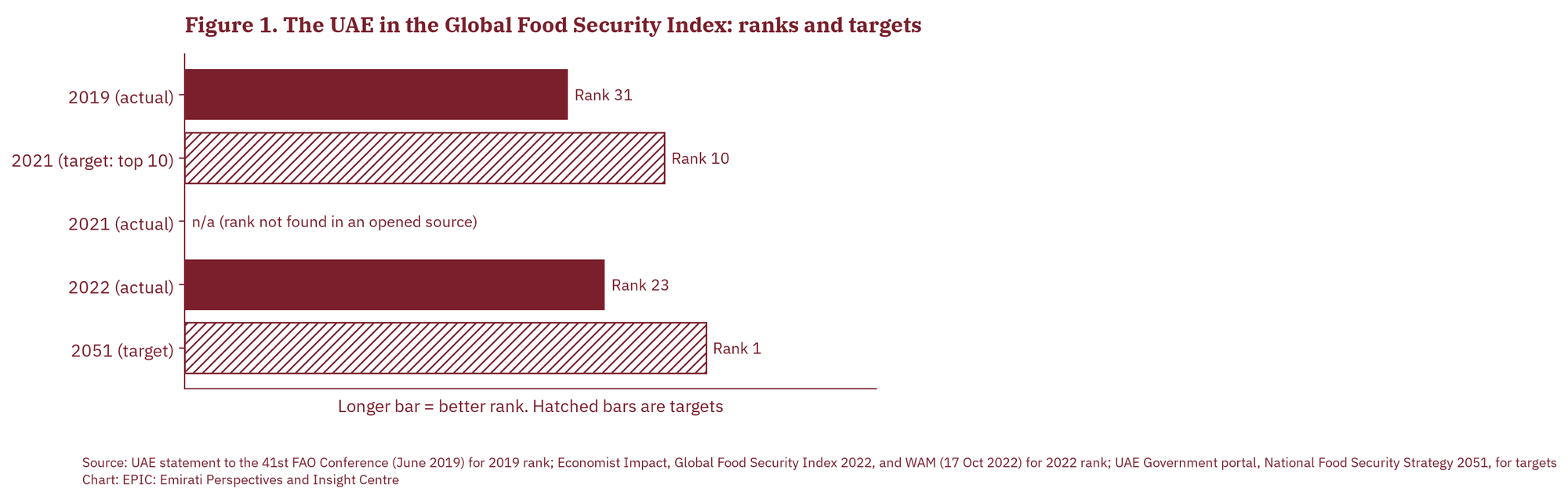
Two conclusions follow, as Figure 1 shows. The direction of travel is good: eight places gained in three years is a substantial move in an index of this kind. But the 2021 target of a top-ten place was not met. In 2022 the UAE remained 13 places outside the top ten. This paper did not find an opened source giving the UAE's 2021 rank, so it is marked n/a in the figure. On the most basic measure of hunger the position is strong: World Bank data put the prevalence of undernourishment in the UAE at 2.5 per cent or below in every year from 2020 to 2024, the lowest value the series reports (World Bank 2026i).
4. The import side of the arithmetic
4.1 How much food is imported
The "90 per cent" figure is an official estimate rather than a published statistical series, and the documents that cite it do not set out how it is calculated, for example whether it is measured by weight, by value or by calories. It should therefore be read as an order of magnitude. Independent data are consistent with it. National cereal production was 20,216 tonnes in 2024, according to World Bank data drawn from FAO (World Bank 2026d). With a population of 10.99 million that year (World Bank 2026e), domestic cereal output works out at about 1.8 kilograms per resident per year, a small fraction of any plausible cereal diet. Staple grains, in other words, are almost entirely imported.
4.2 Food in the import bill
A different picture emerges when food imports are measured by value. World Bank data show food accounting for 4.99 per cent of UAE merchandise imports in 2023, down from 7.31 per cent in 2018. That is far lower than in neighbouring Gulf states, where the share ranged from 11.2 per cent in Qatar to 17.1 per cent in Kuwait (World Bank 2026f), as Figure 2 shows.
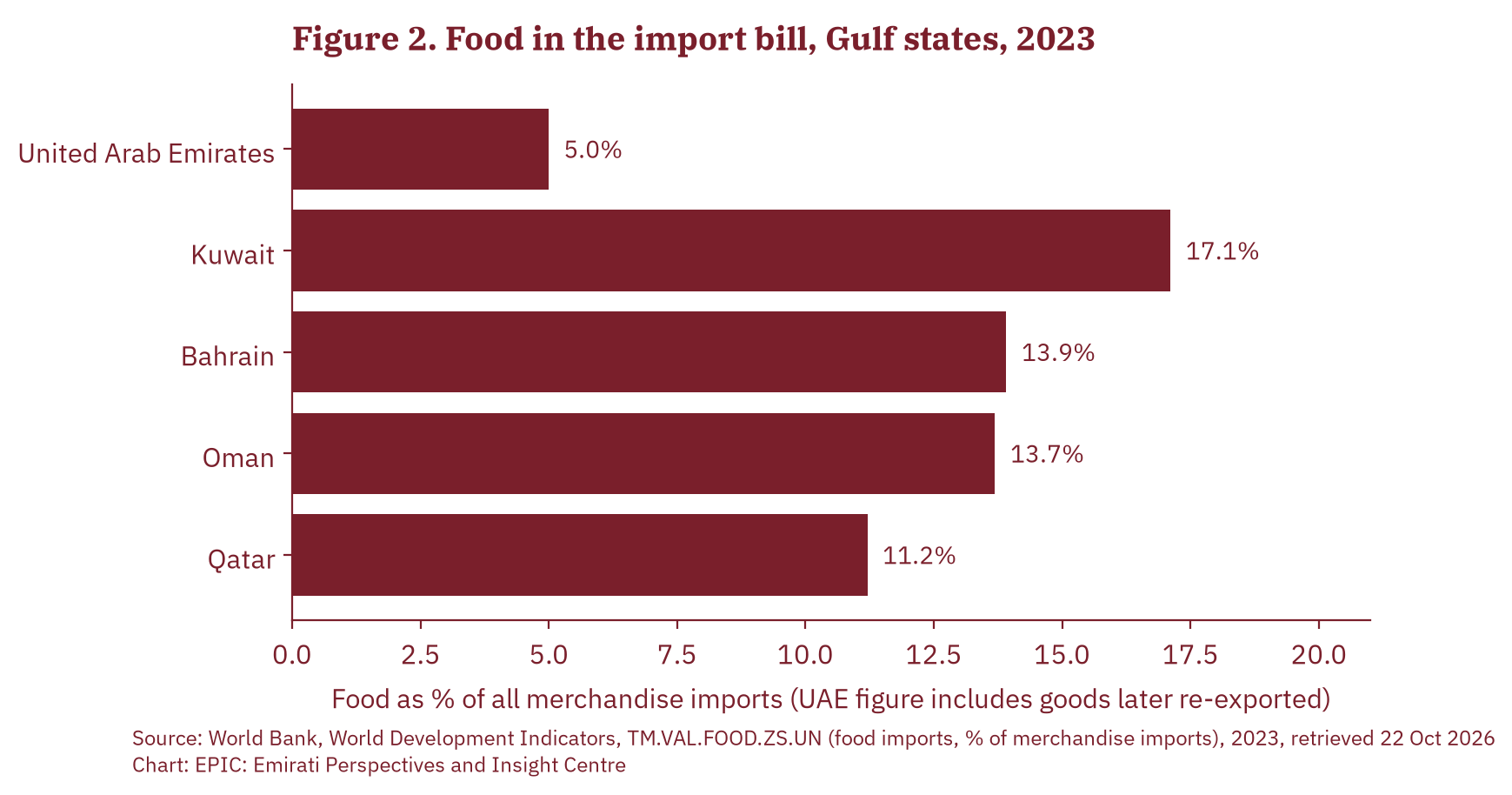
The low UAE share does not mean low dependence. It reflects the size of the UAE's total import bill, which includes a very large volume of goods that are later re-exported. Total merchandise imports were USD 470.5 billion in 2023 (World Bank 2026g). On those figures, food imports were worth roughly USD 23.5 billion that year, a derived estimate that should be treated with the same caution as the underlying data, since part of that food is itself re-exported to other markets. The point for policy is that food is a small share of a very large trading system. The UAE's food security therefore depends heavily on the health of its wider logistics and re-export economy, a theme taken up in EPIC's companion paper on maritime security.
4.3 Diversity of supply
The strategy's answer to import dependence is diversity: three to five alternative sources for each major food category (UAE Government 2024). In the 2026 crisis the Ministry of Economy and Tourism pointed to the same asset, describing "a broad network of trading partners worldwide" and plans "to diversify import sources and continuously open new markets" (WAM 2026a). This paper did not find a public dataset showing, for each item in the national food basket, how many sources are in active use and what share the largest supplier holds. Without that information, outside observers cannot judge how far the diversity target has been met.
5. Domestic production and its ceiling
5.1 Growth from a small base
Domestic food output has grown. The World Bank's food production index, which uses 2014–2016 as its base, rose from 98.4 in 2015 to 133.1 in 2024, an increase of about 35 per cent. Over the same period the population grew from 8.51 million to 10.99 million, an increase of about 29 per cent (World Bank 2026e; 2026h). Figure 3 compares the two.
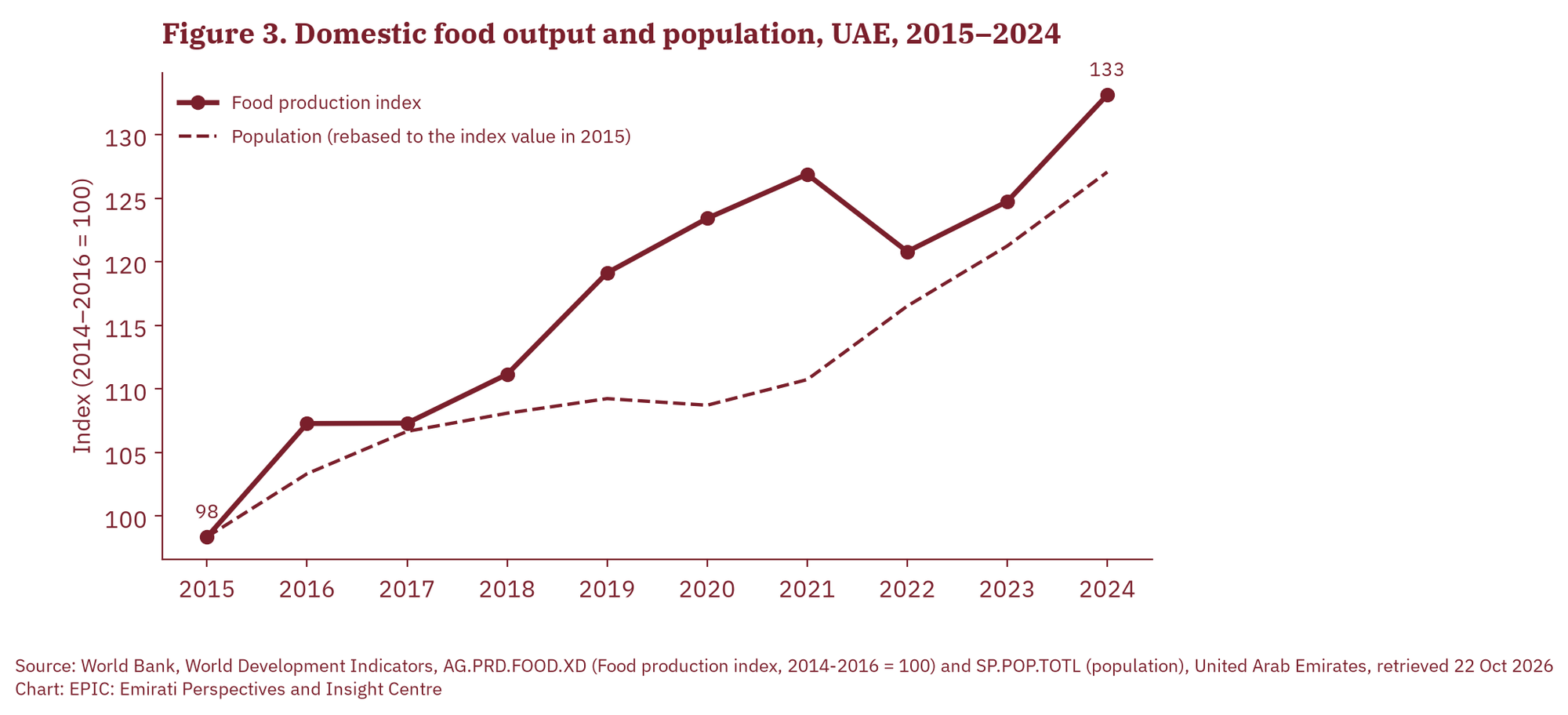
Output has therefore grown slightly faster than population, but not by enough to change the basic import arithmetic. The index also fluctuates: it fell from 126.9 in 2021 to 120.8 in 2022 before recovering. A growth path of this kind narrows the gap at the margin; it does not close it.
5.2 What controlled-environment agriculture can do
The strategy aims to make the UAE a hub for "Closed Environment Agriculture" and to launch an "Agriculture 4.0" programme to upgrade traditional farms with technology (UAE 2021). The best-documented example is Bustanica, a vertical farm near Al Maktoum International Airport in Dubai, opened in July 2022 by a joint venture of Emirates Flight Catering and Crop One. According to its operators, the 330,000 square foot facility cost USD 40 million, produces more than one million kilograms of leafy greens a year, or about three tonnes a day, and uses up to 95 per cent less water than outdoor farming: 15 litres per kilogram of produce against 317 litres (Emirates 2022a; 2022b).
These are real gains for the products concerned. Leafy greens are perishable, expensive to air-freight and vulnerable to supply interruptions, and a closed-loop system that uses a fraction of the water of open-field farming is well suited to a water-scarce country.
The arithmetic of scale is less encouraging. One million kilograms a year, shared across 10.99 million residents, is about 91 grams per person per year. By the operators' own figures, the largest facility of its kind supplies a useful but small slice of one food category. The crops grown are kale, spinach, rocket and mixed greens (Emirates 2022b), not the grains, oils, sugars and proteins that make up most calories. Even many facilities of this size would not alter the share of calories that must be imported.
This paper therefore treats controlled-environment agriculture as a tool for resilience in fresh produce, not as a route to self-sufficiency. A claim that technology will allow the UAE to grow most of its own food would require evidence that this paper did not find.
5.3 Waste as a source of supply
The third strategic direction, reducing food loss and waste, includes regulation for waste segregation and mandatory reporting of food loss and waste by organisations (UAE 2021). Food that is not wasted is food that does not have to be imported, so this direction belongs in the supply arithmetic. The pathway document sets out the indicator, the percentage reduction in food loss and waste, but this paper did not find a published baseline or current value for it.
6. Strategic reserves and the 2026 test
6.1 The legal framework
The UAE's main legal instrument for food stocks is Federal Law No. 3 of 2020 Regulating the Strategic Stock of Food Commodities in the State, issued on 30 March 2020 and in force from 1 April 2020 (UAE Legislation 2020). The law gives the Ministry of Economy responsibility for proposing policies, plans and programmes on the strategic stock, in coordination with the competent authorities. It applies to food providers, defined as producers or importers, and to registered vendors, and it defines a "safe stock" as a specified percentage below which the strategic stock must not fall. The National Emergency, Crisis and Disasters Management Authority is named in the law (UAE Legislation 2020).
The law sets the framework, but the quantities, the list of commodities and the safe-stock percentages are determined by ministerial decision. This paper did not find those values in an opened public source.
6.2 What the 2026 war revealed
On the day the regional war began, 28 February 2026, the Ministry of Economy and Tourism said that strategic reserves of essential commodities were "robust, comprehensive and diversified", that imports were proceeding normally and that it was monitoring stock levels held by suppliers and retailers through an electronic monitoring system (WAM 2026a). On 3 March 2026 the Minister of Economy and Tourism said that the strategic stockpile of essential commodities was sufficient to meet market needs for between four and six months, that reserves were distributed across the country, and that a digital platform tracked prices at 627 major retail outlets (Gulf News 2026).
Shipping through the Strait of Hormuz fell sharply from the start of March 2026. IMF PortWatch data, based on ships' automatic identification signals, show average recorded daily transits through the strait falling from 68 in January and February 2026 to fewer than 4 in October 2026 (IMF PortWatch 2026). These counts understate actual traffic, because many vessels have transited with transponders switched off (IEA 2026a), but the direction is not in doubt.
By July 2026 the Ministry described the measures it had taken: preventing increases in the prices of essential consumer goods or in transport and shipping costs without prior approval, speeding up customs clearance, providing regulatory flexibility for the entry of goods, and strengthening domestic road transport and the use of air freight (The National 2026). Retailers described longer and costlier supply chains. Cargo that would normally travel 40 to 50 kilometres by road from Jebel Ali was being rerouted through Khor Fakkan, with a trucking distance of about 150 kilometres, or through Salalah in Oman, more than 1,250 kilometres away. Dubai inflation reached 5.5 per cent in May 2026, driven by fuel, transport and imported food prices linked to the conflict (The National 2026).
The record so far supports a qualified conclusion. The system of reserves, monitoring and alternative routes kept shelves supplied, by the government's account and that of retailers, through more than seven months of severe disruption. But it did so at a cost: higher freight and insurance, longer lead times, some temporary gaps in specific products and higher consumer prices. Reserves bought time; they did not remove the exposure.
6.3 Inputs as well as food
The 2026 disruption also showed that food security depends on inputs that pass through the same sea lanes. Speaking in May 2026, ADNOC's leadership said that fertiliser prices were up 50 per cent and fuel prices up 30 per cent since the conflict began (WAM 2026b). These are global effects, but they reach UAE food prices through the cost of food produced abroad, and they raise the cost of domestic farming too.
7. Risks and limits
7.1 Concentration of routes
The UAE's main import gateways sit inside the Gulf. When the Strait of Hormuz is disrupted, the east-coast ports and overland routes become critical, and their capacity sets a limit on how much food can enter by other routes. The 2026 experience suggests the alternatives work, but at higher cost, and their full capacity has not been publicly documented.
7.2 The unpublished numbers
The strategy has key performance indicators, the law has safe-stock percentages and the government monitors stock levels daily, but the values are not published. There may be good reasons for confidentiality about some reserve quantities. Yet the result is that outside analysts, including EPIC, cannot assess how close the system is to its targets, or whether the "four to six months" of cover applies to all items in the national food basket or only to some.
7.3 A single headline measure
The strategy's headline target is a rank in an index produced by a private organisation. A rank is a useful benchmark, but it depends on the methodology and the set of countries included, and it can change for reasons unrelated to national policy. This paper did not find a more recent GFSI edition than 2022 in an opened source.
7.4 Self-sufficiency rhetoric
The data in Section 5 show that technology-led farming can improve supply in some categories but will not make the UAE self-sufficient in calories. Public discussion that implies otherwise risks misallocating capital and water.
8. Policy recommendations
1. Publish a food security dashboard. The UAE should publish, at least annually, the values of the key performance indicators already defined in the National Food Security Strategy 2051: reserve-target achievement, alternative-source coverage, food loss and waste, and the yield and production indicators. Where full figures are sensitive, ranges or indices would still allow progress to be tracked.
2. Define and publish the self-sufficiency measure. The "90 per cent" import figure should be replaced by a published, repeatable statistic, with the method stated: by weight, value or calories, and by food group. This would allow the effect of domestic production to be measured honestly over time.
3. Treat routes as part of the reserve. The 2026 crisis showed that east-coast ports, road corridors and air freight are as important as warehouse stocks. Planning for strategic food stocks should include the capacity of these alternative routes, tested through the emergency drills the strategy already envisages.
4. Target agricultural technology at perishables and water. Public support for controlled-environment agriculture should be aimed at products where it makes the strongest case: perishable, high-value produce with high air-freight costs, grown with far less water than open-field farming. It should not be justified by claims of calorie self-sufficiency.
5. Link food planning with water and energy planning. Every tonne of food grown domestically has a water and energy cost. Food production targets should be set together with groundwater and desalination plans, so that gains in food supply do not deepen the water imbalance described in EPIC's earlier paper.
6. Count inputs, not just food. Fertiliser, animal feed and packaging pass through the same supply chains as food. Reserve and diversification planning should cover these inputs explicitly.
9. Conclusion
The UAE's food security rests on a deliberate bargain: import most food, and make the import system resilient through trade partnerships, logistics, reserves and monitoring. The data show that this bargain has largely worked. The country rose in the international index, undernourishment is very low, and the system carried the population through the severe disruption of 2026. The same data show its limits. Domestic production, including the most advanced forms of farming, can improve supply at the margin but cannot change the basic arithmetic for staple foods. The protections that matter most are routes, reserves and transparency. The strongest single step the UAE could take now is to publish the measures it already collects, so that progress towards the 2051 vision can be tracked in the open.
References
Economist Impact. 2022. Global Food Security Index 2022. London: Economist Impact. https://impact.economist.com/sustainability/project/food-security-index/.
Emirates. 2022a. "Emirates Flight Catering Opens World's Largest Vertical Farm in Dubai." Media release, 18 July 2022. https://www.emirates.com/media-centre/emirates-flight-catering-opens-worlds-largest-vertical-farm-in-dubai/.
Emirates. 2022b. "Bustanica Fact Sheet." Emirates Media Centre. https://www.emirates.com/media-centre/download/1216756/bustanicafactsheet-2.pdf.
EPIC Research Team. 2026. The Desalinated State: Seawater, Groundwater and the UAE's Water Security to 2036. EPIC-PP-2026-017. EPIC: Emirati Perspectives and Insight Centre.
Gulf News. 2026. "UAE Says Strategic Food Stock Sufficient for 4 to 6 Months." 3 March 2026. https://gulfnews.com/business/retail/uae-says-strategic-food-stock-sufficient-for-4-to-6-months-1.500462161.
IEA (International Energy Agency). 2026a. "Middle East Maritime Chokepoints Shipping Monitor." Last updated 7 October 2026. https://www.iea.org/data-and-statistics/data-tools/middle-east-maritime-chokepoints-shipping-monitor.
IMF PortWatch. 2026. "Daily Chokepoints Data." International Monetary Fund. Retrieved 22 October 2026. https://portwatch.imf.org/.
The National. 2026. "UAE Food Stocks Will Not Be Compromised by Conflict, Economy Ministry Says." 19 July 2026. https://www.thenationalnews.com/news/uae/2026/07/19/uae-price-rise-supermarkets/.
UAE (United Arab Emirates). 2019. Statement to the 41st Session of the FAO Conference, June 2019. https://www.fao.org/docs/governingbodieslibraries/fao-conference/c-2019/united-arab-emirates.pdf.
UAE (United Arab Emirates). 2021. "Articulating National Pathways for Food Systems Transformation in Support of the 2030 Agenda: United Arab Emirates." UN Food Systems Summit, September 2021. https://www.unfoodsystemshub.org/docs/unfoodsystemslibraries/national-pathways/united-arab-emirates/2021-09-17-en-uae-national-pathways_final.pdf.
UAE Government. 2024. "National Food Security Strategy 2051." The Official Portal of the UAE Government, updated 30 December 2024. https://u.ae/en/about-the-uae/strategies-initiatives-and-awards/strategies-plans-and-visions/environment-and-energy/national-food-security-strategy-2051.
UAE Legislation. 2020. "Federal Law No. (3) of 2020 Regulating the Strategic Stock of Food Commodities in the State." https://uaelegislation.gov.ae/en/legislations/1976.
WAM (Emirates News Agency). 2021. "Ensuring Availability of Food, Water at All Times Is My Mission: Minister." 10 March 2021. https://www.wam.ae/en/article/hszrbx37-ensuring-availability-food-water-all-times-mission.
WAM (Emirates News Agency). 2022. "UAE Tops MENA Region in Global Food Security Index 2022." 17 October 2022. https://www.wam.ae/en/article/hszrfogt-uae-tops-mena-region-global-food-security-index.
WAM (Emirates News Agency). 2026a. "Ministry of Economy & Tourism Affirms Ample Supplies, Market Stability." 28 February 2026. https://www.wam.ae/en/article/byyv9xd-ministry-economy-tourism-affirms-ample-supplies.
WAM (Emirates News Agency). 2026b. "New Investment, AI, Freedom of Navigation Key to Building Resilient Energy System." 20 May 2026. https://www.wam.ae/en/article/c0b3eaf-new-investment-ai-freedom-navigation-key-building.
World Bank. 2026a. "Arable Land (% of Land Area)" (AG.LND.ARBL.ZS). World Development Indicators. Retrieved 22 October 2026.
World Bank. 2026b. "Agricultural Land (% of Land Area)" (AG.LND.AGRI.ZS). World Development Indicators. Retrieved 22 October 2026.
World Bank. 2026c. "Agriculture, Forestry, and Fishing, Value Added (% of GDP)" (NV.AGR.TOTL.ZS). World Development Indicators. Retrieved 22 October 2026.
World Bank. 2026d. "Cereal Production (Metric Tons)" (AG.PRD.CREL.MT). World Development Indicators. Retrieved 22 October 2026.
World Bank. 2026e. "Population, Total" (SP.POP.TOTL). World Development Indicators. Retrieved 22 October 2026.
World Bank. 2026f. "Food Imports (% of Merchandise Imports)" (TM.VAL.FOOD.ZS.UN). World Development Indicators. Retrieved 22 October 2026.
World Bank. 2026g. "Merchandise Imports (Current US$)" (TM.VAL.MRCH.CD.WT). World Development Indicators. Retrieved 22 October 2026.
World Bank. 2026h. "Food Production Index (2014–2016 = 100)" (AG.PRD.FOOD.XD). World Development Indicators. Retrieved 22 October 2026.
World Bank. 2026i. "Prevalence of Undernourishment (% of Population)" (SN.ITK.DEFC.ZS). World Development Indicators. Retrieved 22 October 2026.
Sources and verification notes
Sources and verification notes: "Imported Plates"
All sources were retrieved and checked on 22 October 2026 (Asia/Dubai, UTC+4). Verdicts use the four house categories: correct, needs correction, unverifiable and mixed. Local copies are kept in research/epic-new/_data/food/ (World Bank API JSON files, pathways.pdf/txt, fao2019.pdf/txt).
| # | Claim in paper | Source checked | Verdict | Action |
|---|---|---|---|---|
| 1 | UAE told FAO in 2019 it imports 90% of food, very little arable land, ranked 31st in GFSI, liable to disruption | UAE statement to 41st FAO Conference (local fao2019.txt) | Correct | Kept |
| 2 | "Still imports up to 90 percent of its food needs"; top date exporter | WAM, 10 Mar 2021 | Correct | Kept; minister referred to by title only |
| 3 | Pathway document: >90% imported; 0.5% arable; ~100 mm rain; five strategic directions, KPIs, CEA hub, Agriculture 4.0, reserves of food, fodder and water, waste reporting | UAE national pathways (2021), local pathways.txt | Correct | Kept |
| 4 | Arable land 0.79% (2024), 0.63% (2016); agricultural land ~5.6% | World Bank WDI AG.LND.ARBL.ZS, AG.LND.AGRI.ZS | Correct | Kept |
| 5 | Agriculture 0.77% of GDP (2024) | World Bank WDI NV.AGR.TOTL.ZS (0.769) | Correct | Kept |
| 6 | Strategy aims: best in GFSI by 2051, top 10 by 2021; 18 food types; 38 initiatives; 5 goals; 3–5 sources per category | UAE Government portal, NFSS 2051 page | Correct | Kept |
| 7 | Strategy launched November 2018 | Oxford Business Group (search snippet only; page timed out) | Unverifiable | Removed with its reference |
| 8 | GFSI 2022: 23rd of 113, 75.2; up from 71 in 2021; 7th availability, 16th quality and safety; first in MENA | WAM, 17 Oct 2022; Economist Impact GFSI 2022 report table | Correct | Kept |
| 9 | 2021 GFSI rank | No opened source | Unverifiable | Shown as n/a in Figure 1 |
| 10 | Undernourishment ≤2.5% in 2020–2024 (series floor) | World Bank WDI SN.ITK.DEFC.ZS | Correct | Kept, floor explained |
| 11 | Cereal production 20,216 t (2024); population 10.99 m; ~1.8 kg per resident | World Bank WDI AG.PRD.CREL.MT, SP.POP.TOTL; derived | Correct | Kept, marked as derived |
| 12 | Food 4.99% of merchandise imports (2023), 7.31% (2018); Qatar 11.2%, Kuwait 17.1% | World Bank WDI TM.VAL.FOOD.ZS.UN | Correct | Kept |
| 13 | Merchandise imports USD 470.5 bn (2023); food imports ~USD 23.5 bn | World Bank WDI TM.VAL.MRCH.CD.WT; derived | Mixed | Kept as derived estimate with re-export caveat |
| 14 | Food production index 98.4 (2015) → 133.1 (2024), +35%; population +29%; dip 126.9 → 120.8 (2021–22) | World Bank WDI AG.PRD.FOOD.XD, SP.POP.TOTL | Correct | Kept |
| 15 | Bustanica: July 2022, 330,000 sq ft, USD 40 m, >1 m kg/yr, ~3 t/day, 95% less water, 15 vs 317 L/kg; crops kale, spinach, rocket, mixed greens | Emirates media release (18 Jul 2022); Bustanica fact sheet | Correct | Kept, attributed to operators |
| 16 | ~91 g per resident per year | Derived: 1,000,000 kg / 10,986,400 | Correct | Kept, marked as derived |
| 17 | Federal Law No. 3 of 2020: issued 30 Mar 2020, effective 1 Apr 2020; Ministry of Economy competences; providers and registered vendors; safe stock definition; NCEMA named | uaelegislation.gov.ae/en/legislations/1976 | Correct | Kept |
| 18 | Law issued "in the first weeks of the COVID-19 pandemic" | No source attached | Unverifiable | Removed |
| 19 | 28 Feb 2026 ministry statement: reserves robust, imports normal, electronic monitoring | WAM, 28 Feb 2026 | Correct | Kept |
| 20 | 3 Mar 2026: stockpile covers 4–6 months; reserves distributed; 627 outlets on price platform | Gulf News, 3 Mar 2026 | Correct | Kept; minister referred to by title only |
| 21 | Hormuz transits 68/day (Jan–Feb 2026) to <4/day (Oct 2026); AIS understates | IMF PortWatch daily data (local CSV); IEA monitor | Correct | Kept, caveat stated |
| 22 | July 2026 ministry measures; Jebel Ali 40–50 km, Khor Fakkan ~150 km, Salalah >1,250 km; Dubai inflation 5.5% (May 2026) | The National, 19 Jul 2026 | Correct | Kept; a third rerouting example in the article was not used |
| 23 | Fertiliser +50%, fuel +30% since conflict began | WAM, 20 May 2026 (ADNOC statement) | Correct | Kept, attributed |
| 24 | No GFSI edition after 2022 found | Search on 22 Oct 2026 | Mixed | Worded as "did not find", not as a fact |
Figures. Figure 1 from the FAO 2019 statement, WAM 2022 and Economist Impact 2022 (ranks) and the UAE Government portal (targets), fig1_gfsi_rank.csv; the 2021 actual rank is n/a because no opened source gives it. Figure 2 from World Bank WDI TM.VAL.FOOD.ZS.UN (fig2_food_import_share.csv). Figure 3 from World Bank WDI AG.PRD.FOOD.XD and SP.POP.TOTL (fig3_food_production_index.csv); the population line is rebased to the 2015 index value and is labelled as such.
Summary. 24 items checked: 19 correct, 0 needs correction, 2 mixed, 3 unverifiable (two removed, one shown as n/a), plus 2 derived figures (correct).
Corrections applied. Item 7 and its reference removed; item 18 removed; item 9 shown as n/a; item 13 caveated. No [UNVERIFIED] items remain.