
 Emirati Perspectives and Insight Centre
Full text
1. Introduction
Space programmes are usually justified in three ways: as science, as industry and as national statement. The UAE programme is unusual in stating all three openly. This paper asks what the programme has achieved against each, and what will decide its value over the next decade.
Section 2 describes the institutions. Section 3 sets out the record of missions. Section 4 examines the partnership model. Section 5 discusses the economic ambition, and Section 6 the risks. Section 7 sets out recommendations.
2. Institutions
The UAE Space Agency was created under Federal Law by Decree No. 1 of 2014. It reports to the Council of Ministers and has financial and administrative independence. Its role is to develop the national space sector, set strategy and build partnerships.
Alongside it, the Mohammed bin Rashid Space Centre (MBRSC) in Dubai designs and operates satellites, runs the UAE Astronaut Programme and led the Mars and lunar missions. It grew out of the Emirates Institution for Advanced Science and Technology, launched in February 2006, which was merged into MBRSC in April 2015.
The division of labour, a federal agency for policy and funding and an emirate-level centre for engineering and operations, has allowed the programme to combine national strategy with a concentrated technical team.
3. The record of missions
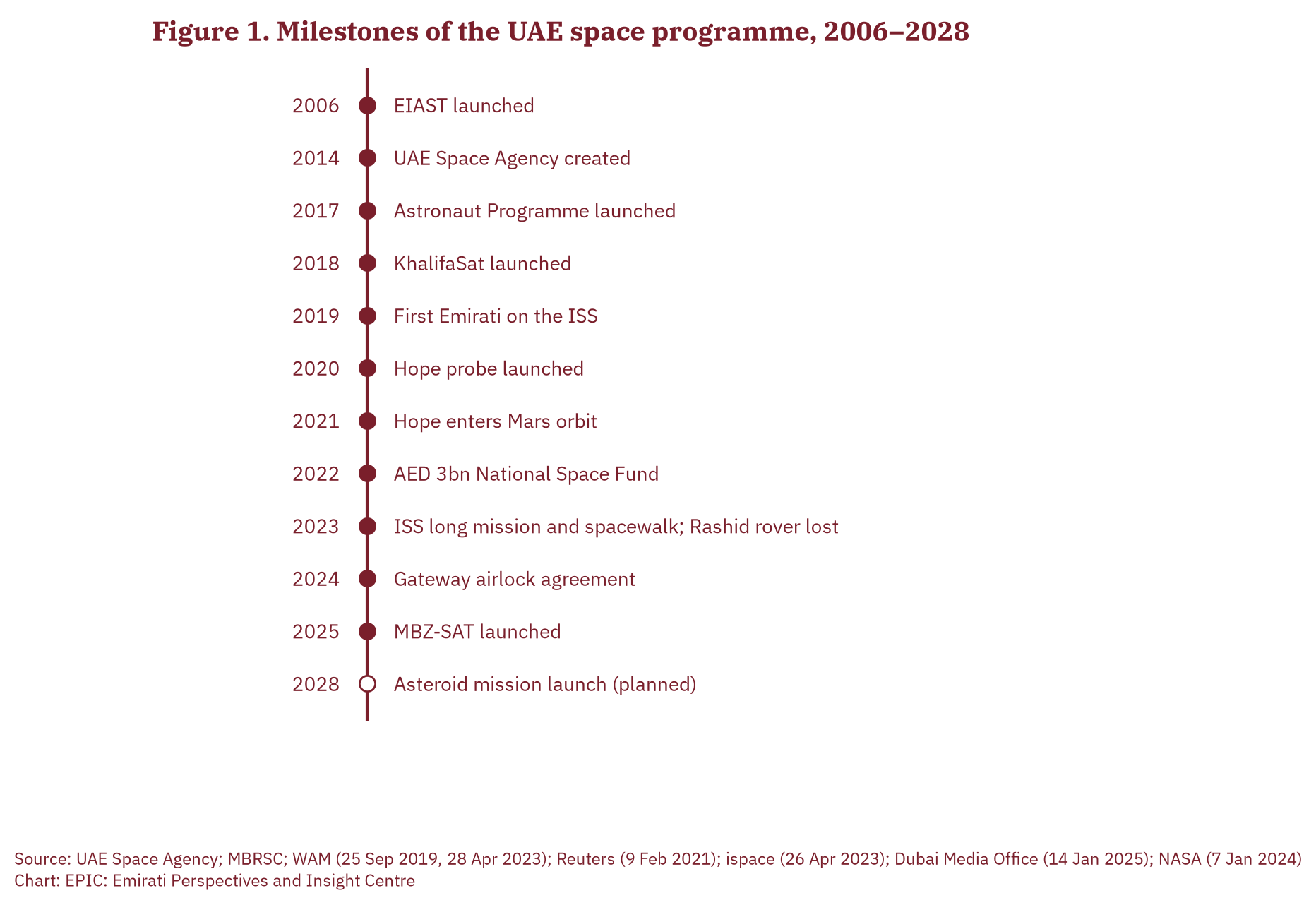
Figure 1 summarises the main milestones.
Satellites. MBRSC lists seven satellites in its development programme, from DubaiSat-1 and DubaiSat-2 to KhalifaSat, launched in 2018 as the first satellite designed and built entirely in the UAE, and MBZ-SAT. MBZ-SAT was launched on a SpaceX Falcon 9 from Vandenberg in California on 14 January 2025. It weighs 750 kilograms and, according to the Dubai Media Office, was developed entirely by Emirati engineers.
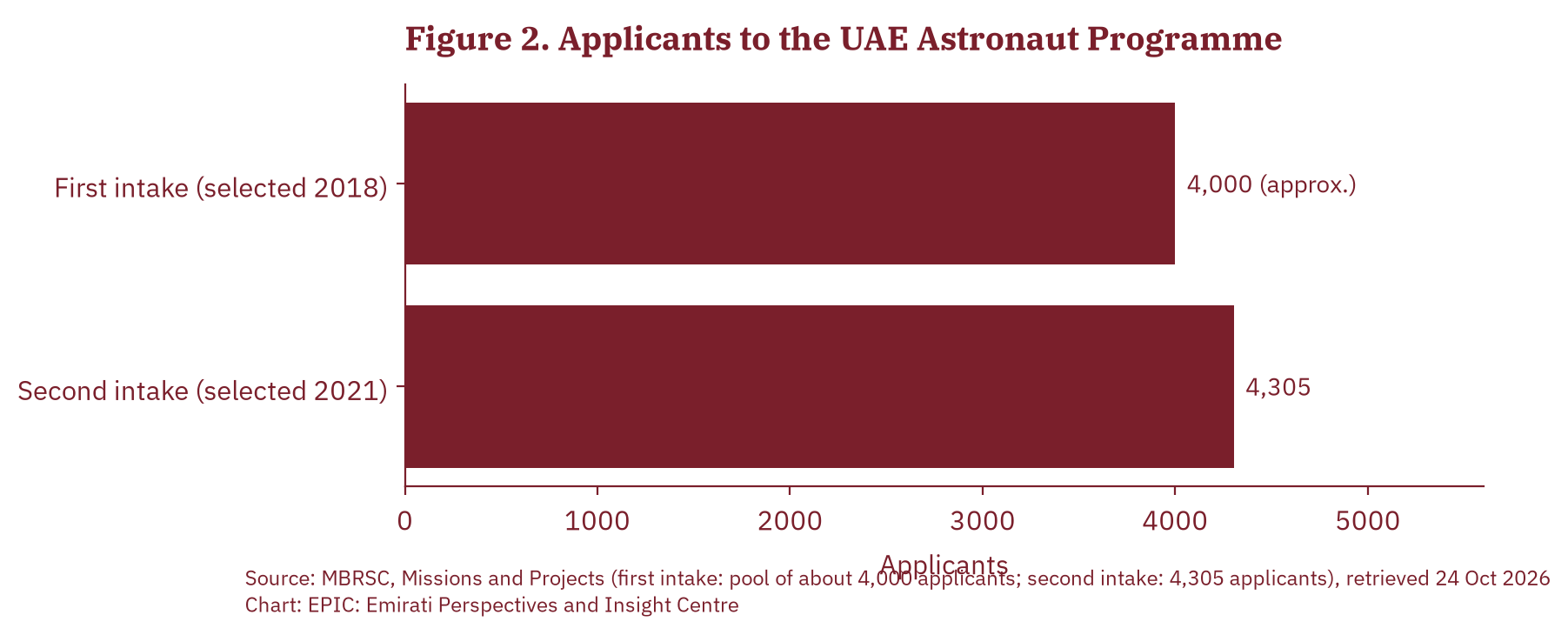
Human spaceflight. The UAE Astronaut Programme was launched in April 2017. Its first two astronauts were selected in 2018 from a pool of about 4,000 applicants, and a second pair, including the first Arab woman astronaut, in 2021 from 4,305 applicants (Figure 2). On 25 September 2019 Hazzaa AlMansoori flew on Soyuz MS-15 from Baikonur, becoming the first Emirati in space; during his mission he carried out 31 scientific experiments. In 2023 Sultan AlNeyadi spent six months on the ISS as part of Expedition 69, the longest Arab space mission, and on 28 April 2023 completed a spacewalk lasting 7.01 hours, the first by an Arab astronaut. MBRSC states that the mission made the UAE the 11th country to send astronauts on long-duration missions to the ISS.
Mars. The Emirates Mars Mission, the Hope probe, was launched from Tanegashima in Japan on 20 July 2020 and entered orbit around Mars on 9 February 2021 after a journey of about 494 million kilometres. The UAE became the first Arab country and the fifth country to reach Mars. In 2023 the probe's orbit was altered to allow observations of the small Martian moon Deimos.
The Moon. The Rashid rover, a compact rover of about 10 kilograms built by MBRSC, travelled to the Moon aboard the HAKUTO-R Mission 1 lander of the Japanese company ispace. On 26 April 2023 ispace lost communication with the lander shortly after its scheduled touchdown. MBRSC stated that the rover could not continue its mission, while noting that it had become the first Emirati and Arab mission to enter lunar orbit. A successor, Rashid 2, has since been announced.
4. The partnership model
Every major UAE mission has relied on foreign partners for launch and, in the early years, for engineering. KhalifaSat and the Hope probe were launched by Mitsubishi Heavy Industries, which in October 2024 signed a third launch agreement with the UAE Space Agency, for the asteroid mission. Human spaceflight has relied on Russian, US and commercial partners. The lunar rover flew on a Japanese commercial lander.
This model trades independence for speed. Its logic is visible in the progression from satellites built with foreign partners to MBZ-SAT, described as fully developed by Emirati engineers. It is also visible in the January 2024 agreement under which MBRSC will provide the Crew and Science Airlock module for Gateway, the planned station in lunar orbit under NASA's Artemis programme, and NASA will fly a UAE astronaut to Gateway on a future Artemis mission. Under that arrangement MBRSC will also provide engineering support for the life of the station.
The Rashid rover shows the other side of the model: when a partner's system fails, the national payload fails with it, however well it was built.
5. From prestige to a space economy
The programme now aims explicitly at a commercial sector.
In July 2022 the UAE Space Agency announced an AED 3 billion National Space Fund to support space engineering, science and research, attract start-ups and build partnerships between national and international companies. Its first named project was Sirb, a constellation of synthetic aperture radar satellites.
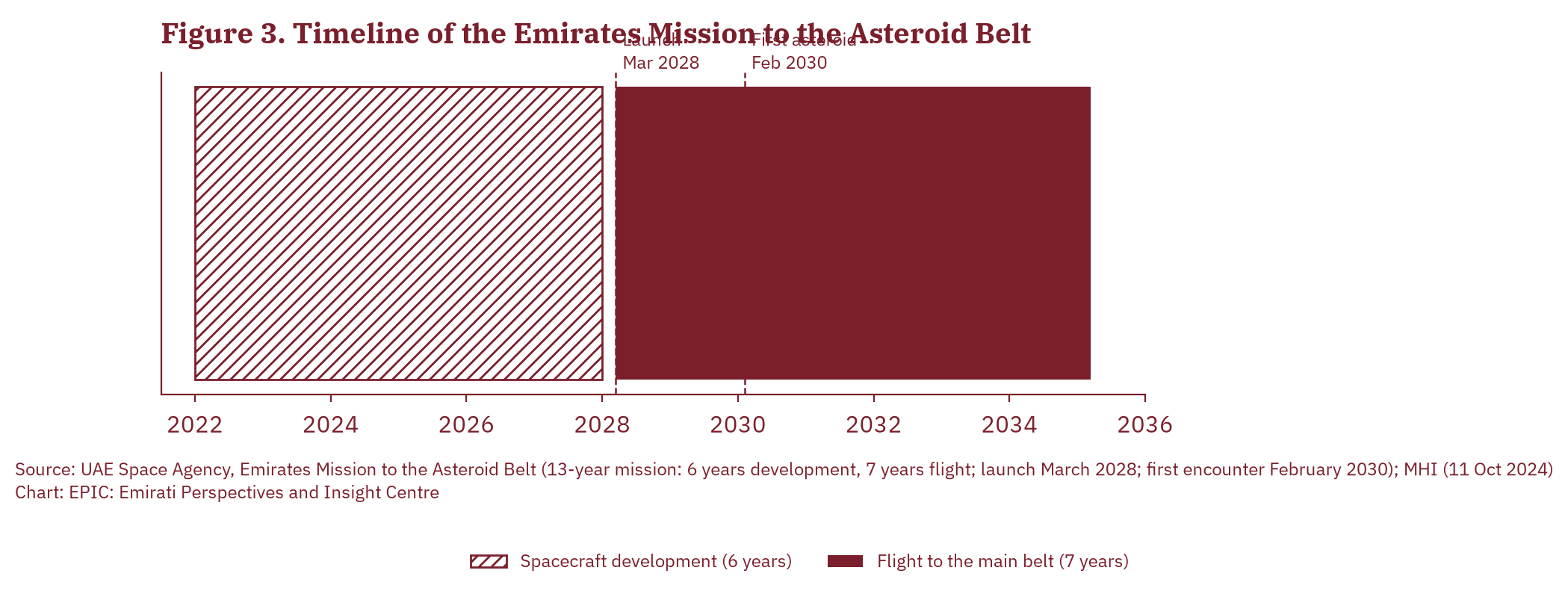
The flagship of the next phase is the Emirates Mission to the Asteroid Belt. According to the UAE Space Agency, its spacecraft, the MBR Explorer, is scheduled to launch in March 2028 on a journey of about 5 billion kilometres, using gravity assists around Venus, Earth and Mars, to fly past seven main-belt asteroids. The first encounter is expected in February 2030. Mitsubishi Heavy Industries states that the mission will end with a landing on the seventh asteroid, Justicia. The mission spans thirteen years, six of spacecraft development and seven of flight (Figure 3). The agency has allocated 50 per cent of the project's work to UAE-based private companies.
The national industrial strategy lists space technology among the industries of the future it seeks to develop, which places the space programme inside the wider effort at economic diversification.
6. Risks and open questions
Technical risk. The asteroid mission is far more complex than Hope: a longer flight, multiple flybys and a landing. Its schedule leaves little room for delay before the 2028 launch window.
Measurement. Public sources describe inputs and milestones well, but not outcomes. The number of Emiratis employed in the space sector, the revenue of UAE space companies and the value of contracts placed under the 50 per cent rule were not found in an opened official source for this paper.
Risk tolerance. The loss of Rashid was handled openly, and a successor was announced. A programme that attempts difficult missions will have further failures; the public framing of risk matters to its sustainability.
7. Recommendations
- Publish an annual space sector report. It should include employment, company revenues, National Space Fund commitments and contracts awarded to UAE companies.
- Report the 50 per cent rule transparently. Disclose the value and type of work placed with UAE-based firms under the asteroid mission.
- Maximise the use of mission data. Continue open release of Hope and future mission data and link it to university research and teaching.
- Build launch and lander redundancy into planning. Where possible, design national payloads so that a partner failure does not end a whole mission line.
- Frame failure as part of the programme. Set public expectations that ambitious missions carry risk.
8. Conclusion
The UAE space programme has delivered a sequence of genuine firsts with remarkable speed. Its next decade will be judged less by firsts than by whether it builds a durable industrial and scientific base. The asteroid mission is both its greatest technical test and the clearest test of that wider ambition.
About this paper
EPIC-PP-2026-023. Written by the EPIC Research Team. All data are cited to public sources listed in the references; where no published value exists, the paper says so.
References
- Dubai Media Office (2025). "MBRSC announces the successful launch of MBZ-SAT, the most advanced satellite in the region", 14 January 2025.
- Emirates News Agency (WAM) (2019). "International Space Station mission carrying first Emirati astronaut launched successfully", 25 September 2019.
- Emirates News Agency (WAM) (2023). "Sultan AlNeyadi makes history as the first Arab astronaut to complete a spacewalk on the ISS", 28 April 2023.
- Emirates News Agency (WAM) (2023). "Mohammed bin Rashid visits MBRSC, announces Rashid 2 new Emirati lunar mission".
- ispace (2023). "Status Update on ispace HAKUTO-R Mission 1 Lunar Lander", 26 April 2023.
- Mitsubishi Heavy Industries (2024). "UAE to partner with Mitsubishi Heavy Industries again for next Emirati national mission", 11 October 2024.
- Mohammed bin Rashid Space Centre. "About"; "Missions and Projects". https://www.mbrsc.ae/
- Mohammed bin Rashid Space Centre (2023). Official announcement on the Emirates Lunar Mission "Rashid Rover", 26 April 2023.
- NASA (2024). "NASA, United Arab Emirates Announce Artemis Lunar Gateway Airlock", 7 January 2024.
- Reuters (2021). "UAE's Hope Probe enters orbit in first Arab Mars mission", 9 February 2021.
- TechCrunch (2022). "United Arab Emirates launches $820M fund to boost space economy", 18 July 2022.
- The National (2023). "Lunar landing and spacewalk: UAE's busiest week yet in space exploration", 23 April 2023.
- The National (2024). "UAE marks three years since Hope probe reached Mars orbit", 9 February 2024.
- UAE Government portal. "Operation 300bn, the UAE's industrial strategy". https://u.ae/
- UAE Space Agency. "About Us"; "History of UAE Space Sector"; "National Space Fund"; "Emirates Mission to the Asteroid Belt". https://space.gov.ae/
Sources and verification notes
Sources and verification notes: "From Hope to the Asteroid Belt"
All sources were retrieved and checked on 24 October 2026 (Asia/Dubai, UTC+4). Verdicts use the four house categories: correct, needs correction, unverifiable and mixed.
| # | Claim in paper | Source checked | Verdict | Action |
|---|---|---|---|---|
| 1 | UAE Space Agency created under Federal Law by Decree No. 1 of 2014; financial and administrative independence | UAE Space Agency, About Us | Correct | Kept |
| 2 | EIAST launched Feb 2006, merged into MBRSC April 2015 | UAE Space Agency, History | Correct | Kept |
| 3 | Seven satellites in MBRSC programme incl. DubaiSat-1/2, KhalifaSat, MBZ-SAT | MBRSC, Missions and Projects | Correct | Kept |
| 4 | KhalifaSat launched 2018, first satellite designed and built entirely in UAE | TechCrunch 18 Jul 2022; MHI 11 Oct 2024 | Correct | Kept |
| 5 | MBZ-SAT launched 14 Jan 2025, Falcon 9, Vandenberg, 750 kg, developed entirely by Emirati engineers | Dubai Media Office 14 Jan 2025 | Correct | Kept, attributed |
| 6 | Astronaut Programme launched April 2017 | MBRSC; WAM 25 Sep 2019 | Correct | Kept |
| 7 | First intake 2018 from about 4,000 applicants; second 2021 from 4,305, incl. first Arab woman astronaut | MBRSC (WAM gives 4,020 others plus the two selected) | Mixed | Kept as "about 4,000"; chart marked approx. |
| 8 | AlMansoori, Soyuz MS-15, 25 Sep 2019, first Emirati in space; 31 experiments | WAM 25 Sep 2019; MBRSC | Correct | Kept |
| 9 | AlNeyadi six months, Expedition 69; spacewalk 28 Apr 2023, 7.01 hours, first Arab | WAM 28 Apr 2023; MBRSC | Correct | Kept |
| 10 | UAE 11th country with long-duration ISS missions | MBRSC About | Correct | Kept, attributed to MBRSC |
| 11 | Hope launched Tanegashima 20 Jul 2020; Mars orbit 9 Feb 2021; ~494m km; first Arab, fifth country | Reuters 9 Feb 2021; The National 9 Feb 2024; MBRSC | Correct | Kept |
| 12 | Hope orbit changed in 2023 to observe Deimos | The National 9 Feb 2024 | Correct | Kept |
| 13 | Rashid ~10 kg; on ispace HAKUTO-R M1; contact lost 26 Apr 2023; MBRSC statement on lunar orbit | The National 23 Apr 2023; ispace 26 Apr 2023; MBRSC 26 Apr 2023 | Correct | Kept |
| 14 | Rashid 2 announced | WAM | Correct | Kept, undated (date not confirmed) |
| 15 | MHI launched KhalifaSat and Hope; third agreement Oct 2024 for EMA | MHI 11 Oct 2024 | Correct | Kept |
| 16 | Gateway Crew and Science Airlock, UAE astronaut on future Artemis mission, engineering support (Jan 2024) | NASA 7 Jan 2024 | Correct | Kept |
| 17 | AED 3bn National Space Fund (July 2022); first project Sirb SAR constellation | UAE Space Agency; TechCrunch 18 Jul 2022 | Correct | Kept |
| 18 | EMA: launch March 2028; ~5bn km; Venus/Earth/Mars assists; seven asteroids; first encounter Feb 2030; 13 years (6+7); 50% of work to UAE firms | UAE Space Agency EMA page | Correct | Kept |
| 19 | Landing on seventh asteroid, Justicia | MHI 11 Oct 2024 | Correct | Kept, attributed to MHI |
| 20 | Space technology among industries of the future in industrial strategy | u.ae Operation 300bn | Correct | Kept |
| 21 | Space sector employment, revenues, contract values | No official figures found | Unverifiable | Not stated; recorded as a gap |
| 22 | UAE space programme budget total since 2014 (drafted as a figure) | No official source opened | Unverifiable | Dropped |
Totals: 22 claims checked: 19 correct, 0 needs correction, 2 unverifiable (not used), 1 mixed (reworded).