
 Emirati Perspectives and Insight Centre
Full text
1. Introduction
Heat is a direct threat to health. The World Health Organization (WHO) states that studies show approximately 489,000 heat-related deaths a year worldwide between 2000 and 2019, with 45 per cent of these in Asia and 36 per cent in Europe (WHO 2024). In the Gulf, high temperatures combine with high humidity on the coast, which makes it harder for the body to cool itself by sweating.
The paper asks how serious the heat-health risk is in Gulf cities and what states have done about it, both through rules for outdoor workers and through the design of the built environment. It then asks what the evidence says about whether these measures work. Section 2 sets out the risk. Section 3 compares outdoor work rules across the GCC. Section 4 reviews the health evidence. Section 5 considers mass gatherings and the 2024 Hajj. Section 6 covers urban cooling. Sections 7 to 9 set out gaps, recommendations and a closing assessment. The paper uses only published sources: ministerial decisions, official announcements, ILO and WHO material, legal guidance and peer-reviewed research.
2. The scale of the risk
2.1 Climate
The physiological limit that matters is the wet-bulb temperature, a combined measure of heat and humidity. A peer-reviewed study in Nature Climate Change notes that a fit human can lose heat through perspiration provided the wet-bulb temperature remains below a threshold of 35°C, that this threshold defines a limit of survivability under well-ventilated outdoor conditions, and that it is lower for most people. Using an ensemble of high-resolution regional climate models, the authors projected that extremes of wet-bulb temperature in the region around the Arabian Gulf are likely to approach and exceed this threshold in the future under a business-as-usual emissions scenario (Pal and Eltahir 2016). The finding is a projection for the future under high emissions. Its policy relevance lies in the direction of travel: adaptation in the Gulf is a long-term task, and today's rules set the base on which later measures will be built.
2.2 Workers
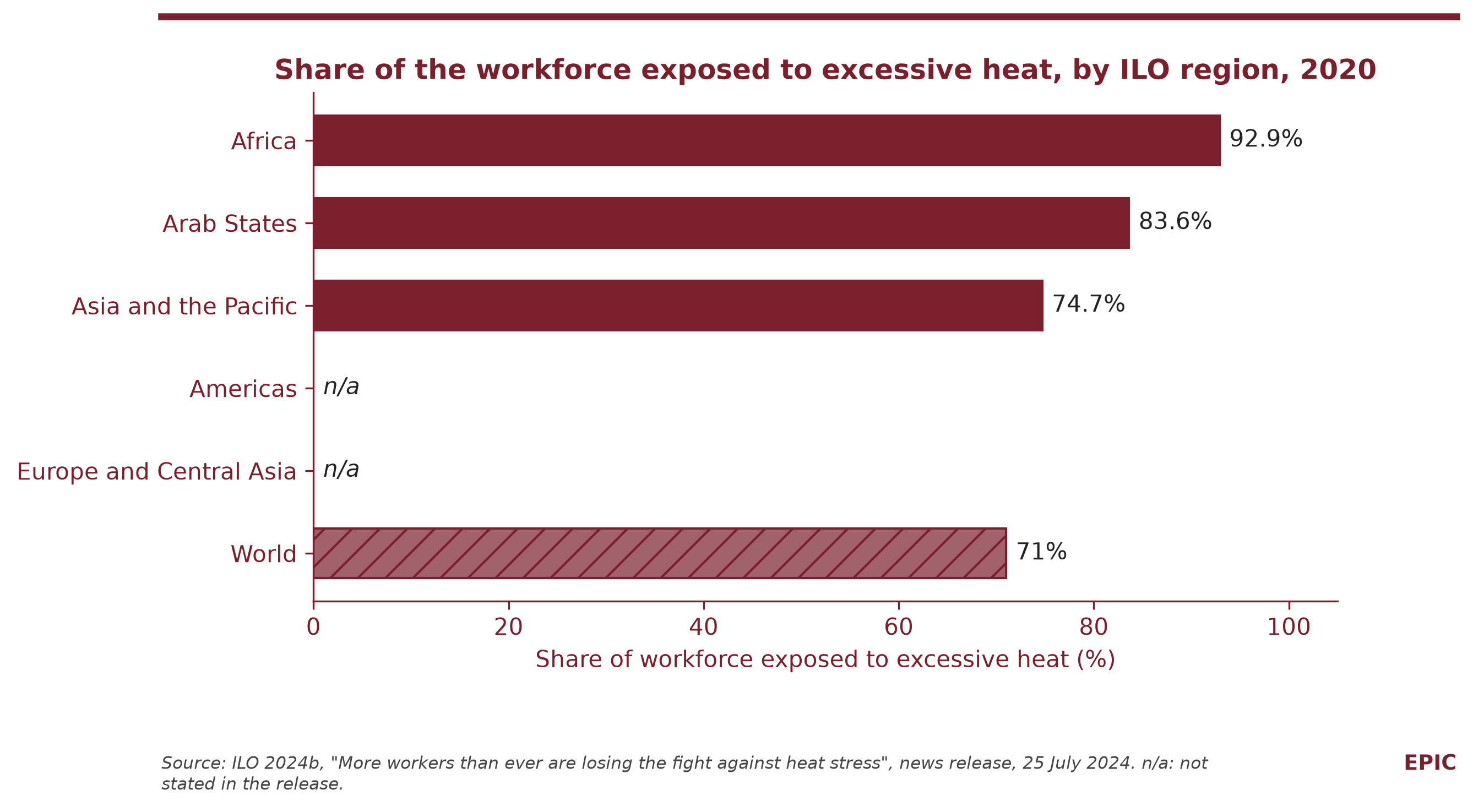
The ILO's 2024 report on safety and health in a changing climate estimates that at least 2.41 billion workers are exposed to excessive heat, and that excessive heat causes 22.85 million occupational injuries and 18,970 work-related deaths each year (ILO 2024a). Its regional figures for 2020 show that 92.9 per cent of the workforce in Africa, 83.6 per cent in the Arab States and 74.7 per cent in Asia and the Pacific are exposed, against a global average of 71 per cent (ILO 2024b). The ILO's Arab States region includes the GCC. The ILO also stresses that nine out of ten workers globally were exposed to excessive heat outside a heatwave (ILO 2024b). In the Gulf this means heat is a routine feature of every summer working day, with heatwaves adding to an already high baseline.
3. Outdoor work rules across the GCC
All six GCC states restrict outdoor work in direct sun during the hottest part of the day in summer. The details differ.
UAE. The Ministry of Human Resources and Emiratisation (MoHRE) prohibits work under direct sunlight and in open-air spaces in the hours 12:30–15:00 each day, 15 June–15 September. In 2026 the rule, now called the Occupational Heat Stress Prevention Policy, ran for the 22nd consecutive year (WAM 2026). Employers must provide shaded areas, cooling equipment such as fans, drinking water, hydration supplements such as electrolytes, and first-aid supplies. Exemptions apply to work that must continue for technical reasons, such as laying asphalt or pouring concrete, to urgent repairs affecting the community such as water or electricity outages, and to activities that require a permit from a competent government authority. Violations carry a fine of AED 5,000 per worker, up to AED 50,000 where several workers are involved. The ministry reports company compliance rates above 99 per cent in recent years (WAM 2025; WAM 2026).
Saudi Arabia. The Ministry of Human Resources and Social Development bans outdoor work under direct sunlight in the private sector in the hours 12:00–15:00, 15 June–15 September. The ministry applied these dates and hours in the 2026 season and reported 95 per cent compliance at its close (HRSD 2026; SPA 2026; Clyde & Co 2026).
Qatar. Ministerial Decision No. 17 of 2021 prohibits work in open places and in workplaces that are not shaded or ventilated in the hours 10:00–15:30, 1 June–15 September each year. In addition, work must stop in workplaces where the wet-bulb globe temperature (WBGT) rises beyond 32.1°C, whatever the date. Employers must also complete a heat-stress risk assessment with workers, train all workers on heat stress, provide free cool drinking water and arrange annual health checks at no cost to the worker (Qatar 2021). The ILO published the decision in May 2021 and describes it as a significant expansion of the summer hours during which outdoor work is prohibited (ILO 2021).
Kuwait. Ministerial Resolution No. 3 of 2026 of the Public Authority for Manpower prohibits work in open workplaces in the hours 11:00–16:00 each day, 1 June–31 August each year, and allows the authority to adjust the hours or period as climatic conditions change. It also prohibits outdoor work whenever weather or environmental conditions endanger workers, including dust storms, heavy rain and unusually high humidity or temperature, without setting a numeric threshold (Al-Anba 2026; Kuwait MOI 2026).
Oman. Ministerial Decision No. 286 of 2008, article 16(3), as amended by Decision No. 322 of 2011, prohibits work at construction sites and in open areas in the hours 12:30–15:30 in June, July and August; establishments providing necessary public services may apply for an exemption on conditions such as shaded, air-conditioned rest areas and cold drinking water (PDO, undated; Oman Ministry of Labour 2026).
Bahrain. Minister of Labour Decision No. 5 of 2026 prohibits employing workers in open places under the sun in the hours 12:00–16:00, 15 June–31 August each year, and repeals Decision No. 3 of 2013 (Bahrain 2026).
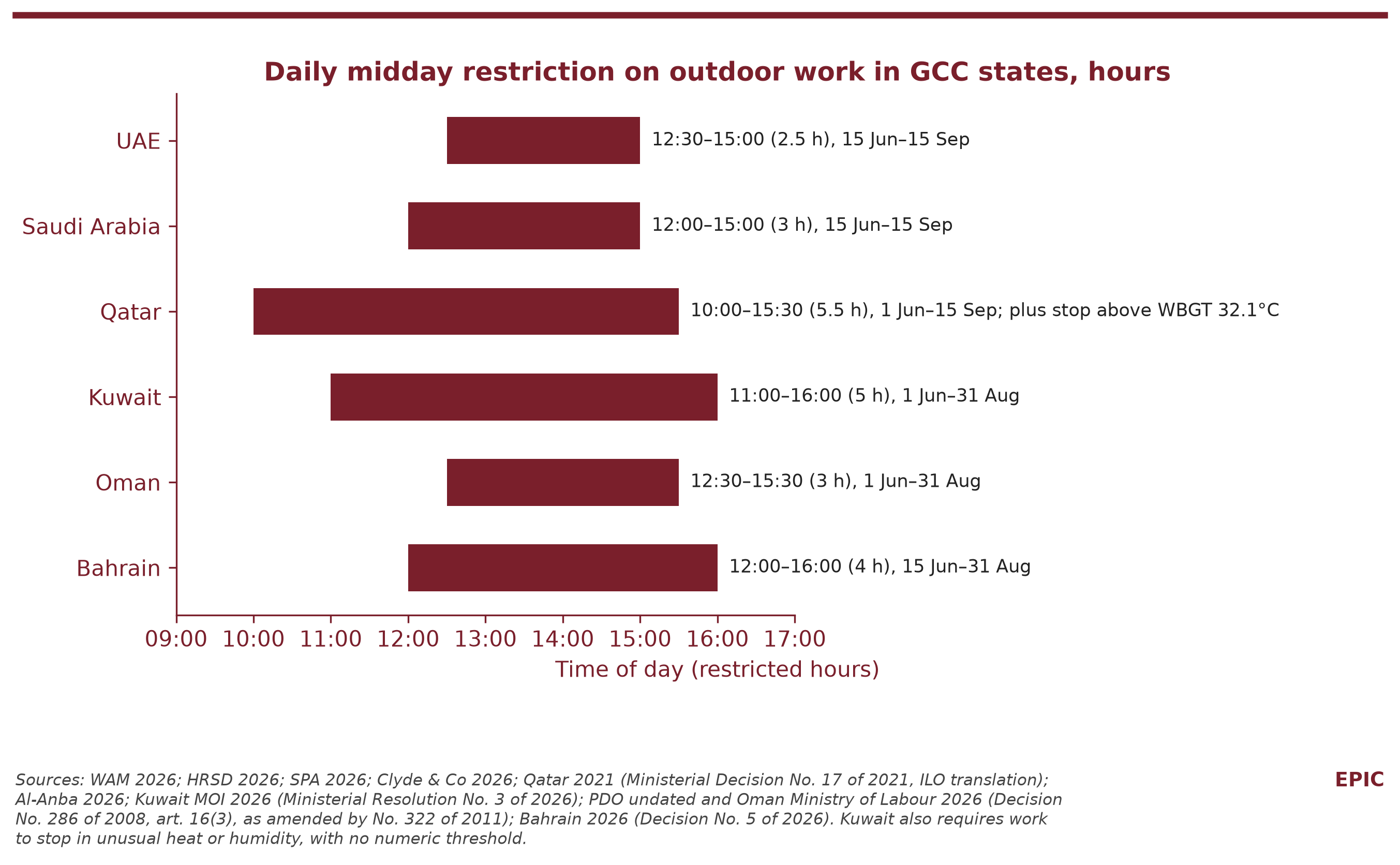
The comparison shows two models. Five states rely on a calendar rule: fixed hours on fixed dates. Qatar adds a measured threshold that applies at any time. Kuwait's 2026 resolution also allows work to be stopped in unusual heat or humidity outside the calendar, though without a numeric threshold. The calendar rule is simple to communicate and enforce. Its weakness is that heat does not follow the calendar. Hot and humid days occur before and after the restricted season, and dangerous conditions can arise outside the restricted hours. The ILO's finding that most exposure happens outside heatwaves points the same way.
4. What the health evidence shows
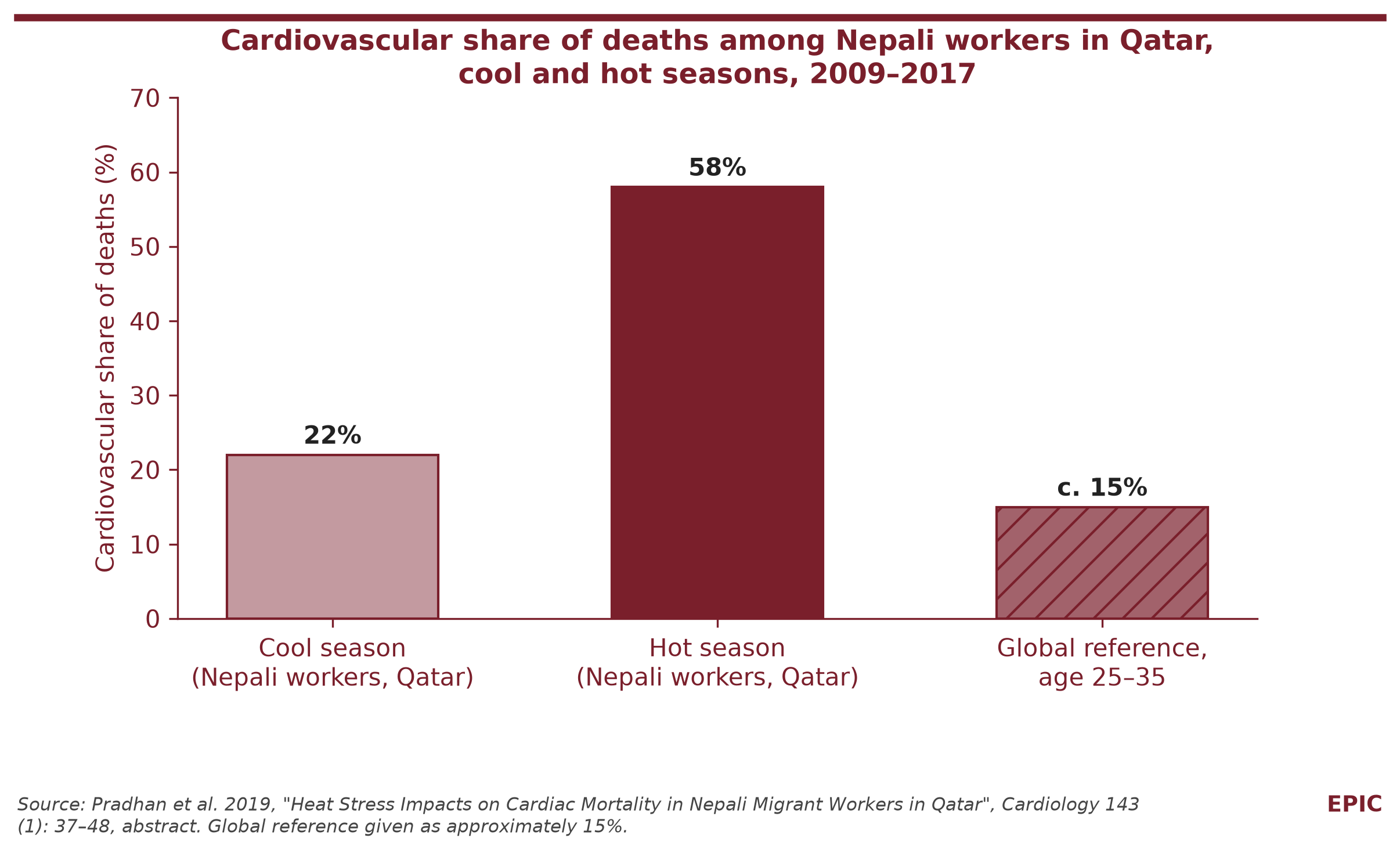
The strongest regional evidence comes from Qatar. A peer-reviewed study in Cardiology examined deaths among Nepali migrant workers in Qatar between 2009 and 2017, using death records held in Nepal and monthly estimates of WBGT from the Doha weather station. The average annual death rate was 150 per 100,000. The authors found a strong correlation between average monthly afternoon WBGT and cardiovascular mortality. Cardiovascular causes accounted for 22 per cent of deaths in the cool season and 58 per cent in the hot season, against about 15 per cent globally in the 25 to 35 age group. They estimated that as many as 200 of the 571 cardiovascular deaths in the period could have been prevented by effective heat protection (Pradhan et al. 2019).
The authors also flagged the limits of the data. Causes of death were poorly described, and many deaths were listed only as "cardiac arrest", which the authors grouped with cardiovascular causes. They called for cause-of-death records for workers dying in hot conditions to be more precise (Pradhan et al. 2019). The study concerns one national group in one country. It is still the clearest documented evidence that heat stress affects mortality among outdoor workers in the Gulf, and it supports protection that responds to measured conditions as well as to dates.
Evidence on whether midday bans reduce harm is weaker. The UAE ministry reports compliance above 99 per cent (WAM 2025), and compliance measures whether a rule is followed. It does not measure whether illness and death fall. No GCC state was found to publish a long-run series of heat-related illness and deaths among workers that would allow the effect of the rules to be measured. This is the most important evidence gap identified in this paper.
5. Beyond the workplace: the 2024 Hajj
Heat risk extends well beyond formal employment. At least 1,301 people died during the 2024 Hajj, which took place during a heatwave with temperatures at times above 50°C. According to the Saudi Press Agency, as reported by the BBC, more than three-quarters of those who died did not have official permits and had walked under direct sunlight without adequate shelter. Saudi Arabia's health minister said health facilities treated nearly half a million pilgrims, including more than 140,000 without a permit. About 1.8 million people took part (BBC News 2024).
The case shows that the people most exposed to heat are often those outside formal systems of protection, without permits, shelter or access to services. It also shows how heat interacts with mass gatherings, which are a growing part of Gulf economies through religious tourism, sport and large events.
6. Urban cooling
Gulf cities have also begun to treat heat through design. In May 2010 the Abu Dhabi Executive Council mandated that all new building projects comply with the Pearl Rating System for Estidama. From September 2010 all new villas had to achieve at least a 1 Pearl rating, which meant documenting all 13 required credits to obtain development review approval from the Urban Planning Council or a building permit from a municipality (Abu Dhabi Urban Planning Council 2010).
Codes of this kind address heat mainly through the efficiency of buildings and their cooling systems. They do less for the heat of streets and public spaces, where outdoor workers, pedestrians and transit users spend their time. This paper found no published, peer-reviewed evaluation of city-scale cooling measures in a Gulf city that measured health outcomes. Claims about the effect of specific urban cooling projects in the region should be treated with caution until they are evaluated.
7. Gaps
Outcome data. No GCC state was found to publish a consistent annual series of heat-related illness and death, by occupation, that would allow the effect of policy to be measured.
Calendar versus conditions. Five of six GCC states rely on fixed dates and hours. Only Qatar adds a measured WBGT threshold.
Recording causes of death. The Qatar study points to weaknesses in how causes of death are recorded among migrant workers.
Public space. Building codes address indoor heat. Streets, bus stops and outdoor workplaces receive less attention.
People outside formal protection. The 2024 Hajj showed that those without permits or shelter face the greatest risk.
8. Recommendations
- Add a measured threshold. GCC states that rely on a calendar rule could add a WBGT threshold, as Qatar has, so that work stops when conditions are dangerous whatever the date.
- Publish outcome data. Ministries of health and labour could publish an annual series of heat-related illness and deaths by sector, with clear definitions.
- Improve death certification. Causes of death among workers should be recorded in a way that allows heat to be identified as a factor, as the Qatar study's authors recommend.
- Evaluate urban cooling. Cities could commission independent evaluations of shade, tree planting and cool surfaces, using temperature and health data.
- Protect the unprotected. Heat plans for mass gatherings should include water, shade and medical support for people outside formal systems.
- Coordinate across the GCC. A shared GCC framework would let workers and employers who move between states work to a common standard, and would make national rules easier to compare.
9. Assessment
Gulf states were early to regulate heat at work, and the UAE's midday break has now run for more than two decades. The weak point in the current system is measurement. Until ministries publish outcome data and record causes of death precisely, no one can show whether the rules save lives, and the case for moving from calendar rules to Qatar-style measured thresholds will rest on one study of one national group.
About this paper
This paper was prepared by the EPIC Research Team. All facts are drawn from the documented sources listed below, which were checked on 27 October 2026 (Asia/Dubai). Charts use only cited data. Where no value is available, charts show n/a.
References
Abu Dhabi Urban Planning Council. 2010. Pearl Villa Rating System: What is Estidama? Guide. https://pages.dmt.gov.ae/-/media/98238FDB213645699A3AA4A01E9C6C96.ashx.
Al-Anba. 2026. "Public Authority for Manpower: ban on employing workers in open places daily from 11 am to 4 pm" [Arabic]. 20 May 2026. https://www.alanba.com.kw/1359424.
Bahrain. 2026. Minister of Labour Decision No. 5 of 2026 regulating the midday work ban during the summer [Arabic]. Legislation and Legal Opinion Commission. https://www.lloc.gov.bh/Legislation/HTM/RLAB0526.
BBC News. 2024. "At least 1,301 people died during Hajj - Saudi Arabia." 23 June 2024. https://www.bbc.com/news/articles/c8000dgk9gzo.
Clyde & Co. 2026. "Understanding the GCC midday work ban: A comparative guide." 1 July 2026. https://www.clydeco.com/en/insights/2026/06/understanding-the-gcc-midday-work-ban.
HRSD (Ministry of Human Resources and Social Development, Saudi Arabia). 2026. "Implementation of the Midday Work Ban Decision Begins on 15 June." https://www.hrsd.gov.sa/en/media-center/news/%D8%AA%D8%B7%D8%A8%D9%8A%D9%82-%D9%82%D8%B1%D8%A7%D8%B1-%D8%AD%D8%B8%D8%B1-%D8%A7%D9%84%D8%B9%D9%85%D9%84-%D8%AA%D8%AD%D8%AA-%D8%A3%D8%B4%D8%B9%D8%A9-%D8%A7%D9%84%D8%B4%D9%85%D8%B3.
ILO. 2021. "Qatar's Ministerial Decision on Heat Stress." 25 May 2021. https://www.ilo.org/resource/qatars-ministerial-decision-heat-stress.
ILO. 2024a. Ensuring Safety and Health at Work in a Changing Climate. Geneva: International Labour Organization. https://www.ilo.org/sites/default/files/2024-07/ILO%5FSafeDay24%5FReport%5Fr11.pdf.
ILO. 2024b. "More workers than ever are losing the fight against heat stress." 25 July 2024. https://www.ilo.org/resource/news/more-workers-ever-are-losing-fight-against-heat-stress.
Kuwait MOI (Ministry of Interior). 2026. Notice on the midday ban for delivery motorcycles, citing Ministerial Resolution No. 3 of 2026 [Arabic]. 2 June 2026. https://moi.gov.kw/gdt/traffic-news/details/53959.
Oman Ministry of Labour. 2026. "Get a permit to work at noon during summer" [Arabic]. Gov.om service page, updated 18 August 2026. https://gov.om/w/get-permit-to-work-at-noon-during-summer-.
Pal, Jeremy S., and Elfatih A. B. Eltahir. 2016. "Future Temperature in Southwest Asia Projected to Exceed a Threshold for Human Adaptability." Nature Climate Change 6: 197–200. Published online 26 October 2015. https://www.nature.com/articles/nclimate2833.
PDO (Petroleum Development Oman). Undated. "Summer Campaign", quoting Ministerial Decisions No. 286/2008, art. 16(3), and No. 322/2011. https://pdo.co.om/hseforcontractors/Pages/SummerCampaign.aspx.
Pradhan, Bandana, Tord Kjellstrom, Dan Atar, et al. 2019. "Heat Stress Impacts on Cardiac Mortality in Nepali Migrant Workers in Qatar." Cardiology 143 (1): 37–48. https://doi.org/10.1159/000500853.
Qatar. 2021. Decision of the Minister of Administrative Development, Labour and Social Affairs No. 17 of 2021 specifying measures to protect workers from heat stress. Unofficial English translation, ILO. https://www.ilo.org/sites/default/files/wcmsp5/groups/public/@arabstates/@ro-beirut/documents/legaldocument/wcms_794551.pdf.
SPA (Saudi Press Agency). 2026. Ministry of Human Resources and National Council for Occupational Safety and Health announce end of the 2026 midday work ban [Arabic]. 15 September 2026. https://www.spa.gov.sa/N2676888.
WAM. 2025. "MoHRE to implement Midday Break for 21st consecutive year from 15 June to 15 September 2025." 3 June 2025. https://www.wam.ae/en/article/bk01z89-mohre-implement-midday-break-for-21st-consecutive.
WAM. 2026. "MoHRE announces return of Occupational Heat Stress Prevention Policy from 15th June until 15th September." 8 June 2026. https://www.wam.ae/en/article/c0memda-mohre-announces-return-occupational-heat-stress.
WHO. 2024. "Climate change: heat and health." Fact sheet. https://www.who.int/news-room/fact-sheets/detail/climate-change-heat-and-health.
Sources and verification notes
Sources: EPIC-PP-2026-031, Extreme Heat: Adaptation in Gulf Cities
Chicago author-date. All URLs accessed 27 October 2026 (Asia/Dubai, UTC+4) unless noted. Prepared by the EPIC Research Team.
Abu Dhabi Urban Planning Council. 2010. Pearl Villa Rating System: What is Estidama? Guide. https://pages.dmt.gov.ae/-/media/98238FDB213645699A3AA4A01E9C6C96.ashx. Accessed 27 October 2026.
Al-Anba. 2026. "Public Authority for Manpower: ban on employing workers in open places daily from 11 am to 4 pm" [Arabic]. 20 May 2026. https://www.alanba.com.kw/1359424. Accessed 27 October 2026.
Bahrain. 2026. Minister of Labour Decision No. 5 of 2026 regulating the midday work ban during the summer [Arabic]. Legislation and Legal Opinion Commission. https://www.lloc.gov.bh/Legislation/HTM/RLAB0526. Accessed 27 October 2026.
BBC News. 2024. "At least 1,301 people died during Hajj - Saudi Arabia." 23 June 2024. https://www.bbc.com/news/articles/c8000dgk9gzo. Accessed 27 October 2026.
Clyde & Co. 2026. "Understanding the GCC midday work ban: A comparative guide." 1 July 2026. https://www.clydeco.com/en/insights/2026/06/understanding-the-gcc-midday-work-ban. Accessed 27 October 2026.
HRSD (Ministry of Human Resources and Social Development, Saudi Arabia). 2026. "Implementation of the Midday Work Ban Decision Begins on 15 June." https://www.hrsd.gov.sa/en/media-center/news/%D8%AA%D8%B7%D8%A8%D9%8A%D9%82-%D9%82%D8%B1%D8%A7%D8%B1-%D8%AD%D8%B8%D8%B1-%D8%A7%D9%84%D8%B9%D9%85%D9%84-%D8%AA%D8%AD%D8%AA-%D8%A3%D8%B4%D8%B9%D8%A9-%D8%A7%D9%84%D8%B4%D9%85%D8%B3. Accessed 27 October 2026.
ILO. 2021. "Qatar's Ministerial Decision on Heat Stress." 25 May 2021. https://www.ilo.org/resource/qatars-ministerial-decision-heat-stress. Accessed 27 October 2026.
ILO. 2024a. Ensuring Safety and Health at Work in a Changing Climate. Geneva: International Labour Organization. https://www.ilo.org/sites/default/files/2024-07/ILO%5FSafeDay24%5FReport%5Fr11.pdf. Accessed 27 October 2026.
ILO. 2024b. "More workers than ever are losing the fight against heat stress." 25 July 2024. https://www.ilo.org/resource/news/more-workers-ever-are-losing-fight-against-heat-stress. Accessed 27 October 2026.
Kuwait MOI (Ministry of Interior). 2026. Notice on the midday ban for delivery motorcycles, citing Ministerial Resolution No. 3 of 2026 [Arabic]. 2 June 2026. https://moi.gov.kw/gdt/traffic-news/details/53959. Accessed 27 October 2026.
Oman Ministry of Labour. 2026. "Get a permit to work at noon during summer" [Arabic]. Gov.om service page, updated 18 August 2026. https://gov.om/w/get-permit-to-work-at-noon-during-summer-. Accessed 27 October 2026.
Pal, Jeremy S., and Elfatih A. B. Eltahir. 2016. "Future Temperature in Southwest Asia Projected to Exceed a Threshold for Human Adaptability." Nature Climate Change 6: 197–200. Published online 26 October 2015. https://www.nature.com/articles/nclimate2833. Accessed 27 October 2026.
PDO (Petroleum Development Oman). Undated. "Summer Campaign", quoting Ministerial Decisions No. 286/2008, art. 16(3), and No. 322/2011. https://pdo.co.om/hseforcontractors/Pages/SummerCampaign.aspx. Accessed 27 October 2026.
Pradhan, Bandana, Tord Kjellstrom, Dan Atar, et al. 2019. "Heat Stress Impacts on Cardiac Mortality in Nepali Migrant Workers in Qatar." Cardiology 143 (1): 37–48. https://doi.org/10.1159/000500853. Accessed 27 October 2026.
Qatar. 2021. Decision of the Minister of Administrative Development, Labour and Social Affairs No. 17 of 2021 specifying measures to protect workers from heat stress. Unofficial English translation, ILO. https://www.ilo.org/sites/default/files/wcmsp5/groups/public/@arabstates/@ro-beirut/documents/legaldocument/wcms_794551.pdf. Accessed 27 October 2026.
SPA (Saudi Press Agency). 2026. Ministry of Human Resources and National Council for Occupational Safety and Health announce end of the 2026 midday work ban [Arabic]. 15 September 2026. https://www.spa.gov.sa/N2676888. Accessed 27 October 2026.
WAM. 2025. "MoHRE to implement Midday Break for 21st consecutive year from 15 June to 15 September 2025." 3 June 2025. https://www.wam.ae/en/article/bk01z89-mohre-implement-midday-break-for-21st-consecutive. Accessed 27 October 2026.
WAM. 2026. "MoHRE announces return of Occupational Heat Stress Prevention Policy from 15th June until 15th September." 8 June 2026. https://www.wam.ae/en/article/c0memda-mohre-announces-return-occupational-heat-stress. Accessed 27 October 2026.
WHO. 2024. "Climate change: heat and health." Fact sheet. https://www.who.int/news-room/fact-sheets/detail/climate-change-heat-and-health. Accessed 27 October 2026.
Verification notes
- All sources above opened and checked on 27 Oct 2026. Pradhan et al. 2019 checked via the PubMed abstract (PMID 31302648); the Karger page blocks automated access. Pal and Eltahir checked on nature.com.
- Opened on 27 Oct 2026 for the Research Integrity fixes: WAM 8 Jun 2026; lloc.gov.bh Decision 5/2026 (full text); HRSD 2026 news and SPA N2676888 (opened directly); Al-Anba 20 May 2026, Kuwait MOI notice, Lexis Middle East record (Resolution 3/2026 issued 18 May 2026); gov.om service page (updated 18 Aug 2026); PDO page quoting Oman decisions 286/2008 and 322/2011; BBC page datePublished 23 Jun 2024.
- Not opened: Al-Jarida 24 May 2026, mol.gov.bh news of 13 Jun 2026, and the full Kuwaiti resolution text; the repeal of Resolution 535/2015 is therefore not stated in the paper.
- Dropped from the 08:10 draft: Arab News 2025 (403; Saudi rule now cited to Clyde & Co), Saudi Press Agency N2128054 (page did not show the cited figures), u.ae green building codes page (404), Zhao et al. 2021 (Lancet page blocked; WHO figure cited to WHO only).