
 Emirati Perspectives and Insight Centre
Full text
1. Introduction: a country that makes its own water
Few states depend on manufactured water as completely as the United Arab Emirates. The country has no permanent rivers, rainfall is scarce and irregular, and the natural recharge of its aquifers is small. Yet it supports a large urban population, a farming sector, extensive public landscaping and heavy industry. The gap between what nature supplies and what the country uses is filled by two sources: seawater turned into drinking water in coastal plants, and groundwater pumped from aquifers that refill, where they refill at all, over very long periods.
This paper asks a practical question. With the UAE Water Security Strategy 2036 now past its midpoint, and with Abu Dhabi hosting the United Nations Water Conference from 8 to 10 December 2026 (UN DESA 2026), where does the country's water security actually stand, and where are the weak points? It draws only on documented sources: federal and emirate-level strategy documents, regulator statements, utility data and international datasets. Where a figure is a forecast or a target, the paper says so.
The argument runs as follows. Section 2 sets out the scale of the imbalance. Section 3 describes the national strategy and its targets. Section 4 examines the rapid shift in desalination technology from thermal plants to reverse osmosis. Section 5 turns to groundwater, which remains the largest and least sustainable part of the system in Abu Dhabi. Section 6 considers resilience: storage, coastal exposure and emergency supply. Section 7 discusses the links between water, energy and food. Section 8 sets out recommendations.
2. The scale of the imbalance
The standard international measure of water scarcity is Sustainable Development Goal indicator 6.4.2, the level of water stress. It expresses total freshwater withdrawal as a percentage of available renewable freshwater resources, after allowing for the flows that ecosystems need. A value above 100 per cent means that a country withdraws more freshwater than its renewable resources supply.
According to the World Bank's World Development Indicators, which reproduce FAO AQUASTAT data, the UAE's level of water stress stood at 1,509.93 per cent in 2022 (World Bank 2026a). Total annual freshwater withdrawals were 2.26 billion cubic metres in that year (World Bank 2026b). Renewable internal freshwater resources amounted to 14.89 cubic metres per person (World Bank 2026c).
The UAE is not alone in the region. Figure 1 compares it with four neighbouring Gulf states using the same indicator and the same year. Kuwait's level of stress is higher, at 3,850.5 per cent; Qatar's is 431.03 per cent, Bahrain's 133.71 per cent and Oman's 116.71 per cent (World Bank 2026a). All five exceed 100 per cent. The comparison is a reminder that the UAE's position is a regional condition, and that the policy choices it makes are relevant to its neighbours.
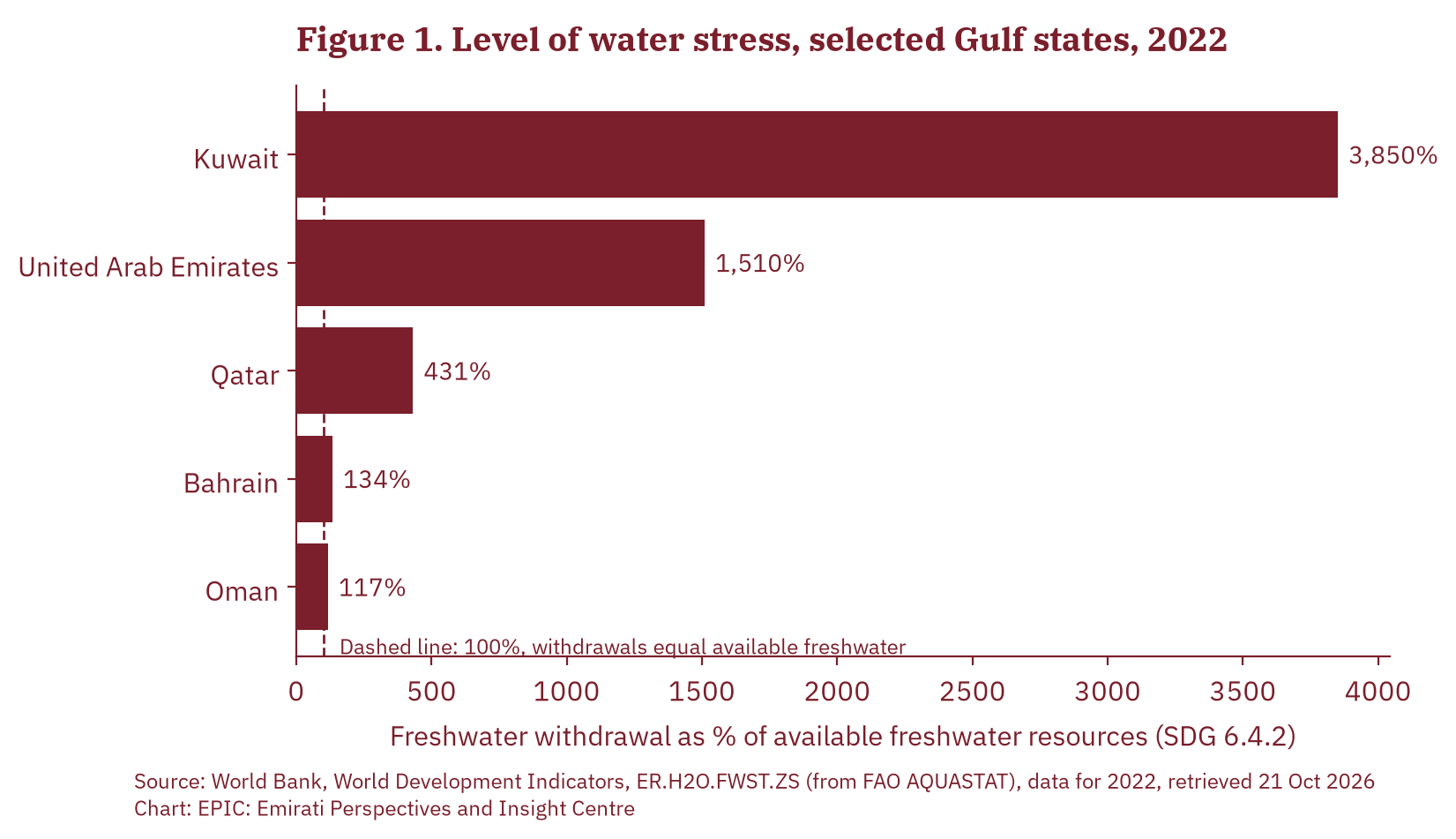
Two cautions apply. First, AQUASTAT figures for Gulf states are often estimates carried forward from earlier survey years, and some series in the dataset repeat the same value for several years. Second, the indicator counts freshwater withdrawals, and its treatment of desalinated water and treated wastewater differs between countries' reporting. The figures are therefore best read as an order of magnitude. That order of magnitude is not in doubt.
The same dataset shows how withdrawals are used. In 2022, agriculture accounted for 51.18 per cent of the UAE's freshwater withdrawals, municipal (domestic) use for 47.68 per cent and industry for 1.14 per cent (World Bank 2026d; 2026e; 2026f). The share of agriculture matters because, as Section 5 shows, much agricultural water in the UAE comes from groundwater that is not being replaced.
3. The national strategy and its targets
The federal Ministry of Energy unveiled the UAE Water Security Strategy 2036 on 27 September 2017 at the UAE Annual Government Meetings in Abu Dhabi (WAM 2017). The strategy's stated purpose is to ensure sustainable access to water in normal conditions and in emergencies. It is organised around three programmes: water demand management, water supply management, and emergency production and distribution (UAE Government 2026).
Its headline targets, as published on the government portal and reported at launch, are to:
- reduce total demand for water resources by 21 per cent;
- raise the water productivity index to USD 110 per cubic metre;
- reduce the water scarcity index by three degrees;
- increase the reuse of treated water to 95 per cent; and
- increase national water storage capacity to two days (UAE Government 2026; WAM 2017).
At the launch, the minister also said the strategy sought to halve average consumption per person. The storage target was explained in operational terms: two days of storage under normal conditions was described as equivalent to 16 days in an emergency and to more than 45 days in an extreme emergency, with networks able to supply 91 litres per person per day in an emergency and 30 litres per person per day in an extreme emergency. The strategy was expected to save AED 74 billion and to cut carbon dioxide emissions associated with desalination by 100 million tonnes (WAM 2017).
The strategy has since been revised. A 2024 presentation by the Water Resources Department of the Ministry of Energy and Infrastructure states that the strategy was developed in 2018 through a participatory process and updated in 2023 (Al Ali 2024). The update matters chiefly for desalination technology, discussed below.
Two features of the targets deserve attention. The first is that the demand target is a reduction in total demand, not only in demand per person, which is harder to achieve in a country whose population has grown quickly. The second is that only one of the five targets, storage, deals directly with resilience to disruption. The others concern efficiency and reuse. That balance is reasonable for a long-term strategy, but it means that the resilience of supply rests heavily on one number: two days.
4. Desalination: from heat to membranes
4.1 Why technology matters
Desalinated water in the UAE has historically come from thermal plants, which evaporate seawater using heat from power stations, through multi-stage flash or multi-effect distillation. These plants were built as cogeneration units, producing electricity and water together. The arrangement made sense when gas was the only large energy source, but it ties water output to power output and carries a large carbon cost. In winter, when electricity demand falls but water demand does not, cogeneration plants must run to make water even when their electricity is not needed.
Reverse osmosis works differently. It pushes seawater through membranes using electrically driven pumps. It uses far less energy per cubic metre, it can run on electricity from any source, and it allows water production to be planned separately from power production. The Emirates Water and Electricity Company (EWEC), Abu Dhabi's single buyer and seller of water and electricity, describes low-carbon reverse osmosis as up to 96 per cent more efficient than traditional thermal desalination, enabling a reduction of more than 85 per cent in carbon emissions (Novo 2023).
4.2 The pace of the shift
The shift has been fast. According to the Ministry of Energy and Infrastructure, reverse osmosis accounted for 13 per cent of UAE desalination in 2018, 23 per cent in 2021 and 37 per cent in 2023. The original 2018 strategy forecast a 54 per cent share by 2036; the 2023 update raised that forecast to 79 per cent, citing the UAE's net zero commitment, the national energy strategy and the decoupling of water from power production (Al Ali 2024). Figure 2 shows the trajectory.
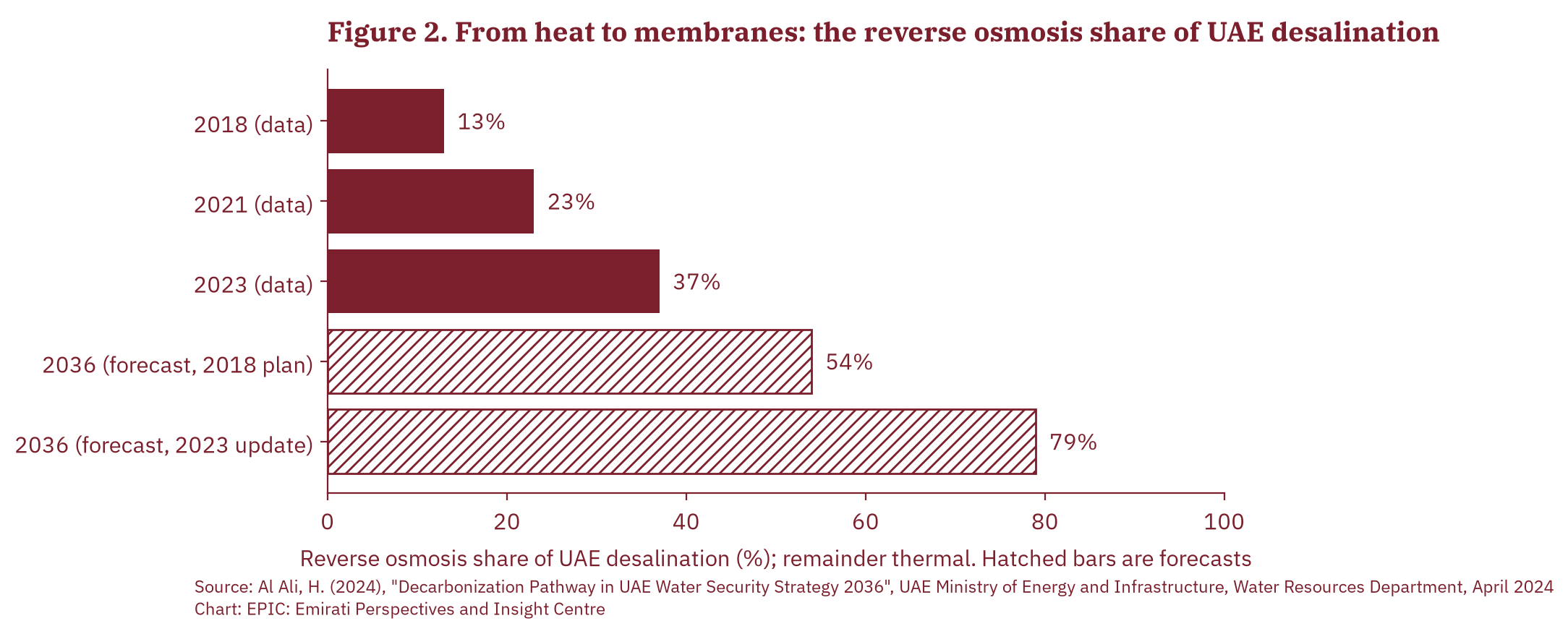
Abu Dhabi is moving faster than the national average. In a 2023 interview, EWEC's Asset Management Executive Director said the company forecast that more than 90 per cent of its water production would come from reverse osmosis plants by 2030, and that the average carbon intensity of its water production would fall from 11.5 kilograms of CO2 per cubic metre in 2019 to an estimated 1.4 kilograms per cubic metre by 2029 (Novo 2023).
4.3 Taweelah and the new generation of plants
The emblem of the shift is the Taweelah reverse osmosis plant north of Abu Dhabi city. Its capacity is 909,218 cubic metres a day, or about 200 million imperial gallons, and its developers describe it as the world's largest reverse osmosis desalination plant in operation. It was brought into service in stages: the first phase entered commercial operation in June 2022, the second in April 2023, and the full plant in March 2024. It is paired with a photovoltaic solar field of more than 70 megawatts peak (Grupo Cox 2024; Utilities Middle East 2024). EWEC has also procured further reverse osmosis plants, including Mirfa 2, Shuweihat 4 and plants on Saadiyat and Hudayriat islands (Novo 2023).
The same interview makes a point that is easy to miss. EWEC explains that running reverse osmosis plants in winter, when power demand is low, has been made possible by powering them with nuclear electricity (Novo 2023). The water transition, in other words, depends on the power transition. A system that makes most of its water with electricity needs a large, steady and low-carbon supply of electricity. That link is examined in Section 7.
4.4 What the shift does not solve
The move to reverse osmosis lowers cost and carbon, and it frees water production from the timing of power demand. It does not change three things. Every desalination plant still draws on the sea and is exposed to what happens in it. Plants are still concentrated on the coast, often at a small number of large sites. And desalinated water is still expensive to move inland to farms, which is one reason why farms continue to use groundwater.
5. Groundwater: the slow emergency
5.1 The largest source in Abu Dhabi
Discussion of UAE water tends to focus on desalination, but in the emirate of Abu Dhabi the largest source by volume is groundwater. In 2021 the Environment Agency – Abu Dhabi (EAD) stated that groundwater represented around 60 per cent of the water resources used in the emirate, desalinated water about 30 per cent and treated wastewater the remaining 10 per cent. About 65 per cent of water resources were used for irrigation in agriculture, forests, gardens and parks (EAD 2021). Figure 3 sets out the split.
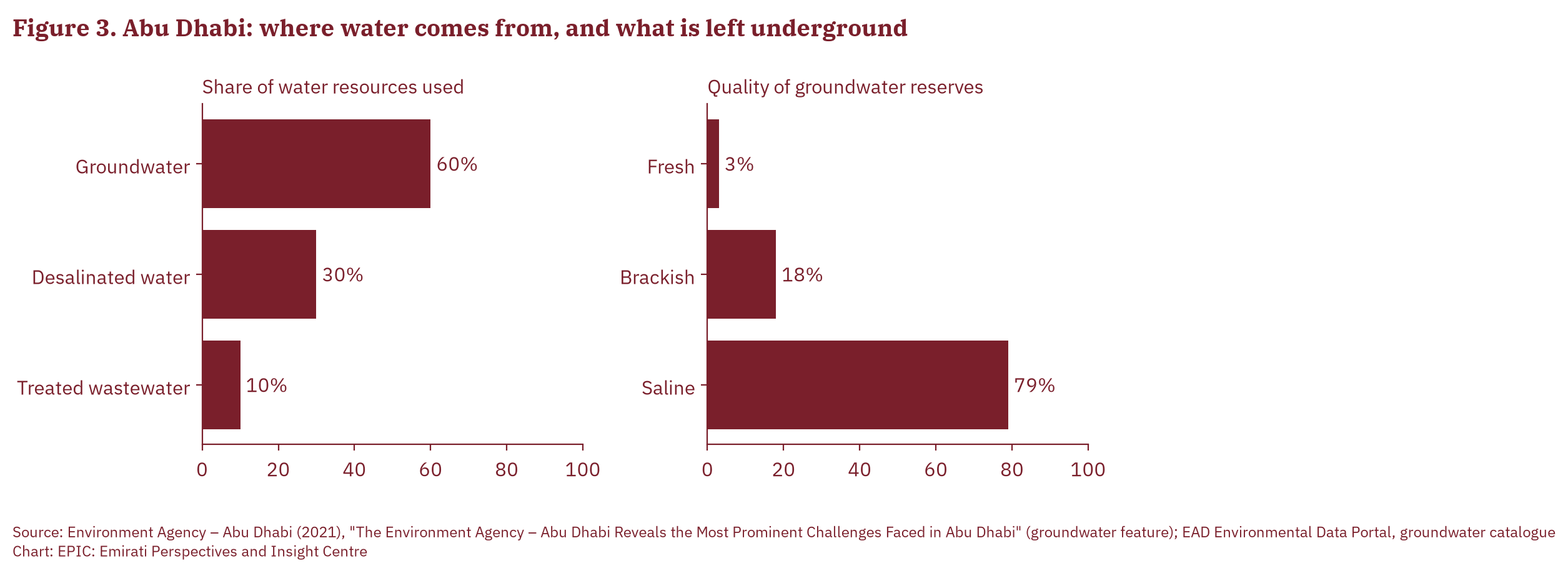
The same EAD statement counted more than 100,000 wells across the emirate, including more than 53,000 working wells on more than 24,000 farms. It broke down groundwater use by sector as follows.
| Sector | Groundwater used (million m³ a year) | Share of groundwater use |
|---|---|---|
| Agriculture | 1,756 | 84% |
| Forestry | 248 | 12% |
| Parks and gardens | 86 | 4% |
Table 1. Groundwater use in Abu Dhabi by sector. Source: Environment Agency – Abu Dhabi (2021).
5.2 A resource being mined
Groundwater in Abu Dhabi is, in EAD's words, "considered a non-renewable resource", with natural recharge occurring only in the Hajar Mountains area (EAD 2021). EAD's strategic plan states that current abstraction is estimated at twenty times the natural recharge rate and that, as a result, usable groundwater will last approximately 50 years in the emirate, and much less in areas of intensive irrigation (EAD n.d.-b). A study of groundwater economics in Abu Dhabi, published in Desalination and Water Treatment, gives total annual abstraction at about 2,300 million cubic metres against natural recharge of between 90 and 140 million cubic metres (Dawoud 2020).
Quality is falling with quantity. EAD's data portal records that only 3 per cent of Abu Dhabi's groundwater is fresh, 18 per cent brackish and 79 per cent saline (EAD n.d.-a). In announcing a policy on managing and protecting groundwater, EAD reported that 79 per cent of the emirate's groundwater had become highly saline, 18 per cent was medium brackish and only 3 per cent was fresh. It linked over-abstraction to declining water levels and deteriorating quality, and noted the costs that salinity imposes on farmers (Abu Dhabi Media Office n.d.).
5.3 Why groundwater is hard to govern
The groundwater problem has a different structure from the desalination problem. Desalination is centralised: a handful of utilities, a few dozen large plants, long-term contracts. Groundwater is dispersed among tens of thousands of wells on tens of thousands of farms. Its costs are borne in the future and by everyone, while its benefits are immediate and private. It is the classic common-pool resource.
EAD's approach, set out in its strategic plan, combines better monitoring of abstraction, tighter enforcement against illegal abstraction and the illegal sale of water, awareness among users, irrigation efficiency on farms and forests, and the substitution of treated wastewater or desalinated water for groundwater where infrastructure allows (EAD n.d.-b). Each of these is sensible. The difficulty is scale: the national strategy's demand-reduction target of 21 per cent will be hard to reach while agriculture, the largest single user, continues to draw on a resource that is priced at the cost of pumping rather than at the cost of its depletion.
6. Resilience: storage, the sea and the margin of safety
6.1 Strategic storage
The most important resilience asset built so far is the Liwa strategic water reserve in Abu Dhabi's Al Dhafra region. It uses aquifer storage and recovery: desalinated water produced in normal times is injected into the aquifer beneath the Liwa desert and can be pumped back out in an emergency. According to the International Water Management Institute's case study, the full scheme was completed in December 2017 and stores about 26 million cubic metres, enough to supply the emirate with emergency water for 90 days (IWMI 2018). At its inauguration, officials said the project had cost an estimated AED 1.61 billion, that its 315 wells lie up to 80 metres below ground, and that it could deliver a fallback pumping capacity of 100 million gallons of water per day (WAM n.d.).
Liwa is a real achievement and a model that other arid states study. It also shows the limits of the current margin. The national target is two days of storage capacity in normal operation (UAE Government 2026). Ninety days of emergency supply in one emirate, delivered at rationed emergency volumes, is very different from ninety days of normal supply for the whole country.
6.2 Exposure to the sea
Concentrating supply on the coast creates exposure to marine events. The UAE has direct experience of this. In 2008 a prolonged harmful algal bloom, or red tide, affected UAE coastal waters. In late October or early November 2008, officials closed the Al Ghalileh desalination plant in Ras Al Khaimah because of the bloom, cutting water to many residents; some bought water from tankers while the plant was shut (Kakande 2008). The bloom, caused by the dinoflagellate Cochlodinium polykrikoides, is described in the scientific literature as catastrophic for the region (Richlen et al. 2010), and reverse osmosis plants are known to be vulnerable to such blooms because algae clog pre-treatment systems and foul membranes (Villacorte et al. 2015).
The 2036 strategy recognises related risks: the government's description of the strategy includes the prevention of contamination of water supplies by oil pollution, and the ministry's 2024 presentation lists oil spill prevention among its emergency programmes (WAM 2017; Al Ali 2024). As reverse osmosis replaces thermal plants, exposure to marine biology does not disappear; in some respects it changes form. Pre-treatment capacity, intake design and the ability to shift production between plants on different coasts become part of water security.
6.3 The margin of safety
Taken together, these facts point to a system that is highly capable in normal conditions and thinner than it looks under stress. Production capacity has grown and become cleaner. Stored water is limited to a strategic reserve in one emirate and a national target of two days. And a large part of the agricultural system relies on a groundwater buffer that is shrinking and becoming saltier. The buffer that groundwater has historically provided, a reserve under the desert that could be drawn on in hard times, is being consumed in ordinary times.
7. Water, energy and food
7.1 Water as an electricity load
As the UAE moves from thermal desalination to reverse osmosis, water becomes an electricity load. This has two consequences. The carbon intensity of water now depends on the carbon intensity of the grid, which in turn depends on gas, solar and nuclear generation. And the reliability of water supply now depends partly on the reliability of electricity supply. EWEC's description of nuclear power keeping reverse osmosis plants running through the winter is a concrete example of this coupling (Novo 2023). Water planners and power planners in the UAE are, in practice, planning the same system.
7.2 Water as a food input
Agriculture accounts for about half of national freshwater withdrawals (World Bank 2026d) and, in Abu Dhabi, for 84 per cent of groundwater use (EAD 2021). Food security policy and water policy therefore cannot be separated. Growing crops with water that will not be replaced converts a long-term water reserve into a short-term food supply. Where crops are high in value and grown with efficient irrigation, treated wastewater or controlled-environment methods, the trade may be worth making. Where they are low in value and grown with flood irrigation from fresh or brackish aquifers, it is harder to justify. The question is one of allocation: which uses of a non-renewable reserve deliver the most security per cubic metre.
8. Policy recommendations
The following recommendations follow from the evidence above. They are directed at federal and emirate-level authorities and are intended as proposals for discussion.
1. Publish an annual national water balance. The most recent consistent international figures for the UAE date from 2022 and partly rest on estimates. A national water balance, published each year and setting out production, use and losses by source, sector and emirate, would allow progress against the 2036 targets to be measured in public. It would also strengthen the UAE's position as host of the 2026 UN Water Conference.
2. Treat groundwater as a strategic reserve. Groundwater should be managed as a reserve for emergencies and high-value uses rather than a routine input. This means metering abstraction at all significant wells, setting abstraction limits by aquifer, and reporting depletion and salinity trends annually against the 50-year horizon in EAD's strategic plan.
3. Price agricultural water to reflect depletion. Support for farming can continue while signalling the true cost of groundwater. Options include tiered abstraction charges, payments to farmers who switch to treated wastewater or retire wells, and support targeted at efficient irrigation and high-value crops.
4. Extend strategic storage beyond Abu Dhabi. The Liwa reserve shows that aquifer storage and recovery works in UAE conditions. Feasibility studies for comparable reserves serving other emirates, and for linking storage across the national network, would raise the national margin of safety well beyond the two-day target.
5. Build coastal resilience into reverse osmosis planning. New reverse osmosis capacity should be planned with harmful algal blooms and oil spills in mind: robust pre-treatment, intake monitoring and early warning, and geographic diversity between the Gulf and Gulf of Oman coasts so that production can be shifted between them.
6. Plan water and power together. Because water is becoming an electricity load, water security targets should be written into power sector planning, including the scheduling of nuclear and solar output and storage, and vice versa.
7. Use the December 2026 UN Water Conference. The conference in Abu Dhabi is a chance to present the UAE's experience in decarbonising desalination and in aquifer storage and recovery as practical models for other arid states, and to commit publicly to a groundwater reporting standard.
9. Conclusion
The UAE has solved the problem of making water at scale, and it is solving the problem of making it cleanly. The shift from thermal desalination to reverse osmosis, moving from 13 per cent of desalination in 2018 to a forecast 79 per cent by 2036, is among the most significant changes in the country's infrastructure in this decade. The harder problems now lie elsewhere: in an aquifer system being drawn down at about twenty times its recharge, in a storage margin measured in days, and in a coastline that concentrates supply where the sea can interrupt it. Water security to 2036 will depend on how those three problems are handled.
References
Abu Dhabi Media Office. n.d. "Environment Agency – Abu Dhabi Issues Policy for Managing and Protecting Groundwater in the Emirate." Abu Dhabi Media Office. https://www.mediaoffice.abudhabi/en/environment/environment-agency-abu-dhabi-issues-policy-for-managing-and-protecting-groundwater-in-the-emirate/.
Al Ali, Hind. 2024. "Decarbonization Pathway in UAE Water Security Strategy 2036." Presentation, Water Resources Department, UAE Ministry of Energy and Infrastructure, April 2024. https://wstagcc.org/wp-content/uploads/2017/11/1.-WSTA-15-GWC-Hind-Al-Ali.pdf.
Dawoud, Mohamed A. 2020. "Groundwater Economics in Arid Regions: Abu Dhabi Emirate Case Study." Desalination and Water Treatment 176: 84–93. https://doi.org/10.5004/dwt.2020.25501.
EAD (Environment Agency – Abu Dhabi). 2021. "The Environment Agency – Abu Dhabi Reveals the Most Prominent Challenges Faced in Abu Dhabi." Groundwater feature, February 2021. https://www.ead.gov.ae/en/Media-Centre/News/022021-Groundwater-Feature.
EAD (Environment Agency – Abu Dhabi). n.d.-a. "Unlocking Groundwater Potential." EAD Environmental Data Portal, groundwater catalogue. https://edp.ead.ae/map/Catalogue/GW.
EAD (Environment Agency – Abu Dhabi). n.d.-b. Strategic Plan. Abu Dhabi: EAD. Via FAOLEX. https://faolex.fao.org/docs/pdf/uae179255E.pdf.
Grupo Cox. 2024. "Coxabengoa Group Begins Commercial Operation of the Complete Taweelah Desalination Plant in Abu Dhabi." Press release. https://grupocox.com/en/coxabengoa-group-begins-commercial-operation-of-the-complete-taweelah-desalination-plant-in-abu-dhabi/.
IWMI (International Water Management Institute). 2018. "Securing Large-Scale Emergency Water Supplies in Arid Regions through Innovative Aquifer Storage and Recovery." Groundwater Solutions Initiative for Policy and Practice (GRIPP) case profile. http://gripp.iwmi.org/wp-content/uploads/sites/2/2018/08/WaterStorage_Abu-Dhabi_SWWW2018.pdf.
Kakande, Yasin. 2008. "Desalination Plant Forced to Close by Red Tide May Reopen." The National, 6 November 2008. https://www.thenationalnews.com/uae/desalination-plant-forced-to-close-by-red-tide-may-reopen-1.533227.
Novo, Cristina. 2023. "'Creating a Pipeline of RO Projects That Attract Private Investment Drives Technology Innovation'." Interview with Mark Hedges, Emirates Water and Electricity Company. Smart Water Magazine, 1 August 2023. https://smartwatermagazine.com/news/emirates-water-electricity-ewec/creating-a-pipeline-ro-projects-attract-private-investment.
Richlen, Mindy L., Steve L. Morton, Ebrahim A. Jamali, Anbiah Rajan and Donald M. Anderson. 2010. "The Catastrophic 2008–2009 Red Tide in the Arabian Gulf Region, with Observations on the Identification and Phylogeny of the Fish-Killing Dinoflagellate Cochlodinium polykrikoides." Harmful Algae 9 (2): 163–172. https://doi.org/10.1016/j.hal.2009.08.013.
UAE Government. 2026. "The UAE Water Security Strategy 2036." The Official Portal of the UAE Government, updated 25 August 2026. https://u.ae/en/about-the-uae/strategies-initiatives-and-awards/strategies-plans-and-visions/environment-and-energy/the-uae-water-security-strategy-2036.
UN DESA (United Nations Department of Economic and Social Affairs). 2026. "2026 UN Water Conference." https://sdgs.un.org/conferences/water2026.
Utilities Middle East. 2024. "Acwa Power Achieves Full Commercial Operation at Taweelah RO Desalination Plant." https://www.utilities-me.com/utilities/acwa-power-achieves-full-commercial-operation-at-taweelah-ro-desalination-plant.
Villacorte, Loreen O., S. Assiyeh Alizadeh Tabatabai, Donald M. Anderson, Gary L. Amy, Jan C. Schippers and Maria D. Kennedy. 2015. "Seawater Reverse Osmosis Desalination and (Harmful) Algal Blooms." Desalination 360: 61–80. https://doi.org/10.1016/j.desal.2015.01.007.
WAM (Emirates News Agency). 2017. "Ministry of Energy Unveils UAE Water Security Strategy 2036." 27 September 2017. https://www.wam.ae/en/article/hszr5vih-ministry-energy-unveils-uae-water-security.
WAM (Emirates News Agency). n.d. "Liwa Water Reserve Ensures Continuous Supply for Abu Dhabi." https://www.wam.ae/en/article/hszr6f1w-liwa-water-reserve-ensures-continuous-supply-for.
World Bank. 2026a. "Level of Water Stress: Freshwater Withdrawal as a Proportion of Available Freshwater Resources (ER.H2O.FWST.ZS)." World Development Indicators. Accessed 21 October 2026. https://data.worldbank.org/indicator/ER.H2O.FWST.ZS.
World Bank. 2026b. "Annual Freshwater Withdrawals, Total (Billion Cubic Meters) (ER.H2O.FWTL.K3)." World Development Indicators. Accessed 21 October 2026. https://data.worldbank.org/indicator/ER.H2O.FWTL.K3.
World Bank. 2026c. "Renewable Internal Freshwater Resources per Capita (Cubic Meters) (ER.H2O.INTR.PC)." World Development Indicators. Accessed 21 October 2026. https://data.worldbank.org/indicator/ER.H2O.INTR.PC.
World Bank. 2026d. "Annual Freshwater Withdrawals, Agriculture (% of Total Freshwater Withdrawal) (ER.H2O.FWAG.ZS)." World Development Indicators. Accessed 21 October 2026. https://data.worldbank.org/indicator/ER.H2O.FWAG.ZS.
World Bank. 2026e. "Annual Freshwater Withdrawals, Domestic (% of Total Freshwater Withdrawal) (ER.H2O.FWDM.ZS)." World Development Indicators. Accessed 21 October 2026. https://data.worldbank.org/indicator/ER.H2O.FWDM.ZS.
World Bank. 2026f. "Annual Freshwater Withdrawals, Industry (% of Total Freshwater Withdrawal) (ER.H2O.FWIN.ZS)." World Development Indicators. Accessed 21 October 2026. https://data.worldbank.org/indicator/ER.H2O.FWIN.ZS.
Sources and verification notes
Sources and verification notes: "The Desalinated State"
All sources were retrieved and checked on 21 October 2026 (Asia/Dubai, UTC+4). Verdicts use the four house categories: correct, needs correction, unverifiable and mixed. Local copies of data and documents are kept in research/epic-new/_data/.
| # | Claim in paper | Source checked | Verdict | Action |
|---|---|---|---|---|
| 1 | UAE water stress 1,509.93% (2022); Kuwait 3,850.5, Qatar 431.03, Bahrain 133.71, Oman 116.71 | World Bank WDI ER.H2O.FWST.ZS via API (wb_ER.H2O.FWST.ZS.json) | Correct | Kept |
| 2 | Withdrawals 2.26 bn m³ (2022); renewable internal freshwater 14.89 m³ per person (2022) | WDI ER.H2O.FWTL.K3, ER.H2O.INTR.PC (local JSON) | Correct | Kept |
| 3 | Agriculture 51.18%, domestic 47.68%, industry 1.14% of withdrawals (2022) | WDI ER.H2O.FWAG/FWDM/FWIN.ZS | Correct | Kept |
| 4 | "About fifteen times" renewable resources | Derived from 1,509.93% | Correct | Kept |
| 5 | Absolute-scarcity threshold of 500 m³ per person | No source attached in draft | Unverifiable | Removed |
| 6 | WSS 2036 unveiled 27 Sept 2017; five targets; halve per-capita use; 16/45-day equivalents; 91 and 30 L/day; AED 74 bn; 100 Mt CO2; oil-pollution prevention | WAM (2017); u.ae strategy page | Correct | Kept |
| 7 | Strategy developed 2018 and updated 2023; RO 13% (2018), 23% (2021), 37% (2023); forecast 54% → 79% by 2036; oil-spill prevention programme | Al Ali (2024), MoEI presentation, 13 pp., saved as wsta_alali.pdf | Correct | Kept; launch year 2017 (WAM) and "developed in 2018" (MoEI) both recorded |
| 8 | RO up to 96% more efficient, >85% emission cut; >90% RO by 2030; 11.5 → 1.4 kg CO2/m³; nuclear powers RO in winter; Mirfa 2, Shuweihat 4, Saadiyat, Hudayriat plants | Novo (2023), Smart Water Magazine interview with EWEC | Correct | Kept, attributed as EWEC forecast |
| 9 | Taweelah 909,218 m³/day, world's largest operating RO, >70 MWp PV; phases June 2022, April 2023, March 2024 | Grupo Cox (2024); Utilities Middle East (2024) | Correct | Kept, attributed to developers |
| 10 | Abu Dhabi: groundwater ~60%, desal ~30%, TWW 10%; 65% for irrigation; >100,000 wells, >53,000 working, >24,000 farms; 1,756/248/86 Mm³ (84/12/4%) | EAD (2021) groundwater feature | Correct | Kept |
| 11 | 3% fresh, 18% brackish, 79% saline | EAD data portal; Abu Dhabi Media Office | Correct | Kept; date of the Media Office item could not be confirmed, cited n.d. |
| 12 | Abstraction 20 × recharge; usable groundwater ~50 years | EAD Strategic Plan (FAOLEX) | Correct | Kept |
| 13 | Abstraction ~2,300 Mm³ vs recharge 90–140 Mm³ | Dawoud (2020), Desalination and Water Treatment 176: 84–93 | Mixed | Draft cited the journal without author and wrong page range; corrected via Crossref |
| 14 | Liwa ASR completed Dec 2017, ~26 Mm³, 90 days | IWMI GRIPP (2018) | Correct | Kept |
| 15 | Liwa AED 1.61 bn, 315 wells up to 80 m, 100 million gallons/day fallback | WAM (n.d.) | Correct | Kept; "sandstone" removed (not in cited source) |
| 16 | Al Ghalileh plant closed by red tide, residents bought tanker water | Kakande (2008), The National, 6 Nov 2008 | Needs correction | Draft said "In November 2008"; article says closure was "Thursday last week", so changed to "late October or early November 2008"; "east coast" wording generalised |
| 17 | 2008–2009 red tide described as catastrophic; Cochlodinium polykrikoides | Richlen et al. (2010), metadata via Crossref | Correct | Kept |
| 18 | RO vulnerable to algal blooms | Villacorte et al. (2015), Desalination 360 | Correct | Kept |
| 19 | UN Water Conference 8–10 Dec 2026, Abu Dhabi, co-hosted with Senegal | UN DESA conference page | Correct | Kept |
| 20 | ~70 desalination plants, 14% of world output (found in research) | Portal text not retrievable as a primary page | Unverifiable | Not used |
Figures. Figure 1: WDI CSV (fig1_water_stress.csv). Figure 2: Al Ali (2024) (fig2_ro_share.csv). Figure 3: EAD (2021) and EAD data portal (fig3_abudhabi_sources.csv). All values match the sources; no value is missing, so no n/a entries were needed.
Summary. 20 items checked: 15 correct, 1 needs correction, 1 mixed, 2 unverifiable (both removed or not used), plus the derived ratio (correct).
Corrections applied. Item 5 removed; item 13 citation corrected; item 15 detail removed; item 16 date corrected; item 20 not used. No [UNVERIFIED] items remain.