
 Emirati Perspectives and Insight Centre
Full text
1. Introduction
For two decades the central education challenge in the UAE was access: building enough schools and universities for a fast-growing population. That challenge has largely been met. The question now is quality, meaning what students learn and whether it prepares them for an economy that the state wants to be driven by knowledge and technology. This paper asks how far the UAE has moved from access to quality and what the evidence shows.
Section 2 reviews access. Section 3 examines learning outcomes. Section 4 covers spending. Section 5 traces recent reforms. Section 6 looks at the transition to work, Section 7 identifies gaps, and Section 8 sets out recommendations.
2. Access
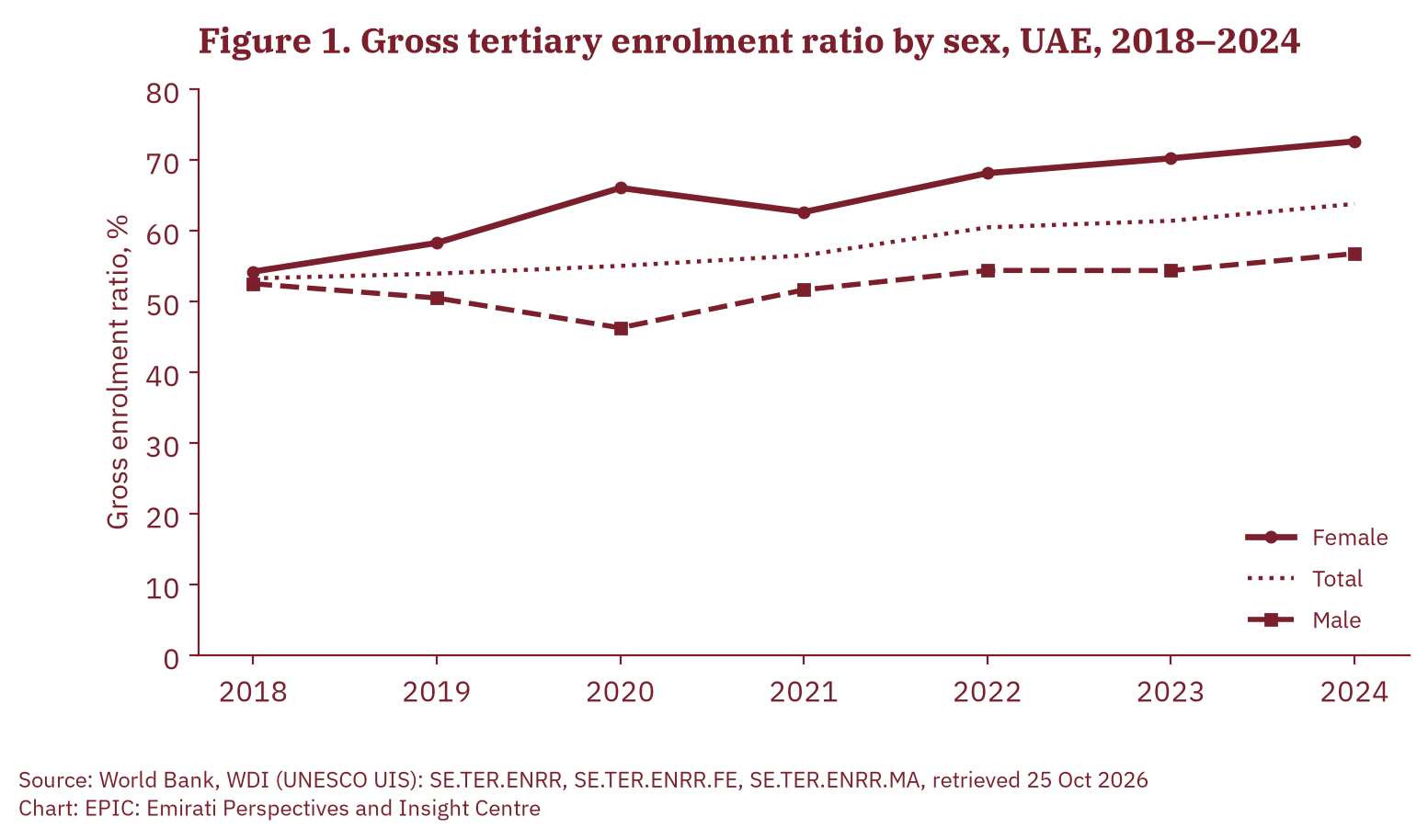
UNESCO data published by the World Bank put the gross secondary enrolment ratio at about 102 per cent in 2024, consistent with near-universal participation (gross ratios can exceed 100 per cent because they include students outside the official age group). The gross tertiary enrolment ratio rose from about 53 per cent in 2018 to about 64 per cent in 2024 (Figure 1).
The rise has been driven by women. The female tertiary ratio rose from about 54 to about 73 per cent between 2018 and 2024, while the male ratio rose from about 52 to about 57 per cent. In 2024 the female ratio was about 16 percentage points higher than the male ratio.
Federal Decree-Law No. 39 of 2022 on Compulsory Education, in force since 2 January 2023, makes education compulsory for UAE citizens from primary school until the completion of their schooling and for expatriate residents until the end of the primary stage, according to the official government portal.
3. Learning outcomes
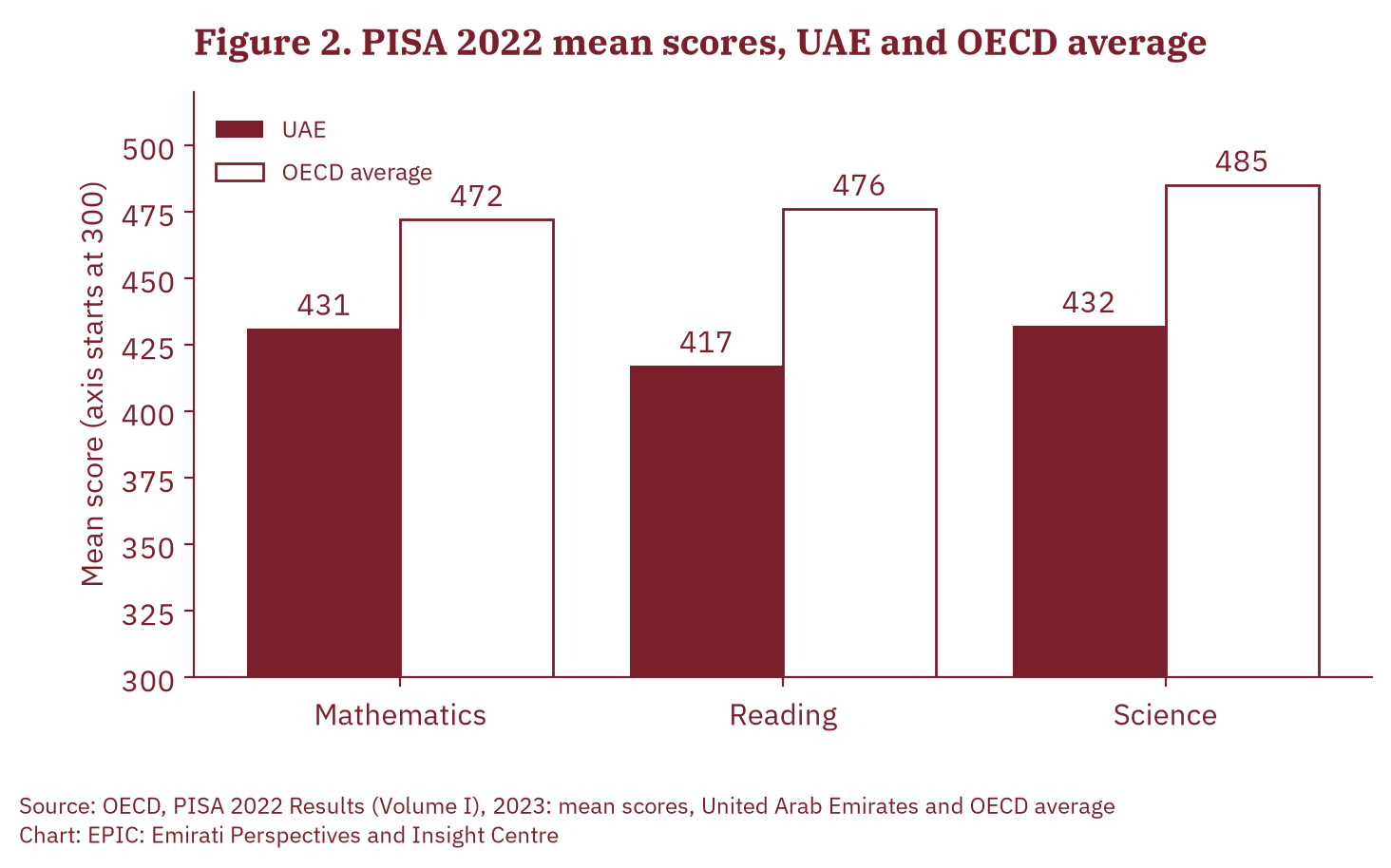
The OECD Programme for International Student Assessment (PISA) tests 15-year-olds in mathematics, reading and science. In PISA 2022, UAE students scored 431 in mathematics, 417 in reading and 432 in science. The corresponding OECD averages were 472, 476 and 485, so UAE scores were between 41 and 59 points below (Figure 2). The OECD's country note judges average results to have been about the same as in 2018 in mathematics and science and lower in reading, where scores were below those of any previous PISA round in the UAE. Only 51 per cent of UAE students reached the baseline proficiency level (Level 2) in mathematics, against an OECD average of 69 per cent, and 52 per cent did so in reading, against 74 per cent. Girls outperformed boys by 7 points in mathematics and 45 points in reading. The OECD reported that UAE data met PISA technical standards.
Within the private school system, inspection gives a second view. Following its 2023 to 2024 inspection cycle, Dubai's Knowledge and Human Development Authority (KHDA) reported that 81 per cent of Dubai students attend private schools rated good or better. Inspection ratings measure school quality against a local framework and are not directly comparable with PISA scores.
4. Spending
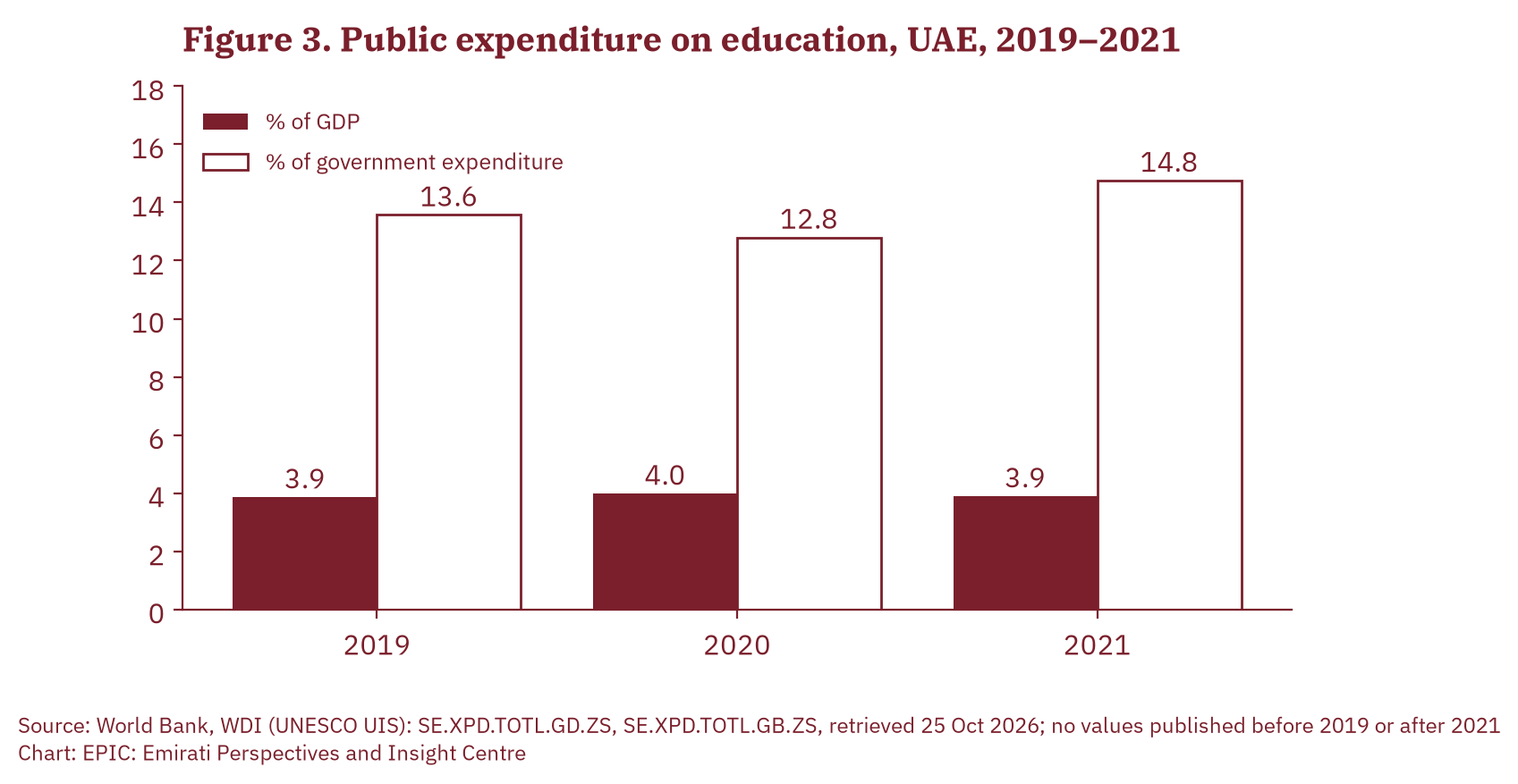
UNESCO data published by the World Bank show public expenditure on education at 3.86 per cent of GDP in 2019, 3.98 per cent in 2020 and 3.89 per cent in 2021, the latest year available (Figure 3). As a share of total government expenditure it was 13.6 per cent in 2019, 12.8 per cent in 2020 and 14.8 per cent in 2021. The series covers only three years, and no later official figure was found in the same series, so trends should not be inferred from it.
5. Reforms
University admission. In February 2023 the Ministry of Education made the Emirates Standardised Test (EmSAT) optional for university admission from the 2023 to 2024 academic year, allowing institutions to use other approved assessments and set their own thresholds.
Ministerial restructuring. In July 2024 the federal government restructured education. The Emirates Schools Establishment and the Federal Authority for Early Childhood Education were merged into the Ministry of Education, which now covers early childhood to secondary education, and a separate Ministry of Higher Education and Scientific Research was established. A new Quality of Education Centre was given responsibility for measuring student performance and the quality of educational outcomes in public and private institutions and for publishing reports. A General Secretariat was tasked with building educational data infrastructure linked to employment and labour market data.
Artificial intelligence in schools. In May 2025 the government announced that artificial intelligence would be taught as a subject in government schools from kindergarten to Grade 12 from the 2025 to 2026 academic year, supported by a national AI literacy curriculum framework.
6. From school to work
ILO modelled estimates published by the World Bank put youth unemployment (ages 15 to 24) at about 6.4 per cent in 2024, after a peak of about 13.5 per cent in 2020. Female labour force participation was about 53 per cent in 2024 on the same source. These are whole-population estimates covering both nationals and migrants, so they say little about how well UAE graduates in particular move into work. No official series linking qualifications to employment outcomes for graduates was found.
7. Gaps
Learning quality. The gap between UAE and OECD average PISA scores of 41 to 59 points is large, about half of students fall below baseline proficiency in mathematics and reading, and reading results declined between 2018 and 2022.
Male participation. The 16-point gap between female and male tertiary enrolment, together with boys' weaker PISA reading results, points to male disengagement from education.
Data on outcomes. There is no regular public data on graduate employment by field and institution, which makes it difficult for students to choose and for policymakers to judge programmes.
Spending data. The public spending series stops in 2021.
8. Recommendations
- Make learning outcomes the headline target. Set public targets for PISA and national assessment results, broken down by school sector, and have the Quality of Education Centre publish progress annually.
- Address male disengagement. Commission research into why young men are less likely to enrol in higher education and pilot targeted pathways, including technical and applied programmes.
- Publish graduate outcome data. Report employment and earnings of graduates by institution and field of study, using the data infrastructure the 2024 restructuring assigned to the Council's General Secretariat.
- Update spending statistics. Report education expenditure to international databases annually.
- Evaluate the reforms. Publish independent evaluations of the 2024 restructuring and the AI curriculum after their first full cycles.
9. Conclusion
The UAE has largely solved the problem of access. Secondary participation is near universal and nearly two-thirds of the relevant age group enters higher education. The harder problem is learning quality, where PISA results show a substantial gap with OECD averages. The recent reforms point in the right direction, but their success will need to be shown in student results and graduate outcomes, measured and published.
About this paper
This paper was prepared by the EPIC Research Team as part of the daily papers programme. All figures were verified against the sources listed below on 25 October 2026. Claims that could not be verified were removed. See the accompanying sources and verification notes.
References
KHDA. 2024. "81% of Dubai students attend private schools rated Good or better." Dubai: Knowledge and Human Development Authority. https://web.khda.gov.ae/en/About-Us/News/2024/81-of-Dubai-students-attend-private-schools-rated.
Ministry of Education. 2022. Federal Law by Decree No. 39 of 2022 Concerning Compulsory Education. https://moe.gov.ae/en/about-us/legislations/Pages/Federal-Law-by-Decree-39-of-2022-Concerning-Compulsory-Education.aspx.
Ministry of Education. 2025. UAE National AI Literacy Curriculum Framework (K to 12). https://moe.gov.ae/Documents/en/AI-Literacy/AI%20Literacy%20Framework/UAE-National-AI-Literacy-Curriculum-Framework.pdf.
OECD. 2023. PISA 2022 Results (Volume I). Paris: OECD Publishing. https://www.oecd.org/content/dam/oecd/en/publications/reports/2023/12/pisa-2022-results-volume-i_76772a36/53f23881-en.pdf.
OECD. 2023. PISA 2022 Results (Volume I and II), Country Notes: United Arab Emirates. 5 December 2023. https://www.oecd.org/en/publications/pisa-2022-results-volume-i-and-ii-country-notes_ed6fbcc5-en/united-arab-emirates_74e92cf9-en.html.
UAE Government Portal. n.d. "Importance of education to the Government." https://u.ae/en/information-and-services/education/importance-of-education-to-the-government.
UAE Legislation. 2022. Federal Decree by Law Concerning Compulsory Education. https://uaelegislation.gov.ae/en/legislations/1565.
WAM. 2023. "EmSAT optional for higher education institutions, from 2023-2024 academic year: MoE." February 2023. https://www.wam.ae/en/article/hszrgd9q-emsat-optional-for-higher-education-institutions.
WAM. 2024. "Mohammed bin Rashid announces cabinet reshuffle, appoints Hamdan bin Mohammed as Deputy PM, Minister of Defence." 14 July 2024. https://www.wam.ae/en/article/b45oq2p-mohammed-bin-rashid-announces-cabinet-reshuffle.
WAM. 2025. "Ministry of Education introduces AI curriculum in public schools starting from 2025-2026 academic year." May 2025. https://www.wam.ae/en/article/bji6z2n-ministry-education-introduces-curriculum-public.
World Bank. 2026. World Development Indicators: SE.TER.ENRR, SE.TER.ENRR.FE, SE.TER.ENRR.MA, SE.SEC.ENRR, SE.XPD.TOTL.GD.ZS, SE.XPD.TOTL.GB.ZS (UNESCO Institute for Statistics); SL.UEM.1524.ZS, SL.TLF.CACT.FE.ZS (ILO modelled estimates). Retrieved 25 October 2026. https://data.worldbank.org.
Sources and verification notes
Sources and verification notes: "Beyond the Classroom"
All sources were retrieved and checked on 25 October 2026 (Asia/Dubai, UTC+4). World Bank data are stored locally in research/epic-new/_data/edu/.
| # | Claim in paper | Source checked | Verdict | Action |
|---|---|---|---|---|
| 1 | Gross secondary enrolment ~102% (2024) | WB SE.SEC.ENRR | Correct | Kept with gross-ratio caveat |
| 2 | Tertiary GER ~53% (2018) to ~64% (2024); female ~54 to ~73, male ~52 to ~57 | WB SE.TER.ENRR, .FE, .MA | Correct | Kept |
| 3 | FDL 39/2022 in force 2 Jan 2023; compulsory until 18 or completion of secondary, whichever first (draft) | MoE legislation page; UAE Legislation portal; u.ae | Needs correction | Corrected: citizens from primary to completion of schooling; expatriates to end of primary (u.ae) |
| 4 | PISA 2022: 431 / 417 / 432; OECD averages 472 / 476 / 485 | OECD PISA 2022 Vol. I | Correct | Kept |
| 5 | Change since 2018: maths +7, reading -12, science -8 (draft, from search summary) | OECD country note: "about the same" in maths and science, down in reading | Needs correction | Replaced with OECD's own wording |
| 6 | 51% / 52% at Level 2 in maths / reading (OECD 69% / 74%); girls ahead by 7 and 45 points; data met standards | OECD country note, 5 Dec 2023 | Correct | Kept |
| 7 | KHDA 2023 to 2024: 209 schools, 360,420 students, 75% of schools good or better (draft) | Search summary only; KHDA pages did not load | Unverifiable | Dropped |
| 8 | KHDA: 81% of Dubai students in private schools rated good or better | KHDA news page title (2024) | Mixed | Kept headline only; detail dropped |
| 9 | Public education spending 3.86 / 3.98 / 3.89% GDP; 13.6 / 12.8 / 14.8% of govt spending (2019 to 2021) | WB SE.XPD.TOTL.GD.ZS, SE.XPD.TOTL.GB.ZS | Correct | Kept |
| 10 | EmSAT optional for university admission from 2023 to 2024 (Feb 2023) | WAM; u.ae EmSAT page | Correct | Kept |
| 11 | July 2024 restructuring: ESE and early education agency merged into MoE; new MoHESR; Quality of Education Centre; General Secretariat data role | WAM 14 Jul 2024 | Correct | Kept |
| 12 | AI subject K to 12 in government schools from 2025 to 2026 (announced May 2025); national AI literacy framework | WAM May 2025; MoE framework PDF | Correct | Kept |
| 13 | Youth unemployment ~6.4% (2024), peak ~13.5% (2020); female participation ~53% (2024) | WB SL.UEM.1524.ZS, SL.TLF.CACT.FE.ZS (ILO modelled) | Correct | Kept with caveat |
| 14 | Official graduate employment outcome series | None found | Unverifiable | Stated as a gap |
Totals: 14 claims checked: 9 correct, 2 needs correction (corrected), 2 unverifiable (1 dropped, 1 stated as a gap), 1 mixed (reworded).