
 Emirati Perspectives and Insight Centre
Full text
1. Introduction
The UAE's economic story is often told as a transition from oil to everything else. The official record supports much of that story. This paper asks a narrower question: how far has the economy diversified, by which measures, and what remains to be done to meet the targets the government has set for 2031?
Section 2 sets out the headline measures. Section 3 examines the structure of non-oil output. Section 4 reviews the 2031 targets and progress towards them. Section 5 discusses the links between oil and non-oil activity. Section 6 sets out recommendations.
2. The headline measures
Non-oil share of GDP. The FCSC reported in June 2025 that real GDP reached AED 1,776 billion in 2024, up 4 per cent on 2023. Non-oil GDP grew by 5 per cent to AED 1,342 billion, while oil-related activities contributed AED 434 billion, giving a non-oil share of 75.5 per cent. For the first nine months of 2024 the FCSC also reported a nominal non-oil share of 76.5 per cent.
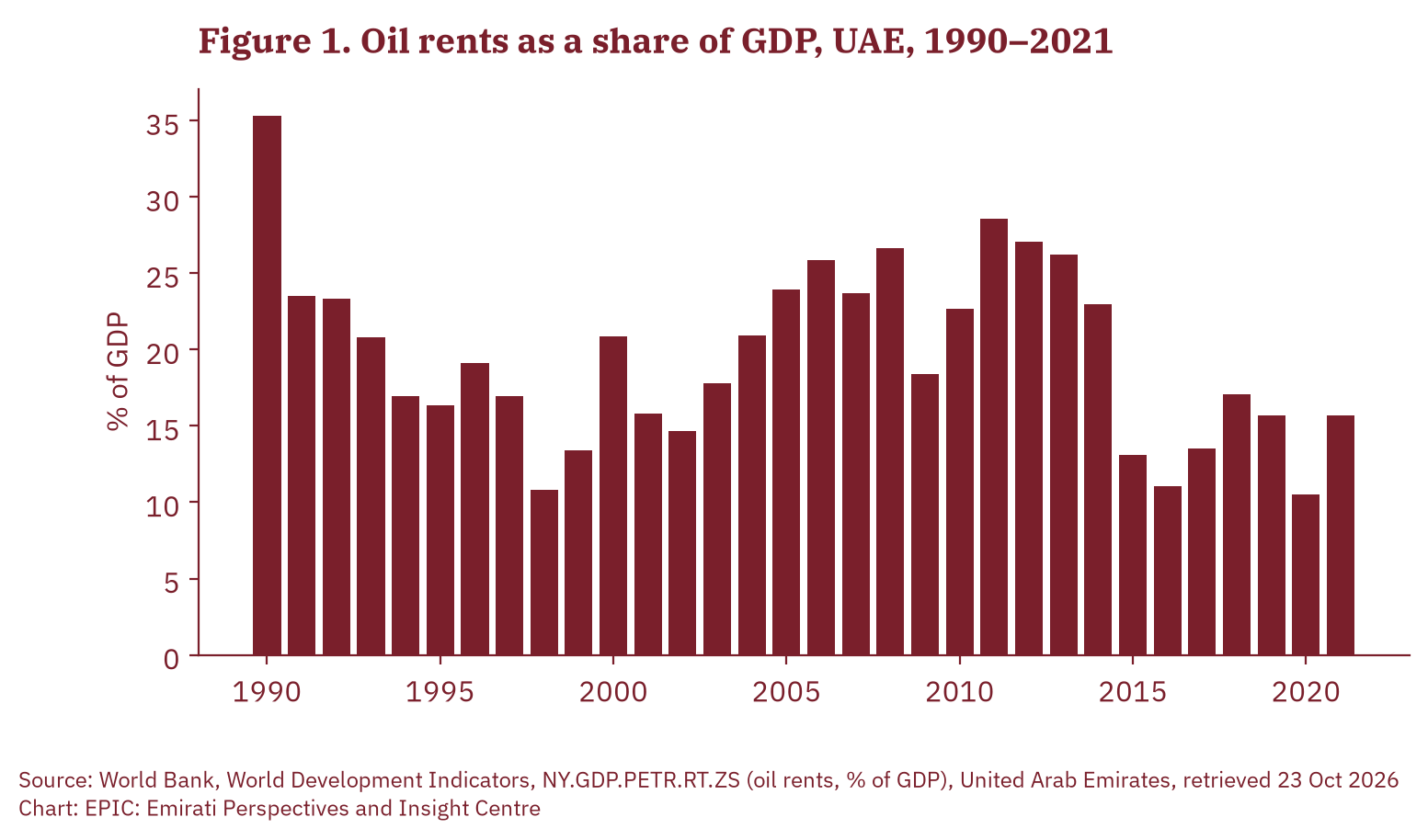
Oil rents. The World Bank's estimate of oil rents, the value of crude oil production at world prices minus the cost of production, fell from about 35.3 per cent of GDP in 1990 to 20.8 per cent in 2000 and 22.7 per cent in 2010, and then to between 10.5 and 17.1 per cent in 2015 to 2021, the latest year available (Figure 1). The 1990 value reflects the oil price spike of that year; by 1991 the share was 23.5 per cent. The series moves with oil prices as well as with the structure of the economy: the low point of 10.5 per cent in 2020 reflects the collapse in prices that year as much as any structural change.
Openness. World Bank data put exports of goods and services at about 107 per cent of GDP in 2023, up from about 77 per cent in 2010. The UAE is above all a trading economy, and much of its trade consists of re-exports.
3. The structure of non-oil output
According to the Ministry of Economy's statement on the 2024 figures, the largest non-oil activities were trade (16.8 per cent), manufacturing (13.5 per cent), financial and insurance activities (13.2 per cent), construction (11.7 per cent) and real estate (7.8 per cent). For the first nine months of 2024 the FCSC gave comparable figures explicitly as shares of non-oil GDP (trade 16.5, manufacturing 15.1, finance 12.1, construction 11.7 and real estate 7.6 per cent), with transport, construction, finance, government and hospitality among the fastest-growing sectors.
This is a broad base. No single non-oil activity dominates, and several of the leading activities, especially trade, transport, finance and hospitality, reflect the UAE's position as a regional and global hub.
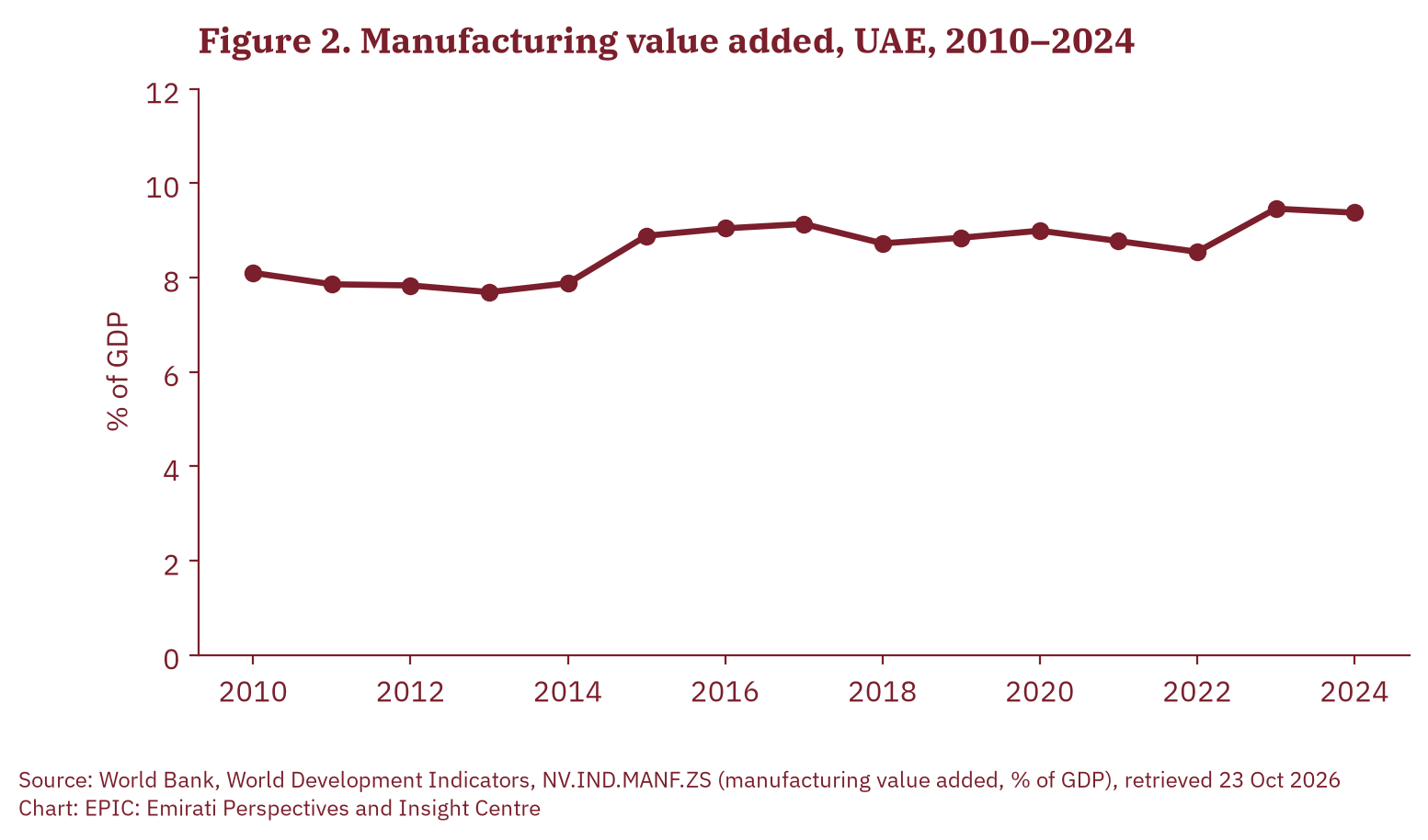
Manufacturing is the exception that matters most for policy. In the World Bank series, manufacturing value added was 8.1 per cent of GDP in 2010, 8.9 per cent in 2015 and 9.4 per cent in 2024 (Figure 2). In March 2021 the government launched "Operation 300bn", a ten-year industrial strategy led by the Ministry of Industry and Advanced Technology, to raise the industrial sector's contribution to GDP from AED 133 billion to AED 300 billion by 2031 and to support 13,500 industrial small and medium enterprises. The strategy also aims to raise industrial research and development spending from AED 21 billion, or 1.3 per cent of GDP, to AED 57 billion. Its priority sectors include pharmaceuticals, electronics, petrochemicals, machinery, hydrogen, medical technology and space technology.
4. The 2031 targets
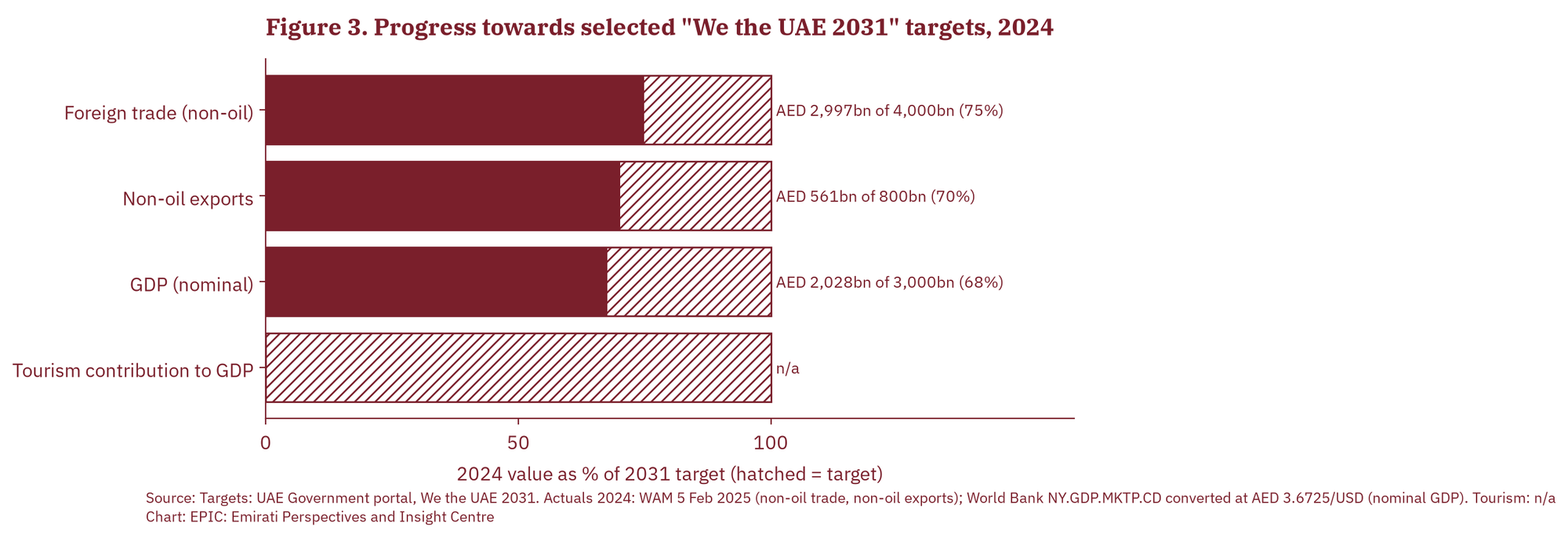
In November 2022 the government launched "We the UAE 2031", a ten-year national plan. Its economic pillar sets four headline targets: to double GDP from AED 1.49 trillion to AED 3 trillion; to raise non-oil exports to AED 800 billion; to raise foreign trade to AED 4 trillion; and to raise the contribution of tourism to GDP to AED 450 billion.
Progress against these targets, using the latest official figures found for this paper, is set out in Figure 3.
- Foreign trade. Non-oil foreign trade reached about AED 3.0 trillion in 2024 (AED 2.997 trillion), up 14.6 per cent on 2023, according to official statements in February 2025. That is about three quarters of the AED 4 trillion target, with seven years remaining. Since 2021 the UAE has pursued a programme of Comprehensive Economic Partnership Agreements (CEPAs), beginning with India, whose agreement entered into force on 1 May 2022.
- Non-oil exports. Non-oil exports of goods reached a record of about AED 561 billion in 2024, up 27.6 per cent, or about 70 per cent of the AED 800 billion target.
- GDP. Real GDP was AED 1,776 billion in 2024. World Bank data put nominal GDP at about USD 552 billion in 2024, roughly AED 2.03 trillion at the fixed exchange rate of AED 3.6725 to the dollar. Reaching AED 3 trillion by 2031 would require nominal growth of roughly 6 per cent a year, above the real growth rates of 4 to 4.3 per cent recorded in 2023 and 2024 in the World Bank series, and so dependent on inflation, oil prices or faster growth.
- Tourism. No official figure for tourism's total contribution to GDP comparable with the AED 450 billion target was found in an opened source for this paper, so the figure is marked n/a.
5. How independent is the non-oil economy?
A non-oil share of three quarters does not mean that three quarters of the economy would be unaffected by a fall in oil revenues. Three links remain.
First, public spending and investment. Hydrocarbon revenues fund government budgets and the national investment institutions, which in turn finance infrastructure, real estate and new industries.
Second, inputs. Petrochemicals, aluminium and other energy-intensive industries count as manufacturing but depend on hydrocarbons for feedstock or power, and the industrial strategy itself lists petrochemicals among its priority sectors.
Third, confidence and liquidity. Trade, finance and real estate respond to regional liquidity, which oil prices strongly influence.
The appropriate conclusion is not that diversification is illusory, but that the non-oil share is a measure of output composition, not of resilience. A complementary measure would show how much of government revenue and of the current account depends on hydrocarbons, and how the non-oil economy performs in years of low oil prices.
6. Recommendations
- Publish a resilience dashboard. Alongside the non-oil share of GDP, the FCSC and the Ministry of Finance should publish regularly the hydrocarbon share of consolidated government revenue, of goods exports and of the current account.
- Define the industrial target clearly. Operation 300bn's baseline of AED 133 billion should be published annually against a stated statistical definition, so that progress can be compared with national accounts.
- Focus industrial support on tradable, non-hydrocarbon products. Support should be weighted towards sectors whose competitiveness does not rest mainly on low-cost energy or feedstock.
- Report tourism's contribution on a consistent basis. A tourism satellite account would make the AED 450 billion target measurable.
- Use trade agreements to deepen exports, not only trade. CEPA reporting should separate domestic exports, re-exports and imports, so that the effect on national production is visible.
7. Conclusion
The UAE has moved further from dependence on oil than most hydrocarbon producers. The official numbers show a broad non-oil economy, a trade sector already close to its 2031 ambition and a clear industrial strategy. The harder tasks are to raise manufacturing to the scale the strategy envisages, to sustain growth fast enough to double GDP, and to measure diversification in a way that captures resilience as well as composition.
About this paper
EPIC-PP-2026-022. Written by the EPIC Research Team. All data are cited to public sources listed in the references; where no published value exists, the paper says so.
References
- Dubai Media Office (2021). "Mohammed bin Rashid launches Operation 300Bn to raise industrial sector's contribution to Dh300 billion", 22 March 2021.
- Emirates News Agency (WAM) (2022). "Mohammed bin Rashid witnesses the launch of 'We The UAE 2031' during the UAE Government annual meetings", 23 November 2022.
- Emirates News Agency (WAM) (2025). "UAE's GDP reached AED1,776 billion in 2024 with 4% growth", 15 June 2025.
- Emirates News Agency (WAM) (2025). "UAE's non-oil foreign trade continued its upward trajectory, reaching AED3 trillion in 2024: Al Zeyoudi", 5 February 2025.
- Federal Competitiveness and Statistics Centre (2025). "UAE Economy Records 4.5% Growth in Non-Oil Sectors, with Real GDP Expanding by 3.8%", press release, March 2025.
- Ministry of Industry and Advanced Technology (2021). "Mohammed bin Rashid launches Operation 300bn to advance UAE industrial sector".
- Press Information Bureau, Government of India (2022). Release on the entry into force of the India–UAE CEPA, 1 May 2022.
- UAE Government portal. "'We the UAE 2031' vision"; "Operation 300bn, the UAE's industrial strategy". https://u.ae/
- World Bank. World Development Indicators: NY.GDP.PETR.RT.ZS, NV.IND.MANF.ZS, NY.GDP.MKTP.CD, NY.GDP.MKTP.KD.ZG, NE.EXP.GNFS.ZS. Retrieved 23 October 2026.
Sources and verification notes
Sources and verification notes: "Beyond the Barrel"
All sources were retrieved and checked on 23 October 2026 (Asia/Dubai, UTC+4). Local World Bank API copies are in research/epic-new/_data/divers/.
| # | Claim in paper | Source checked | Verdict | Action |
|---|---|---|---|---|
| 1 | Real GDP AED 1,776bn in 2024, +4%; non-oil AED 1,342bn, +5%; oil AED 434bn; non-oil share 75.5% | WAM 15 Jun 2025; Ministry of Economy release | Correct | Kept |
| 2 | Nominal non-oil share 76.5%, first nine months 2024 | FCSC press release, Mar 2025 | Correct | Kept |
| 3 | Oil rents 35.3% (1990), 20.8% (2000), 22.7% (2010) | WB NY.GDP.PETR.RT.ZS | Correct | Kept |
| 4 | Oil rents "between 10.5 and 15.7%" 2015–2021 | WB NY.GDP.PETR.RT.ZS (2018 = 17.1) | Needs correction | Corrected to 10.5–17.1%; 1990 spike caveat added |
| 5 | Exports of goods and services 107% of GDP (2023), 77% (2010) | WB NE.EXP.GNFS.ZS | Correct | Kept |
| 6 | 2024 non-oil activity shares: trade 16.8, manufacturing 13.5, finance 13.2, construction 11.7, real estate 7.8 | WAM / Ministry of Economy 15 Jun 2025 | Mixed | Kept, attributed to ministry statement; 9-month FCSC shares of non-oil GDP added for precision |
| 7 | Manufacturing 8.1% (2010), 8.9% (2015), 9.4% (2024) of GDP | WB NV.IND.MANF.ZS | Correct | Kept |
| 8 | Operation 300bn, March 2021: AED 133bn to 300bn by 2031; 13,500 SMEs; R&D AED 21bn (1.3%) to AED 57bn; priority sectors | MoIAT; Dubai Media Office 22 Mar 2021; u.ae | Correct | Kept |
| 9 | We the UAE 2031 launched Nov 2022; GDP 1.49 to 3 trillion; non-oil exports 800bn; trade 4 trillion; tourism 450bn | u.ae; WAM; MOFA | Correct | Kept |
| 10 | Non-oil foreign trade AED 2.997 trillion in 2024, +14.6% | WAM 5 Feb 2025 | Correct | Kept |
| 11 | Non-oil exports AED 561.2bn, +27.6% | WAM 5 Feb 2025 | Correct | Kept |
| 12 | CEPA programme from 2021; India CEPA in force 1 May 2022 | WAM Projects of the 50; PIB India | Correct | Kept |
| 13 | Nominal GDP USD 552bn (2024), about AED 2.03 trillion at 3.6725 | WB NY.GDP.MKTP.CD; calculation | Correct | Kept |
| 14 | Required nominal growth roughly 6% a year to 2031 | Calculation (3.0/2.03)^(1/7) = 5.7% | Correct | Kept |
| 15 | Real growth 4.3% (2023), 4.0% (2024) | WB NY.GDP.MKTP.KD.ZG | Correct | Kept |
| 16 | Tourism total contribution to GDP for 2024 comparable with target | No opened official source | Unverifiable | Dropped; shown as n/a |
| 17 | Industrial strategy lists petrochemicals as a priority sector | u.ae Operation 300bn page | Correct | Kept |
| 18 | Size of sovereign investment portfolios (initially drafted as a figure) | No official AUM disclosure opened | Unverifiable | Dropped; no figure used |
Totals: 18 claims checked: 14 correct, 1 needs correction (corrected), 2 unverifiable (dropped), 1 mixed (reworded).