
 Emirati Perspectives and Insight Centre
Full text
1. Introduction
Artificial intelligence has moved from a research subject to an instrument of national strategy. States now compete on the compute they host, the models they build, the talent they train and the rules they write. The UAE was early to treat AI in this way. This paper asks four questions: how AI policy is governed in the UAE, which institutions carry it, how far AI has been adopted, and where the gaps lie.
The paper does not repeat EPIC's earlier work on cybersecurity governance (EPIC-PP-2026-026; EPIC 2026c) or on the geopolitics of Gulf AI compute (EPIC-PP-2026-009; EPIC 2026a). It focuses on the national strategy and its delivery. Section 2 traces the strategy. Section 3 sets out the institutions. Section 4 covers governance and rules. Section 5 examines compute and data centres, Section 6 adoption, and Section 7 talent and research. Section 8 places the UAE beside Saudi Arabia. Sections 9 and 10 set out gaps and recommendations.
2. From the 2017 announcement to the 2031 strategy
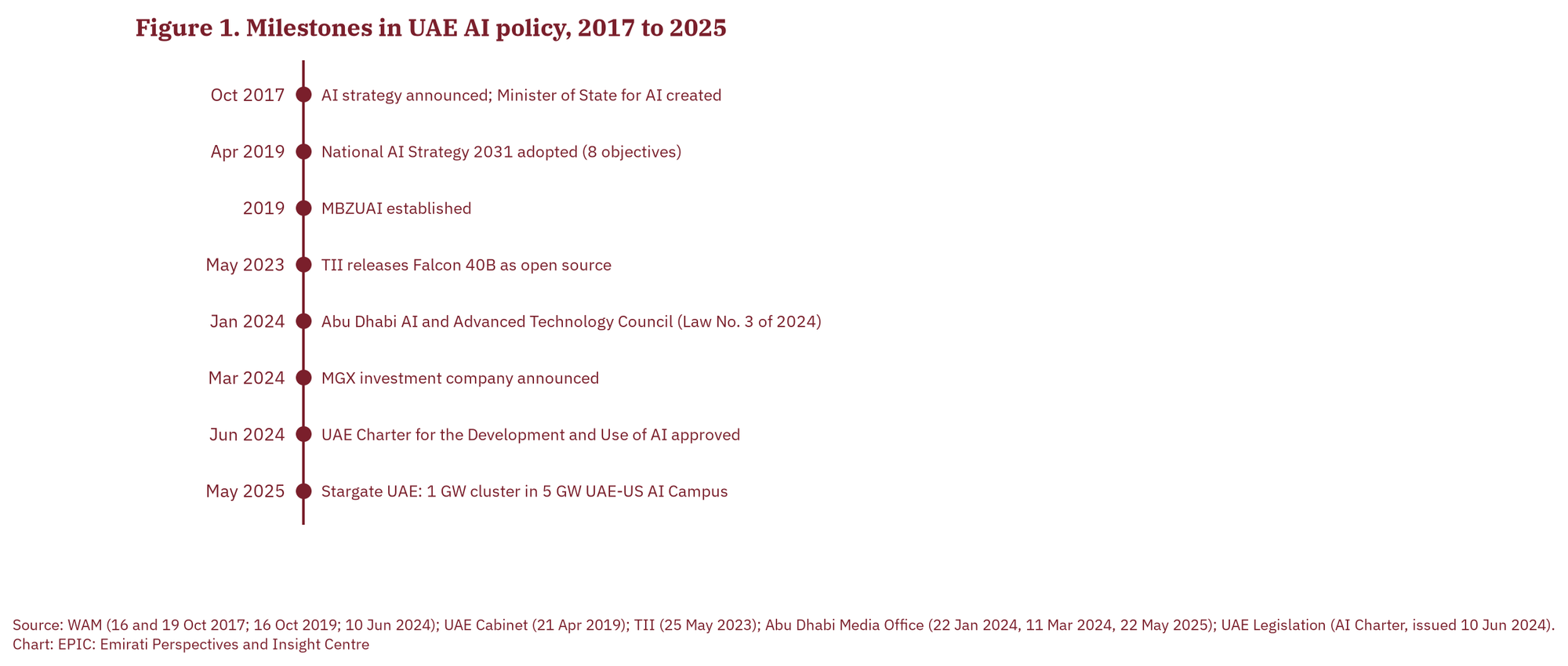
On 16 October 2017 the UAE announced its Strategy for Artificial Intelligence as an initiative within the UAE Centennial 2071 objectives (WAM 2017b). The announcement described five interrelated core axes and named priority sectors including transport, healthcare, space, water, technology, education and agriculture (MoFA 2017). Three days later a federal government restructuring created a Minister of State for Artificial Intelligence (WAM 2017a).
On 21 April 2019 the UAE Cabinet adopted the National Artificial Intelligence Strategy 2031. Its stated aim is to position the UAE as a global leader in AI by 2031. It sets eight strategic objectives (UAE Cabinet 2019):
- reaffirm the UAE's position as a global hub for AI;
- increase the competitive edge of the AI sector;
- establish an incubator for AI innovations;
- employ AI in customer services to improve quality of life;
- attract and train talent for future jobs;
- attract leading research capabilities;
- provide data-driven infrastructure to support AI experiments; and
- optimise AI governance and regulation.
The Cabinet assigned oversight of implementation to the Emirates Council for Artificial Intelligence and Digital Transactions, working with federal and local entities (UAE Cabinet 2019).
3. Institutions
The UAE's AI system combines federal policy bodies with emirate-level, largely Abu Dhabi, institutions for research, investment and infrastructure.
Federal level. The Minister of State for Artificial Intelligence, created in 2017, and the Emirates Council for Artificial Intelligence and Digital Transactions lead federal policy and oversee the 2031 strategy.
Research and education. Abu Dhabi established the Mohamed bin Zayed University of Artificial Intelligence (MBZUAI) in 2019 (WAM 2019). The university describes itself as the world's first graduate-level, research-based AI university, offering master's and doctoral programmes. The Technology Innovation Institute (TII), part of Abu Dhabi's Advanced Technology Research Council, released its Falcon 40B large language model as an open-source model on 25 May 2023, for research and commercial use, and moved it to the royalty-free Apache 2.0 licence on 31 May 2023 (TII 2023b; 2023a). The model was trained on one trillion tokens.
Strategy and investment. In January 2024 Abu Dhabi Law No. 3 of 2024 established the Artificial Intelligence and Advanced Technology Council (AIATC) to set the emirate's policy for AI research, infrastructure and investment (Abu Dhabi Media Office 2024b; Government of Abu Dhabi 2024). On 11 March 2024 the Council announced MGX, a technology investment company with Mubadala and G42 as foundational partners, investing in AI infrastructure, semiconductors and AI applications (Abu Dhabi Media Office 2024a).
Private and partnership capital. On 16 April 2024 Microsoft announced a USD 1.5 billion strategic investment in G42, the Abu Dhabi AI company, together with expanded cooperation on AI and cloud services (Microsoft 2024).
4. Governance and rules
The UAE has so far governed AI mainly through strategy, principles and existing sector law rather than a single AI statute.
The UAE Cabinet approved the UAE Charter for the Development and Use of Artificial Intelligence on 10 June 2024, and it was launched publicly on 30 July 2024 (WAM 2024b; 2024a; UAE Legislation 2024). It sets out twelve principles, including strengthening human-machine ties, safety, mitigation of algorithmic bias, data privacy, transparency, human oversight, governance and accountability, and compliance with laws and treaties. The Charter is a statement of principles. It does not itself create penalties or a licensing regime.
Binding protection for the data on which AI systems depend comes from general law, notably Federal Decree-Law No. 45 of 2021 on the Protection of Personal Data (UAE Legislation 2021), discussed in EPIC-PP-2026-026 (EPIC 2026c). Financial free zones and emirate regulators apply their own rules. The result is a layered system in which principles are national and enforceable obligations are spread across several regimes.
5. Compute and data centres
Compute capacity is the most visible change since 2023. On 22 May 2025 G42, OpenAI, Oracle, NVIDIA, Cisco and SoftBank Group announced Stargate UAE, a 1-gigawatt AI compute cluster to be built by G42 and operated by OpenAI and Oracle. It sits inside a newly established 5-gigawatt UAE-US AI Campus in Abu Dhabi, spanning 10 square miles, which its sponsors describe as the largest such deployment outside the United States (Abu Dhabi Media Office 2025; G42 2025; OpenAI 2025). The campus is to be powered by nuclear, solar and natural gas. The first 200-megawatt cluster was scheduled to go live in 2026. In October 2025 G42 reported that construction of the first 200 megawatts, led by its subsidiary Khazna Data Centers, was well under way and on course for 2026 delivery (WAM 2025). No published confirmation that the cluster is operating was found at the time of writing.
The announcement built on a framework between the two governments, the US-UAE AI Acceleration Partnership. Under the agreement OpenAI stated that the UAE would become the first country to enable ChatGPT nationwide (OpenAI 2025).
Two features matter for policy. First, capacity on this scale depends on imported advanced chips and on the export-control decisions of the supplying state. Second, 5 gigawatts is a very large electrical load for a country whose power system EPIC examined in EPIC-PP-2026-018 (EPIC 2026b). No published official estimate of the campus's annual electricity demand, or of how it will be met as phases come online, was found. This is a data gap.
6. Adoption
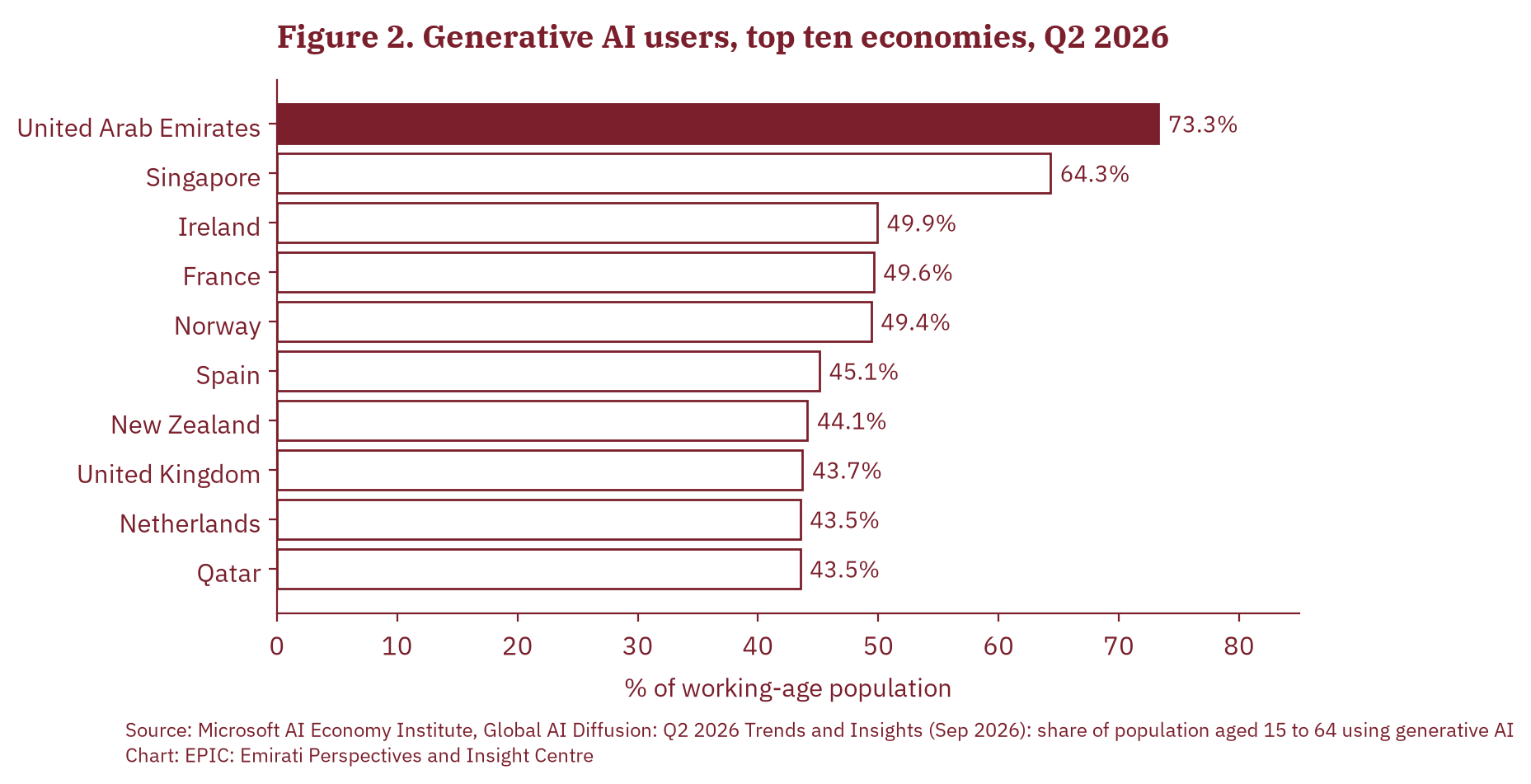
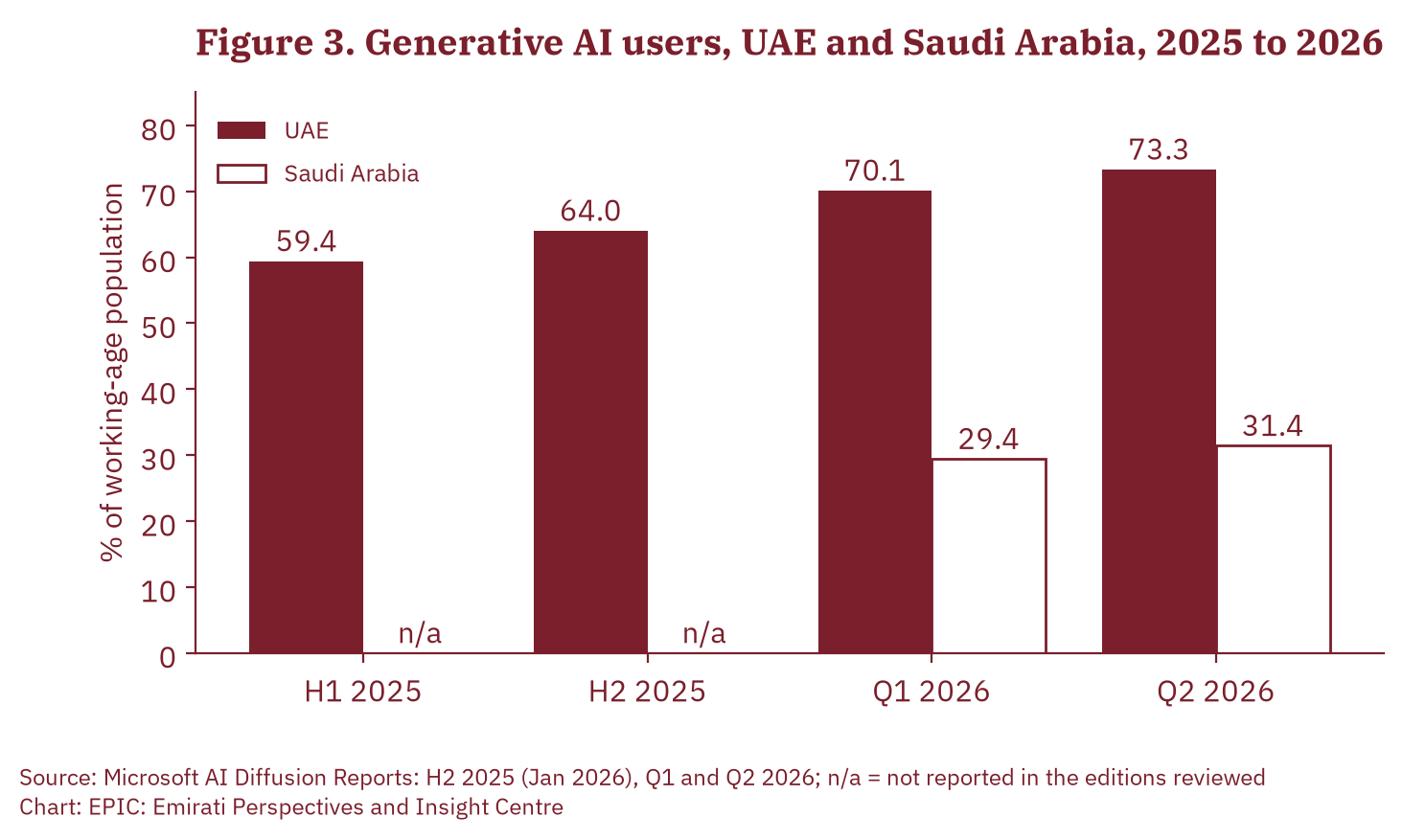
Microsoft's AI Economy Institute publishes the most widely cited cross-country measure of AI use: the share of people aged 15 to 64 who used a generative AI product in a period, derived from anonymised telemetry and adjusted for device-market share, internet penetration and population. On this measure the UAE ranked first in every edition reviewed. Its share rose from 59.4 per cent in the first half of 2025 to 64.0 per cent in the second half (Microsoft AI Economy Institute 2026a), 70.1 per cent in the first quarter of 2026 (Microsoft AI Economy Institute 2026b) and 73.3 per cent in the second quarter of 2026 (Microsoft AI Economy Institute 2026c; Figures 2 and 3). In the second quarter of 2026 Singapore was second at 64.3 per cent, and Saudi Arabia was 25th at 31.4 per cent. Worldwide usage was 18.8 per cent.
The measure has limits that Microsoft itself acknowledges. It counts any use in the period, not intensity or productive use, and it rests on one company's telemetry. It shows breadth of uptake. It does not show economic impact, and no published official estimate of AI's contribution to UAE GDP covering recent years was found.
Source: Microsoft AI Economy Institute 2026a; 2026b; 2026c.
Source: Microsoft AI Economy Institute 2026a; 2026b; 2026c.
7. Talent and research
Talent is the fifth objective of the 2031 strategy. MBZUAI and TII are the clearest institutional responses, and the open release of Falcon models has given the UAE visibility in international AI research. The Microsoft-G42 agreement and the Stargate partnership both include stated commitments to skills (Microsoft 2024; OpenAI 2025).
What cannot yet be assessed is scale. No published official series was found for the number of AI specialists working in the UAE, the share who are Emirati nationals, or the number of AI graduates entering the labour market each year. Without such a baseline, progress on the talent objective cannot be measured.
8. The UAE and Saudi Arabia
Saudi Arabia is building a comparable system on a larger domestic market. The Saudi Data and Artificial Intelligence Authority (SDAIA) was established by royal order in August 2019 and reports to the Prime Minister (SDAIA n.d.). On 12 May 2025 the Public Investment Fund launched HUMAIN, a company to build and operate AI infrastructure, cloud services, models and applications (PIF 2025). On Microsoft's measure Saudi Arabia climbed five places to 25th in the second quarter of 2026, the largest rise in rank in that edition (Microsoft AI Economy Institute 2026b; 2026c).
The two approaches share a direction and differ in emphasis. The UAE combines a federal strategy with Abu Dhabi investment vehicles and international partnerships. Saudi Arabia has concentrated data and AI policy in a single central authority with a sovereign-fund operator. For the Gulf as a whole, two large AI programmes create competition for chips, power and talent. They also create scope for cooperation on Arabic-language models and shared standards.
9. Gaps
No published scorecard. The 2031 strategy has eight objectives, but no published set of indicators or annual progress reports against them was found. The federal government has announced an 'agent control tower' that logs the actions of government AI agents, and a framework that it says includes performance indicators, but no oversight or audit indicators had been published at the time of writing (Gulf News 2026). Announcements are frequent; measurement is not.
Workforce data. No published official count of AI professionals or graduates was found, so the talent objective cannot be tracked.
Energy and supply chains. The power demand of multi-gigawatt compute and dependence on imported chips are not addressed in any published official assessment found for this paper.
From principles to rules. The 2024 Charter sets principles but not enforceable obligations. Oversight of high-risk uses in government, health and finance rests on sector regimes that are not yet harmonised.
Economic impact. Adoption is measured; productivity gains are not.
10. Recommendations
- Publish a 2031 strategy scorecard. Set indicators for each of the eight objectives and report against them annually.
- Create an AI workforce baseline. Publish counts of AI specialists and graduates by nationality and sector, and set targets.
- Publish an energy plan for compute. Set out expected electricity demand of major AI campuses by phase and how it will be supplied.
- Turn the Charter into risk-based rules. Define high-risk uses and minimum obligations for testing, human oversight and redress, applied consistently across federal, emirate and free-zone regulators.
- Measure impact. Commission official estimates of AI use and productivity effects in firms and government.
- Deepen Gulf cooperation. Explore joint work with Saudi Arabia and other Gulf states on Arabic-language models, evaluation standards and research exchange.
11. Conclusion
In nine years the UAE has moved from a strategy announcement to a full AI system: a dedicated minister, a federal strategy, a specialist university, open models, investment vehicles, a charter of principles and one of the largest planned compute campuses in the world. It ranks first on Microsoft's measure of adoption. The next phase is about evidence: showing, with published indicators, whether the system is delivering against each of the 2031 objectives.
About this paper
This paper was prepared by the EPIC Research Team as part of the daily papers programme. All figures were verified against the sources listed below on 26 October 2026. Claims that could not be verified were removed or stated as data gaps. See the accompanying sources and verification notes.
References
Abu Dhabi Media Office. 2024a. "Abu Dhabi Launches Comprehensive Global Investment Strategy on Artificial Intelligence." 11 March 2024. https://www.mediaoffice.abudhabi/en/technology/abu-dhabi-launches-comprehensive-global-investment-strategy-on-artificial-intelligence/.
Abu Dhabi Media Office. 2024b. "UAE President Issues Law Establishing Artificial Intelligence and Advanced Technology Council." 22 January 2024. https://www.mediaoffice.abudhabi/en/government-affairs/in-his-capacity-as-ruler-of-abu-dhabi-uae-president-issues-law-establishing-artificial-intelligence-and-advanced-technology-council/.
Abu Dhabi Media Office. 2025. "Global Tech Alliance Launches Stargate UAE." 22 May 2025. https://www.mediaoffice.abudhabi/en/technology/global-tech-alliance-launches-stargate-uae/.
EPIC (Emirati Perspectives and Insight Centre). 2026a. Data Sovereignty Without Borders: Gulf States and the Geopolitics of AI Compute. EPIC-PP-2026-009. 20 October 2026. https://epicuae.org/research/data-sovereignty.
EPIC (Emirati Perspectives and Insight Centre). 2026b. The Quarter Grid: Barakah, Gas Displacement and the Next Stage of the UAE's Power Transition. EPIC-PP-2026-018. 21 October 2026. https://epicuae.org/research/quarter-grid.
EPIC (Emirati Perspectives and Insight Centre). 2026c. Securing the Digital State: Cybersecurity Governance in the UAE. EPIC-PP-2026-026. 25 October 2026. https://epicuae.org/research/securing-the-digital-state.
G42. 2025. "Global Tech Alliance Launches Stargate UAE." 22 May 2025. https://www.g42.ai/resources/news/global-tech-alliance-launches-stargate-uae.
Government of Abu Dhabi. 2024. "Law No. (3) of 2024 Establishing the Artificial Intelligence and Advanced Technology Council." Issued 22 January 2024. Official Gazette (Abu Dhabi) 53, no. 1 (31 January 2024): 16–21. In Arabic. Accessed 28 October 2026. https://www.abudhabi.gov.ae/-/media/sites/adgov/gazettes/2024/ar/1st-arabic-2024.ashx.
Gulf News. 2026. "UAE Reveals 'Control Tower' to Monitor AI Government Agents." 14 October 2026. https://gulfnews.com/business/economy/uae-reveals-control-tower-to-monitor-ai-government-agents-1.500710167.
Microsoft. 2024. "Microsoft Invests $1.5 Billion in Abu Dhabi's G42 to Accelerate AI Development and Global Expansion." 16 April 2024. https://news.microsoft.com/source/2024/04/16/microsoft-invests-1-5-billion-in-abu-dhabis-g42-to-accelerate-ai-development-and-global-expansion/.
Microsoft AI Economy Institute. 2026a. Global AI Adoption in 2025: A Widening Digital Divide. AI Diffusion Report H2 2025. January 2026. https://www.microsoft.com/en-us/research/wp-content/uploads/2026/01/Microsoft-AI-Diffusion-Report-2025-H2.pdf.
Microsoft AI Economy Institute. 2026b. Global AI Diffusion: Q1 2026 Trends and Insights. May 2026. https://www.microsoft.com/en-us/research/wp-content/uploads/2026/05/Microsoft-AI-Diffusion-Report-2026-Q1.pdf.
Microsoft AI Economy Institute. 2026c. Global AI Diffusion: Q2 2026 Trends and Insights. September 2026. https://www.microsoft.com/en-us/research/wp-content/uploads/2026/09/Microsoft-AI-Diffusion-Report-2026-Q2.pdf.
MoFA (UAE Ministry of Foreign Affairs). 2017. "His Highness Sheikh Mohammed bin Rashid Launches UAE Strategy for Artificial Intelligence." 18 October 2017. https://www.mofa.gov.ae/en/MediaHub/News/2019/2017/10/17/17-10-2017-UAE-Artificial-Intelligence.
OpenAI. 2025. "Introducing Stargate UAE." 22 May 2025. https://openai.com/index/introducing-stargate-uae/.
PIF (Public Investment Fund). 2025. "HRH Crown Prince Launches HUMAIN as Global AI Powerhouse." 12 May 2025. https://www.pif.gov.sa/en/news-and-insights/press-releases/2025/hrh-crown-prince-launches-humain-as-global-ai-powerhouse/.
SDAIA (Saudi Data & AI Authority). n.d. "About SDAIA." Accessed 26 October 2026. https://sdaia.gov.sa/en/SDAIA/about/Pages/About.aspx.
TII (Technology Innovation Institute). 2023a. "UAE's Falcon 40B Is Now Royalty Free." 31 May 2023. https://www.tii.ae/news/uaes-falcon-40b-now-royalty-free.
TII (Technology Innovation Institute). 2023b. "UAE's Technology Innovation Institute Launches Open-Source 'Falcon 40B' Large Language Model." 25 May 2023. https://www.tii.ae/news/uaes-technology-innovation-institute-launches-open-source-falcon-40b-large-language-model.
UAE Cabinet. 2019. "UAE Cabinet Adopts National Artificial Intelligence Strategy 2031." 21 April 2019. https://uaecabinet.ae/en/news/uae-cabinet-adopts-national-artificial-intelligence-strategy-2031.
UAE Legislation. 2021. Federal Decree-Law No. 45 of 2021 Concerning the Protection of Personal Data. Issued 20 September 2021. https://uaelegislation.gov.ae/en/legislations/1972.
UAE Legislation. 2024. "The UAE Charter for the Development and Use of Artificial Intelligence." Issued 10 June 2024. Accessed 26 October 2026. https://uaelegislation.gov.ae/en/policy/details/the-uae-charter-for-the-development-and-use-of-artificial-intelligence.
WAM (Emirates News Agency). 2017a. "Mohammed bin Rashid Announces Cabinet Reshuffle." 19 October 2017. https://www.wam.ae/en/article/hszr5zhp-mohammed-bin-rashid-announces-cabinet-reshuffle.
WAM (Emirates News Agency). 2017b. "Mohammed bin Rashid Launches UAE Strategy for Artificial Intelligence." 16 October 2017. https://www.wam.ae/en/article/hszr5ytv-mohammed-bin-rashid-launches-uae-strategy-for.
WAM (Emirates News Agency). 2019. "Abu Dhabi Announces Establishment of the Mohamed bin Zayed University of Artificial Intelligence." 16 October 2019. https://www.wam.ae/en/article/hszr9b3g-abu-dhabi-announces-establishment-the-mohamed-bin.
WAM (Emirates News Agency). 2024a. "Artificial Intelligence Office Launches 'UAE Charter for Development and Use of AI'." 30 July 2024. https://www.wam.ae/en/article/b4f7n7s-artificial-intelligence-office-launches-%E2%80%98uae.
WAM (Emirates News Agency). 2024b. "UAE Cabinet … Approves Ethical Charter of AI." 10 June 2024. https://www.wam.ae/en/article/b3lfzd4-chaired-mohammed-bin-rashid-uae-cabinet-reviews.
WAM (Emirates News Agency). 2025. "G42 Advances Construction of Stargate UAE AI Infrastructure Cluster." 16 October 2025. https://www.wam.ae/en/article/bm8fieb-g42-advances-construction-stargate-uae.
Sources and verification notes
Sources and verification notes: EPIC-PP-2026-028 "The Algorithmic State"
Recounted by the EPIC Research Team on 26 October 2026 (Asia/Dubai, UTC+4). Verdicts: Correct, Needs correction, Unverifiable, Mixed.
| # | Claim (section) | Verdict | Source | Action |
|---|---|---|---|---|
| 1 | AI Strategy announced 16 Oct 2017 within Centennial 2071; five interrelated core axes; priority sectors incl. transport, healthcare, space, water, technology, education, agriculture (§2) | Correct | WAM, 16 Oct 2017, https://www.wam.ae/en/article/hszr5ytv-mohammed-bin-rashid-launches-uae-strategy-for ; MoFA, 18 Oct 2017, https://www.mofa.gov.ae/en/MediaHub/News/2019/2017/10/17/17-10-2017-UAE-Artificial-Intelligence | Kept |
| 2 | Minister of State for AI post created 2017 (§3; the "world's first" wording was already removed) | Correct | WAM, 19 Oct 2017, https://www.wam.ae/en/article/hszr5zhp-mohammed-bin-rashid-announces-cabinet-reshuffle | Kept; "world's first" stays out |
| 3 | Strategy 2031 adopted 21 Apr 2019; eight objectives (listed); overseen by the Emirates Council for AI and Digital Transactions (§2) | Correct | UAE Cabinet, 21 Apr 2019, https://uaecabinet.ae/en/news/uae-cabinet-adopts-national-artificial-intelligence-strategy-2031 | Kept |
| 4 | MBZUAI set up 2019, describes itself as the first graduate-level, research-based AI university (§3) | Correct | WAM, 16 Oct 2019, https://www.wam.ae/en/article/hszr9b3g-abu-dhabi-announces-establishment-the-mohamed-bin | Kept, attributed to the university |
| 5 | TII is part of ATRC (§3) | Correct | TII, 25 May 2023 (re-opened): "applied research pillar of Abu Dhabi's Advanced Technology Research Council" | Kept |
| 6 | Falcon 40B made open source 25 May 2023; 1 trillion tokens; research and commercial use (§3) | Correct | TII, 25 May 2023 (re-opened), https://www.tii.ae/news/uaes-technology-innovation-institute-launches-open-source-falcon-40b-large-language-model | Kept |
| 7 | Released "under an Apache 2.0 licence" on 25 May 2023 (§3) | Needs correction | TII, 25 May 2023 ("a license built upon the principles of open-source Apache 2.0"); TII, 31 May 2023, https://www.tii.ae/news/uaes-falcon-40b-now-royalty-free | Corrected: open source 25 May 2023, Apache 2.0 from 31 May 2023 |
| 8 | AIATC set up by Abu Dhabi Law No. 3 of 2024 (§3) | Correct | Abu Dhabi Media Office, 22 Jan 2024; Government of Abu Dhabi 2024 (Official Gazette, issued 22 Jan 2024) | Kept |
| 9 | MGX announced 11 Mar 2024 by AIATC; Mubadala and G42 foundational partners (§3) | Correct | Abu Dhabi Media Office, 11 Mar 2024 (re-opened), https://www.mediaoffice.abudhabi/en/technology/abu-dhabi-launches-comprehensive-global-investment-strategy-on-artificial-intelligence/ | Kept |
| 10 | Microsoft USD 1.5bn investment in G42 on 16 Apr 2024 "for a minority stake" (§3) | Mixed | Microsoft, 16 Apr 2024, https://news.microsoft.com/source/2024/04/16/microsoft-invests-1-5-billion-in-abu-dhabis-g42-to-accelerate-ai-development-and-global-expansion/ | Corrected: "minority stake" cut; "strategic investment" |
| 11 | "On 10 June 2024 the UAE published the Charter" (§4) | Mixed | WAM, 10 Jun 2024 (Cabinet approval); WAM, 30 Jul 2024 (public launch); UAE Legislation (issued 10 Jun 2024) | Corrected: approved 10 June 2024, launched 30 July 2024 |
| 12 | Charter: twelve principles incl. human oversight, transparency, accountability (§4) | Correct | UAE Legislation, https://uaelegislation.gov.ae/en/policy/details/the-uae-charter-for-the-development-and-use-of-artificial-intelligence | Kept |
| 13 | Charter is a statement of principles without penalties (§4) | Correct | Same | Kept |
| 14 | Personal data law: Federal Decree-Law No. 45 of 2021 (§4) | Correct | UAE Legislation, issued 20 Sep 2021, https://uaelegislation.gov.ae/en/legislations/1972 | Kept |
| 15 | Stargate UAE: 1 GW; G42 builds; OpenAI and Oracle operate; first 200 MW in 2026; inside the 5 GW campus (§5) | Correct | G42, 22 May 2025; OpenAI, 22 May 2025 | Kept |
| 16 | Oct 2025: Khazna building the first 200 MW, on course for 2026 (§5) | Correct | WAM, 16 Oct 2025, https://www.wam.ae/en/article/bm8fieb-g42-advances-construction-stargate-uae | Kept |
| 17 | No public confirmation that the first 200 MW is operating (§5) | Unverifiable | none | Stated as not found |
| 18 | US-UAE AI Acceleration Partnership; ChatGPT nationwide (§5) | Correct | OpenAI, 22 May 2025, https://openai.com/index/introducing-stargate-uae/ | Kept, attributed to OpenAI |
| 19 | No official estimate of the campus's electricity demand (§5) | Unverifiable | none | Stated as not found |
| 20 | UAE share: 59.4% (H1 2025), 64.0% (H2 2025), 70.1% (Q1 2026), 73.3% (Q2 2026), first in each edition (Abstract, §6) | Correct | Microsoft Q1 2026 report, May 2026 (re-opened), https://www.microsoft.com/en-us/research/wp-content/uploads/2026/05/Microsoft-AI-Diffusion-Report-2026-Q1.pdf (tables give H1, H2 and Q1); Microsoft blog, 21 Sep 2026 (Q2) | Kept |
| 21 | Q2 2026: Singapore 64.3%, world 18.8% (§6) | Correct | Microsoft blog, 21 Sep 2026, https://blogs.microsoft.com/on-the-issues/2026/09/21/the-continued-state-of-global-ai-diffusion-in-2026/ | Kept |
| 22 | Saudi Arabia 29.4% (Q1 2026); 31.4%, 25th, up five places (Q2 2026) (§6, §8, Fig 3) | Correct | Microsoft Q1 2026 report (29.4%, 30th in the table); Microsoft blog, 21 Sep 2026 | Kept |
| 23 | No published estimate of AI's realised GDP contribution (§6) | Unverifiable | none | Stated as not found |
| 24 | No published AI workforce data (§7) | Unverifiable | none | Stated as not found |
| 25 | SDAIA established by royal order, Aug 2019; linked to the Prime Minister (§8) | Correct | SDAIA, "About SDAIA" (accessed 26 Oct 2026), https://sdaia.gov.sa/en/SDAIA/about/Pages/About.aspx | Kept |
| 26 | HUMAIN launched by PIF on 12 May 2025; operates across the AI value chain (§8) | Correct | PIF, 12 May 2025, https://www.pif.gov.sa/en/news-and-insights/press-releases/2025/hrh-crown-prince-launches-humain-as-global-ai-powerhouse/ | Kept |
| 27 | No published 2031 scorecard (§9) | Unverifiable | none | Stated as not found; oversight-indicator sentence added |
| 28 | Talent is the fifth objective of Strategy 2031 (§7) | Correct | UAE Cabinet, 21 Apr 2019 | Kept |
| 29 | Microsoft method: ages 15–64, telemetry adjusted for device share, internet penetration and population (§6) | Correct | Microsoft Q1 2026 report | Kept |
Totals: 29 claims: 21 Correct; 1 Needs correction (corrected); 2 Mixed (corrected); 5 Unverifiable (stated as not found).
Result: passes verification. Every remaining claim is Correct, corrected, or stated as not found.