
 Emirati Perspectives and Insight Centre
Full text
1. Introduction
Foreign aid serves several purposes at once: it relieves suffering and finances development, and it builds relationships between states. The OECD describes development cooperation as a central component of the UAE's foreign policy, aimed at reducing poverty, promoting stability, peace and prosperity, strengthening relationships with partners and fostering trade and investment ties (OECD 2026c). This paper asks how that policy shows up in the data.
Section 2 sets out the institutions. Section 3 examines volumes and the ODA-to-GNI ratio. Section 4 covers recipients, Section 5 the balance between humanitarian and development aid and the channels used, and Section 6 compares the UAE with Saudi Arabia. Section 7 interprets aid as an instrument of foreign policy. Sections 8 and 9 set out gaps and recommendations.
All values are in current US dollars unless stated. OECD figures are revised over time, so values drawn from different releases can differ slightly; this paper states the source of each figure.
2. Institutions
Abu Dhabi Fund for Development (ADFD). Established on 15 July 1971, before the formation of the federation, ADFD is owned by the Government of Abu Dhabi. It provides concessional loans in line with OECD requirements, manages Abu Dhabi government grants for development projects, and invests in companies in developing countries. It is a member of the Arab Coordination Group (ADFD n.d.-a; n.d.-b).
Ministry of Foreign Affairs. According to the OECD, the Ministry sets policy, defines geographical and sectoral priorities, determines aid modalities and coordinates all UAE official providers, including ADFD. It publishes annual foreign aid reports (OECD 2026c).
UAE Aid Agency. Established by federal decree in 2024, UAE Aid is a dedicated entity to oversee and implement the UAE's humanitarian and development assistance programmes, working with the Ministry, ADFD and other UAE donors (WAM 2024).
Policy. In 2022 the UAE updated its foreign assistance policy, setting priorities across seven themes: the empowerment and protection of women and girls, education, health, climate change, food security, infrastructure, and science, technology and innovation (OECD 2026c).
International standing. On 1 July 2014 the UAE became the first Participant of the DAC from outside the OECD membership (MoFA 2015). It has reported aid to the OECD since 1970 and activity-level data since 2010 (OECD 2026c; MoFA 2015).
3. Volumes
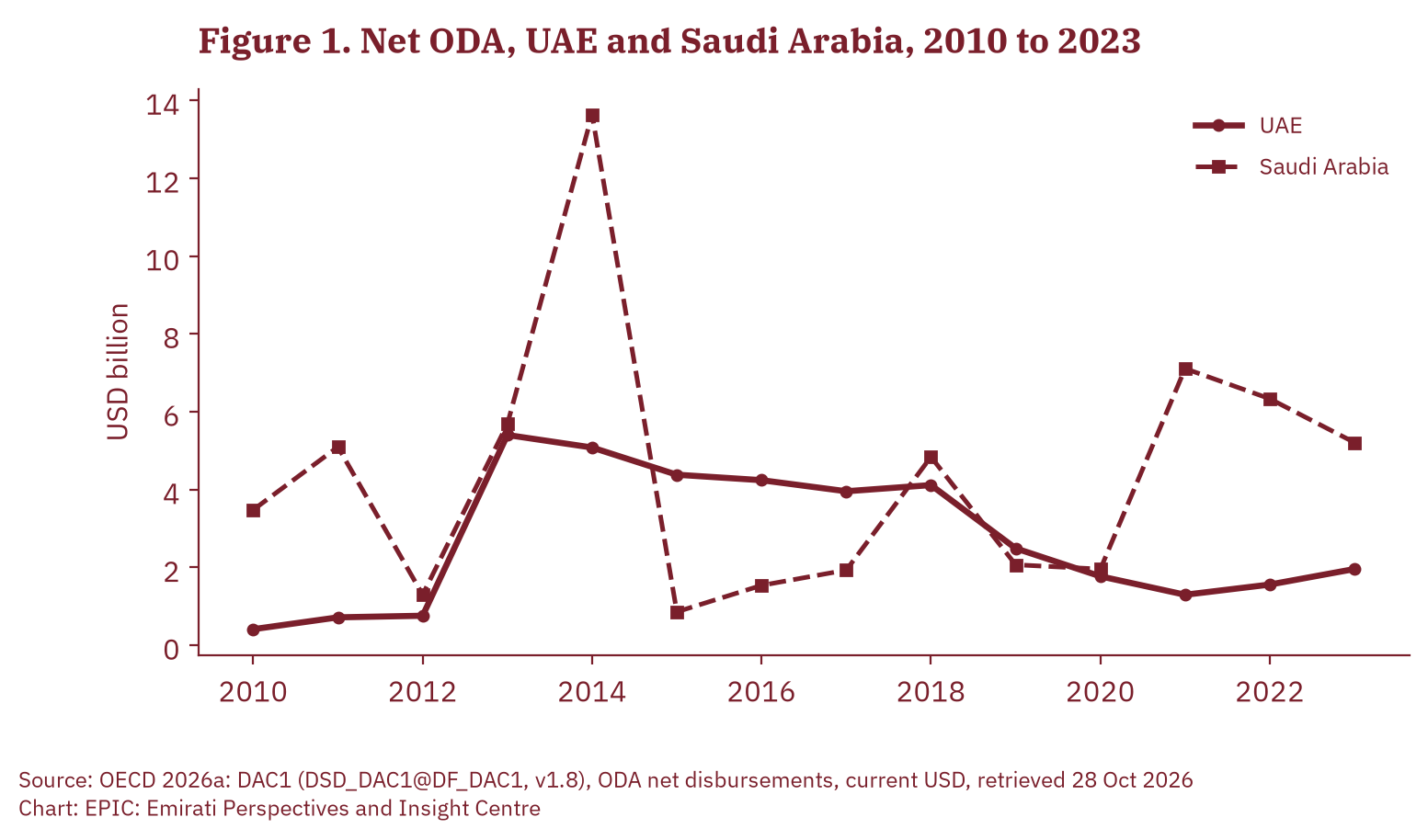
OECD data show UAE net ODA rising from USD 414 million in 2010 to USD 5,402 million in 2013 (Figure 1). It remained above USD 3.9 billion each year from 2014 to 2018, then fell to USD 2,490 million in 2019, USD 1,772 million in 2020 and USD 1,298 million in 2021, before recovering to USD 1,560 million in 2022 and USD 1,959 million in 2023 (OECD 2026a).
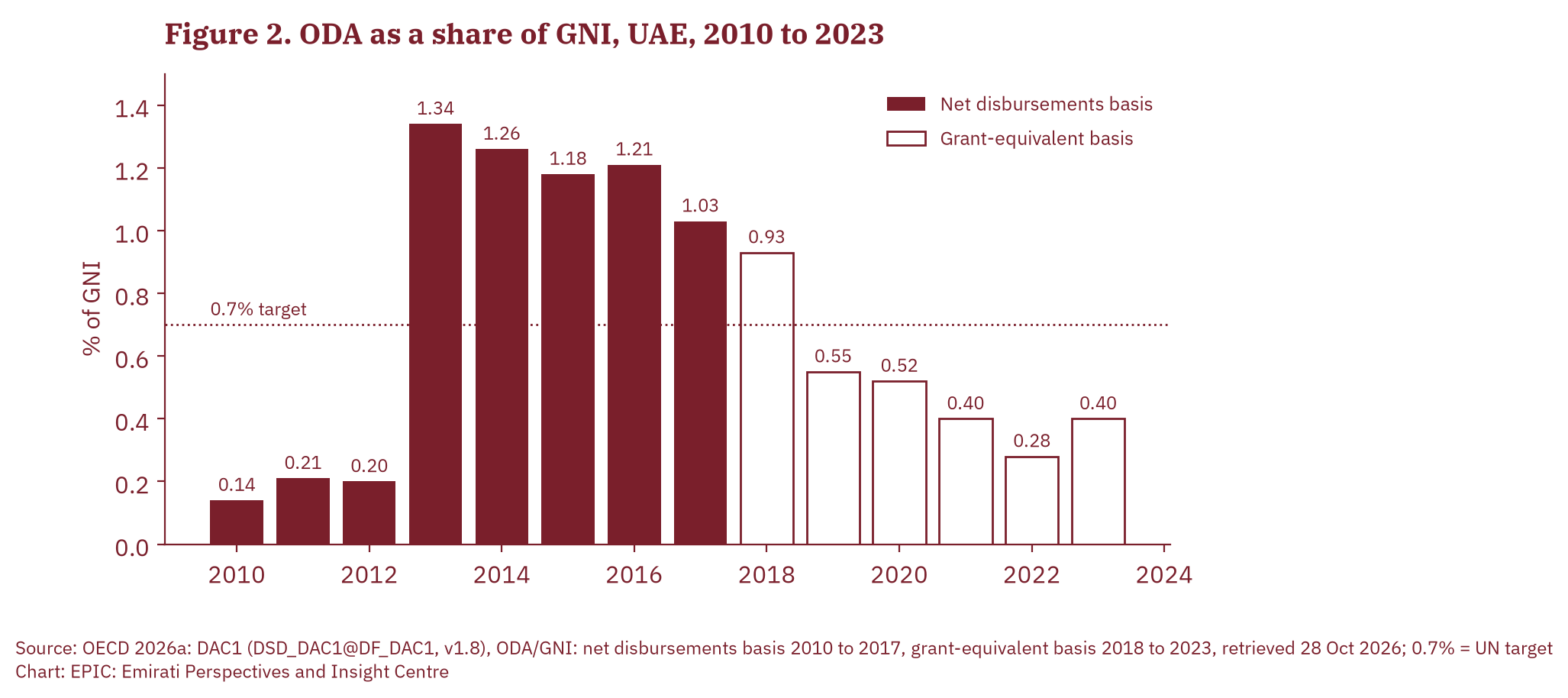
Relative to the economy, net ODA was 1.34 per cent of GNI in 2013, 1.26 per cent in 2014 and above 1 per cent in every year to 2017 (Figure 2). From 2018 the OECD measures donor effort on a grant-equivalent basis, which counts only the grant element of loans. On that basis the ratio was 0.93 per cent in 2018 and between 0.28 and 0.55 per cent from 2019 to 2023 in the data retrieved for this paper. The OECD's 2026 profile of the UAE gives 0.37 per cent for 2024 and a preliminary 0.61 per cent for 2025, when ODA reached USD 3.4 billion, an increase of 55.5 per cent in real terms. The international target for donors is 0.7 per cent (OECD 2026a; 2026c).
The OECD profile also records that 73.5 per cent of UAE ODA in 2024 was provided as grants and 26.5 per cent as loans, and that the grant element of total ODA was 79.2 per cent, below the DAC recommendation of more than 86 per cent (OECD 2026c).
Source: OECD 2026a.
Source: OECD 2026a.
4. Recipients
UAE aid is concentrated on a small number of partners at any time, and the main partner has changed with regional events.
Egypt, 2013 to 2016. OECD recipient data show the UAE disbursing USD 4,606 million in ODA to Egypt in 2013, about 85 per cent of its total that year, followed by USD 3,163 million in 2014, USD 2,452 million in 2015 and USD 2,061 million in 2016. By 2018 the figure had fallen to USD 42 million (OECD 2026b).
Yemen, from 2015. ODA to Yemen rose from USD 55 million in 2013 to USD 890 million in 2015 and USD 2,623 million in 2018, about 64 per cent of the total that year. Yemen remained the largest single recipient in 2019 (USD 433 million), 2021 (USD 259 million) and 2022 (USD 387 million); in 2020 Sudan received most (OECD 2026b).
Other partners. In 2022 the next largest recipients after Yemen were Jordan (USD 385 million), Ethiopia (USD 175 million), Sudan (USD 90 million) and the Palestinian territories (USD 68 million). Other significant recipients in 2019 to 2022 included Afghanistan, Mauritania, Egypt, Mali, Serbia and Eritrea (OECD 2026b).
Sudan. Sudan was the largest single recipient of UAE ODA in 2020, at USD 1,025 million (OECD 2026b). In September 2026 the UN Independent International Fact-Finding Mission for the Sudan reported reasonable grounds to believe that a transnational network of private entities and facilitators, operating from several countries including the UAE, had supplied the Rapid Support Forces; it did not attribute this to the Emirati state (UN Human Rights Council 2026; UN News 2026). The UAE rejected the findings, stating that it is not involved in the war and has not supplied arms or related materiel to any party since April 2023 (Gulf News 2026).
Regional pattern. In 2024, according to the OECD, 43.2 per cent of gross bilateral ODA went to the Middle East and 40.5 per cent to Africa, and 84.4 per cent went to the top ten recipients. Contexts of high and extreme fragility received 83.9 per cent of gross bilateral ODA, and least developed countries 50.1 per cent (OECD 2026c).
5. Humanitarian and development aid, and channels
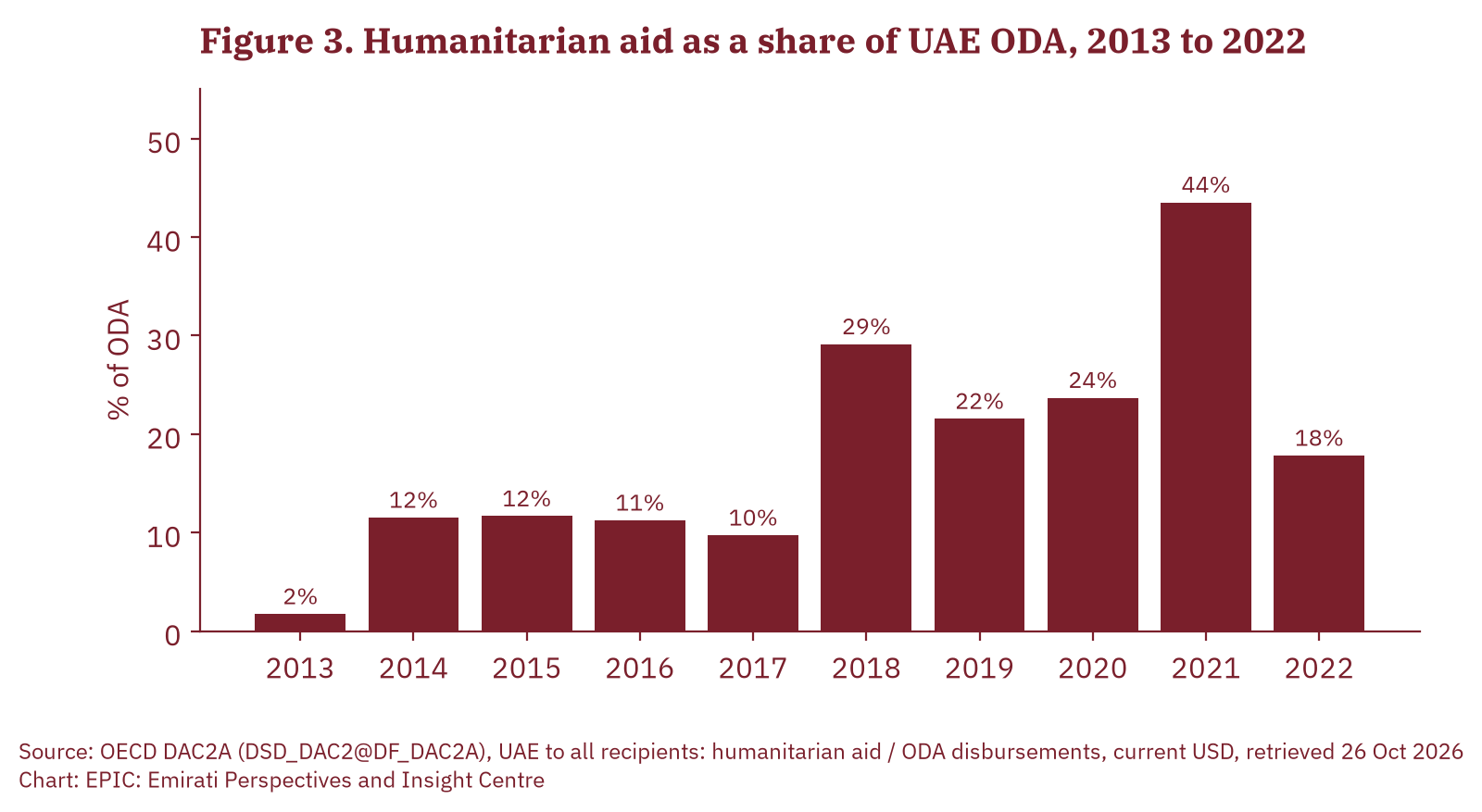
The balance between humanitarian and development aid varies sharply from year to year (Figure 3). Humanitarian aid was about 2 per cent of UAE ODA in 2013, when large budget and development support to Egypt dominated, and about 29 per cent in 2018, when humanitarian aid to Yemen alone exceeded USD 1 billion. It was about 22 per cent in 2019, 24 per cent in 2020, about 43 per cent in 2021 and 18 per cent in 2022 (OECD 2026b). In 2024, according to the OECD, 48.4 per cent of ODA to high and extreme fragility contexts was humanitarian, down from 63.6 per cent in 2023 (OECD 2026c).
On the development side, the largest sector in 2024 was general budget support, at USD 595 million or 44.1 per cent of bilateral commitments. Social infrastructure and services received USD 258 million and production sectors USD 225 million (OECD 2026c).
The UAE works overwhelmingly bilaterally. In 2024 gross bilateral ODA was 98.8 per cent of total ODA, and core contributions to multilateral organisations were only 1.2 per cent. Where the UAE uses multilateral agencies it earmarks most funds: in 2024 the UN system received 92.5 per cent of UAE contributions to multilateral organisations, led by the World Food Programme (USD 162.6 million), the World Health Organization (USD 25.6 million) and UNHCR (USD 23.5 million) (OECD 2026c).
High-visibility operations sit alongside this aid. On 5 November 2023 the UAE launched Operation Gallant Knight 3, a humanitarian operation for the people of Gaza led by the Joint Operations Command of the Ministry of Defence (WAM 2023). OECD data covering the full operation were not available at the time of writing.
Source: OECD 2026b.
6. The UAE and Saudi Arabia
Saudi Arabia is the other large Gulf provider reporting to the OECD, and the two have often acted in parallel, including in Egypt after 2013 and in Yemen after 2015. OECD data show Saudi net ODA peaking at USD 13,634 million in 2014, falling below USD 2 billion in 2015, 2016, 2017 and 2020, and rising to USD 7,108 million in 2021 before falling to USD 6,332 million in 2022 and USD 5,208 million in 2023 (Figure 1). On a grant-equivalent basis Saudi ODA was 1.01 per cent of GNI in 2021 and 0.59 per cent in 2022, against 0.40 and 0.28 per cent for the UAE (OECD 2026a).
The pattern is similar: large, volatile flows concentrated on neighbouring states in crisis. Saudi Arabia's annual volumes have been larger in absolute terms since 2021. On the grant-equivalent measure the UAE recorded the higher ratio to GNI in 2018, 2019 and 2020, and Saudi Arabia in 2021 and 2022.
7. Aid as an instrument of foreign policy
Several features of the data are consistent with aid serving foreign policy as much as development.
Concentration follows strategic priorities. The largest flows went to Egypt after 2013 and to Yemen after 2015, both central to UAE regional policy at the time. Jordan and the Palestinian territories recur among the top recipients.
Form follows purpose. General budget support, the largest sector in 2024, strengthens partner governments directly. Bilateral delivery and earmarked multilateral funding keep decisions and visibility with the UAE.
Institutions follow ambition. DAC participation, activity-level reporting, the 2022 policy and the 2024 creation of UAE Aid show a provider seeking international standing and coordination as well as influence.
None of this makes the aid less valuable to recipients. Humanitarian aid to Yemen, Afghanistan, Ethiopia and Gaza has met acute need. The point is that UAE aid is best understood as statecraft that combines solidarity with strategic interest, as the OECD's summary of UAE policy describes (OECD 2026c).
8. Gaps
Timeliness. Recipient-level OECD data retrieved for this paper ended in 2022. Full data for 2023 to 2025, including the Gaza response, were not yet available at that level of detail.
Results. No public, systematic reporting of outcomes from UAE aid programmes, such as people reached or projects completed against plan, was found in OECD sources.
Evaluation. No published independent evaluations of major UAE aid programmes were identified for this paper.
Volatility. Year-to-year swings of several billion dollars make it hard for partners to plan.
Concessionality. The grant element of ODA, 79.2 per cent in 2024, is below the DAC recommendation of more than 86 per cent (OECD 2026c).
9. Recommendations
- Publish recipient-level data faster. Release activity-level data within a year, including for large emergency operations.
- Report results. Publish outcome indicators for major programmes in the annual foreign aid report.
- Commission independent evaluations. Evaluate the largest programmes of the past decade and publish the findings.
- Smooth volumes. Adopt multi-year envelopes for priority partners so that support is predictable.
- Raise concessionality. Move the grant element towards the DAC benchmark, especially for least developed countries.
- Coordinate with Gulf partners. Build on joint experience with Saudi Arabia to coordinate pledges and reporting in shared crises.
10. Conclusion
The UAE gives more aid than its size would suggest, and it gives mainly bilaterally where its foreign policy is most engaged. Its institutions have matured, from ADFD in 1971 to DAC participation in 2014 and a dedicated aid agency in 2024, and the 2025 preliminary data show a rise to 0.61 per cent of GNI, against the 0.7 per cent target. Faster recipient-level data and published evaluations would allow that development impact to be assessed.
About this paper
This paper was prepared by the EPIC Research Team as part of the daily papers programme. All figures were verified against the sources listed below on 26 October 2026, and the OECD datasets were re-checked on 28 October 2026. Claims that could not be verified were removed or stated as data gaps. See the accompanying sources and verification notes.
References
ADFD (Abu Dhabi Fund for Development). n.d.-a. "About Us." Accessed 26 October 2026. https://www.adfd.ae.
ADFD (Abu Dhabi Fund for Development). n.d.-b. "ADFD Leaflet." Accessed 26 October 2026. https://www.adfd.ae/assets/fd12fdf/ADFD%20leaflet-EN.pdf.aspx.
Gulf News. 2026. "UAE Denies Involvement in Sudan War, Calls for End to Foreign Military Support." 4 September 2026. https://gulfnews.com/uae/government/uae-denies-involvement-in-sudan-war-calls-for-end-to-foreign-military-support-1.500663175.
MoFA (UAE Ministry of Foreign Affairs). 2015. UAE Foreign Aid 2014. Abu Dhabi: MoFA. https://www.mofa.gov.ae/en/the-ministry/uae-international-development-cooperation/~/Media/Foreign%20Aids/En/UAE%20Foreign%20Aid%20Report%202014.
OECD. 2026a. "DAC1: Flows by provider (ODA+OOF+Private) (DSD_DAC1@DF_DAC1, v1.8)." OECD Data Explorer, SDMX query for United Arab Emirates and Saudi Arabia, 2010–2023. Retrieved 28 October 2026. https://sdmx.oecd.org/public/rest/data/OECD.DCD.FSD,DSD_DAC1@DF_DAC1,1.8/ARE+SAU......?startPeriod=2010&endPeriod=2023&format=csvfilewithlabels.
OECD. 2026b. "DAC2A: Aid (ODA) Disbursements to Countries and Regions (DSD_DAC2@DF_DAC2A, v1.7)." OECD Data Explorer, SDMX query for United Arab Emirates, 2013–2022. Retrieved 28 October 2026. https://sdmx.oecd.org/public/rest/data/OECD.DCD.FSD,DSD_DAC2@DF_DAC2A,1.7/ARE....?startPeriod=2013&endPeriod=2022&format=csvfilewithlabels.
OECD. 2026c. "United Arab Emirates." In Development Co-operation Profiles. Paris: OECD Publishing. 16 June 2026. https://www.oecd.org/en/publications/development-co-operation-profiles_04b376d7-en/united-arab-emirates_f39888ef-en.html.
UN Human Rights Council. 2026. Report of the Independent International Fact-Finding Mission for the Sudan. A/HRC/63/23. September 2026. https://www.ecoi.net/en/file/local/2144796/a-hrc-63-23-auv.pdf.
UN News. 2026. "Outside Forces Fuel Sudan War, New Report Finds." 3 September 2026. https://news.un.org/en/story/2026/09/1168270.
WAM (Emirates News Agency). 2023. "UAE President Orders Launch of 'Gallant Knight 3' Humanitarian Operation to Support People of Gaza." 5 November 2023. https://www.wam.ae/en/article/3urxki-uae-president-orders-launch-gallant-knight.
WAM (Emirates News Agency). 2024. "UAE President Issues Federal Decree Establishing UAE Aid Agency." 11 November 2024. https://www.wam.ae/en/article/b654q4k-uae-president-issues-federal-decree-establishing.
Sources and verification notes
EPIC-PP-2026-029 "Aid as Statecraft"
Recounted by the EPIC Research Team on 26 October 2026 (Asia/Dubai, UTC+4). OECD data downloaded from the OECD SDMX API on 26 Oct 2026. Verdicts: Correct, Needs correction, Unverifiable, Mixed.
| # | Claim (section) | Verdict | Source | Action |
|---|---|---|---|---|
| 1 | OECD describes aid as a central part of foreign policy (§1) | Correct | OECD 2026c, 16 Jun 2026 | Kept, attributed to OECD |
| 2 | ADFD founded 15 Jul 1971, owned by the Government of Abu Dhabi (§2) | Correct | ADFD leaflet (undated; accessed 26 Oct 2026), https://www.adfd.ae/assets/fd12fdf/ADFD%20leaflet-EN.pdf.aspx ; ADFD Funding Procedures booklet (2020) | Kept |
| 3 | ADFD gives concessional loans in line with OECD requirements, manages Abu Dhabi government grants, invests in companies in developing countries; Arab Coordination Group (§2) | Correct | ADFD leaflet (accessed 26 Oct 2026); ADFD "About Us", https://www.adfd.ae/en/who-we-are/about-us ; OECD 2026c (Arab Coordination Group) | Kept |
| 4 | MoFA leads aid policy and reporting (§2) | Correct | OECD 2026c | Kept |
| 5 | UAE Aid Agency set up in 2024 by federal decree (§2) | Correct | WAM, 11 Nov 2024, https://www.wam.ae/en/article/b654q4k-uae-president-issues-federal-decree-establishing | Kept |
| 6 | 2022 aid policy with seven themes (§2) | Correct | OECD 2026c | Kept |
| 7 | First non-OECD DAC participant, 1 Jul 2014 (§2) | Correct | MoFA 2015, p.36 (OECD 2014 DOI withdrawn; removed) | Source replaced |
| 8 | Reports to OECD since 1970; activity-level since 2010 (§2) | Correct | OECD 2026c | Kept; abstract now uses the EPIC Research Team's revised wording (OECD records from 1970) |
| 9 | Net ODA USD m: 413.8 (2010), 5,401.9 (2013), 5,080 to 3,957 (2014–17), 4,116 (2018), 2,489.9 (2019), 1,771.8, 1,298.1, 1,560.3, 1,959.2 (§3) | Correct | OECD 2026a (DAC1) | Kept |
| 10 | ODA/GNI 1.34% (2013), 1.26% (2014), above 1% to 2017 (§3) | Correct | DAC1 | Kept |
| 11 | Grant-equivalent 0.93% (2018), 0.28–0.55% (2019–23) (§3) | Correct | DAC1 | Kept |
| 12 | 2023: 0.40% in both (§3) | Correct | OECD 2026a; 2026c | Kept |
| 13 | 2024 0.37%; 2025 USD 3.4bn, 0.61%, +55.5% (§3) | Correct | OECD 2026c | Kept |
| 14 | 0.7% commitment "in line with" (§3) | Correct | OECD 2026c | Kept |
| 15 | 73.5% grants / 26.5% loans; grant element 79.2% vs >86% (§3) | Correct | OECD 2026c | Kept |
| 16 | Egypt 4,606.1 → 42.4 (2013–18); about 85% of 2013 (§4) | Correct | OECD 2026b (DAC2A 2013–18) | Kept |
| 17 | Yemen 54.6 (2013) → 2,622.7 (2018, 63.7%); top recipient 2019, 2021, 2022 (§4) | Correct | DAC2A | Kept; "except 2020, when Sudan received most" added (C5) |
| 18 | 2022: Jordan 384.8, Ethiopia 174.5, Sudan 89.5, Palestine 67.6 (§4) | Correct | DAC2A | Kept |
| 19 | Other large recipients 2019–22 (§4) | Correct | DAC2A | Kept |
| 20 | 2024: Middle East 43.2%, Africa 40.5%, top ten 84.4%, fragile states 83.9%, LDCs 50.1% (§4) | Correct | OECD 2026c | Kept |
| 21 | Humanitarian share 1.7% (2013), 29.1% (2018), 44% (2021); Yemen humanitarian >USD 1bn in 2018 (§5) | Correct | DAC2A recomputed: 43.5% (2021); Yemen 1,003.8 | 2021 share changed to "about 43 per cent" (C6) |
| 22 | Humanitarian share in fragile states 48.4% vs 63.6% (§5) | Correct | OECD 2026c | Kept |
| 23 | Budget support USD 595m (44.1%); social 258.2m; production 225m (§5) | Correct | OECD 2026c | Kept |
| 24 | 98.8% bilateral; core multilateral 1.2%, of which UN 92.5%; WFP 162.6m, WHO (assessed) 25.6m, UNHCR 23.5m (§5) | Correct | OECD 2026c | Kept |
| 25 | Gaza operation launched 5 Nov 2023 by the Joint Operations Command, named "Chivalrous Knight 3" (§5) | Needs correction | WAM, 5 Nov 2023, https://www.wam.ae/en/article/3urxki-uae-president-orders-launch-gallant-knight | Corrected to "Gallant Knight 3" |
| 26 | No OECD data yet on the full cost of the operation (§5) | Unverifiable | none | Stated as not available |
| 27 | Comparator net ODA series (§6) | Correct | OECD 2026a (DAC1) | Kept |
| 28 | Comparator grant-equivalent ratios (§6) | Correct | OECD 2026a (DAC1) | Kept |
| 29 | Comparator volumes larger since 2021 (§6) | Correct | OECD 2026a (DAC1) | Kept |
| 30 | Recipient-level data end in 2022 (§7) | Correct | DAC2A extracts | Kept |
| 31 | No published results or evaluation framework (§7) | Unverifiable | none | Stated as not found |
| 32 | Conclusion: "return to volumes close to the 0.7 per cent target" (§8) | Needs correction | OECD 2026c; DAC1 | Corrected: "a rise to 0.61 per cent of GNI, against the 0.7 per cent target" |
| 33 | High ODA/GNI ratio relative to size (§1, §8) | Correct | OECD 2026c | Kept |
| 34 | Aid serves foreign-policy aims (§8) | Correct | OECD 2026c | Kept, attributed to OECD |
Totals: 34 claims: 30 Correct; 2 Needs correction (corrected); 0 Mixed; 2 Unverifiable (stated as not found). The Sudan paragraph in §4 was verified separately (EPIC Research Team check (a)) and is not counted in this table.
Result: passes verification. Every remaining claim is Correct, corrected, or stated as not found.